Liturgy
Learn the direct teachings & mysteries of HE
WHICH IS through His written word.
WHICH IS through His written word.

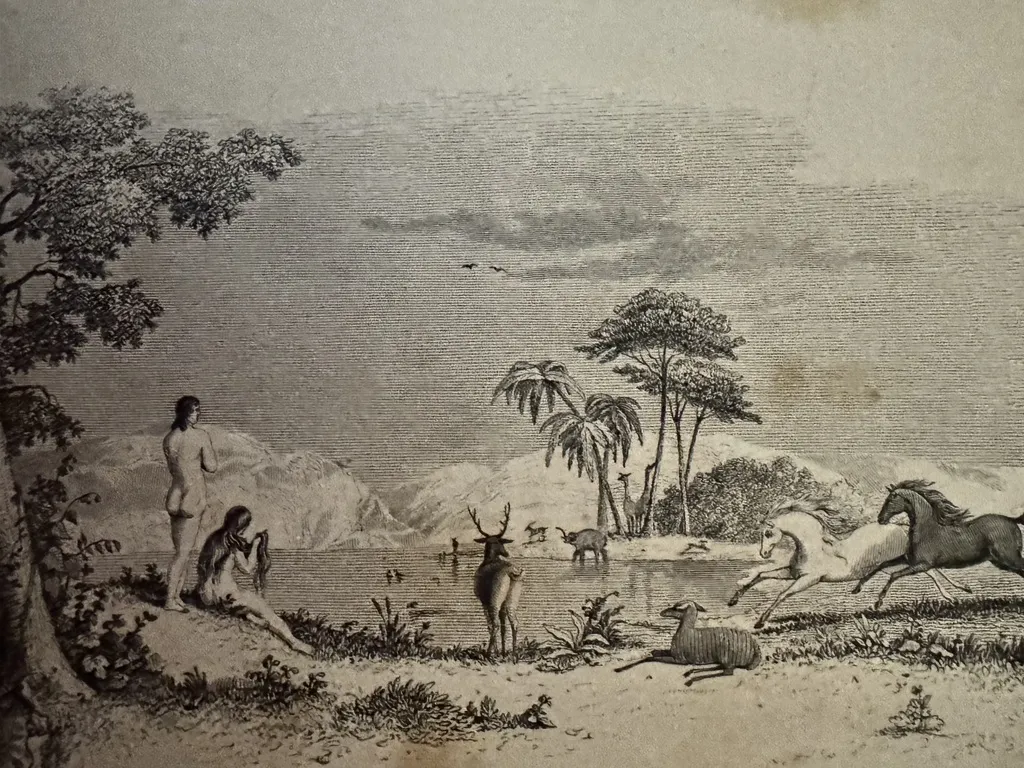
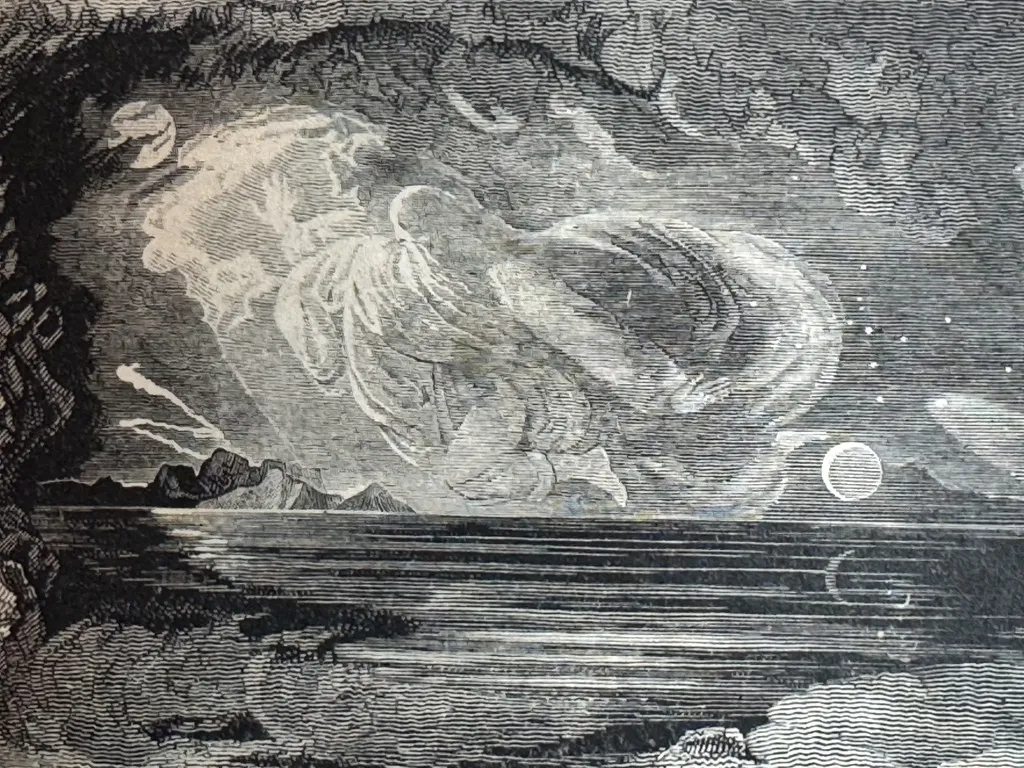
Ample time will be spent discussing this first Epistle because it has been the subject of much confusion and elaboration. Such befuddlement has existed since biblical scholars first began transcribing the Father’s Word. This same Epistle has been equally praised as a fascinating message. i’d like to point out there’s an author in the New Testament who is so enthralled by this Epistle that he begins his own work with Genesis I: S. John! 😀 This sensational evangelist draws a distinct conclusion with: in the beginning, all there is is simplicity. In the end, what do you think the result shall be?
Before we explore this first Chapter, some background information should be provided on a most magnificent men known as GOD’s best friend—Moyses. Moyses happens to be the co-author of Genesis with the other being, HOLY GHOST.
The name, Moyses, signifies, taken from water, in Beresith, Hebrew. Born in Egypt he is the:
To truly learn much more about ELOHIM’s first author, i highly recommend the brief, Summe, penned by the highly credulous historic bishop of Nysse, S Gregory. In this dissertation Gregory discusses the following facts of Moyses’ life:
As our Lord’s first writer Moyses was born some 2400 years before any other profane writer, not just gospel, appeared. In his book, City of God, S Augustine (an English writer’s most acclaimed biblical scholar) declares Moyses existed even before the many Paynimes (of Pagan or false gods) appeared. Also, keep in mind there was no written scripture at all during these initial 2400 years for the Church to rely on. Subsequently, traditions and oral stories were what QUI EST’s Spouse organized Herself upon.
The 120 years of Moyses’ lifespan can be divided into 3 distinct periods:
Singular praises of Moyses are annotated by Josue in the final chapter of Deuteronomy (5th Book of Moyses). Moyses is also mentioned in Ecclesiastes (another Book of the Old Testament).
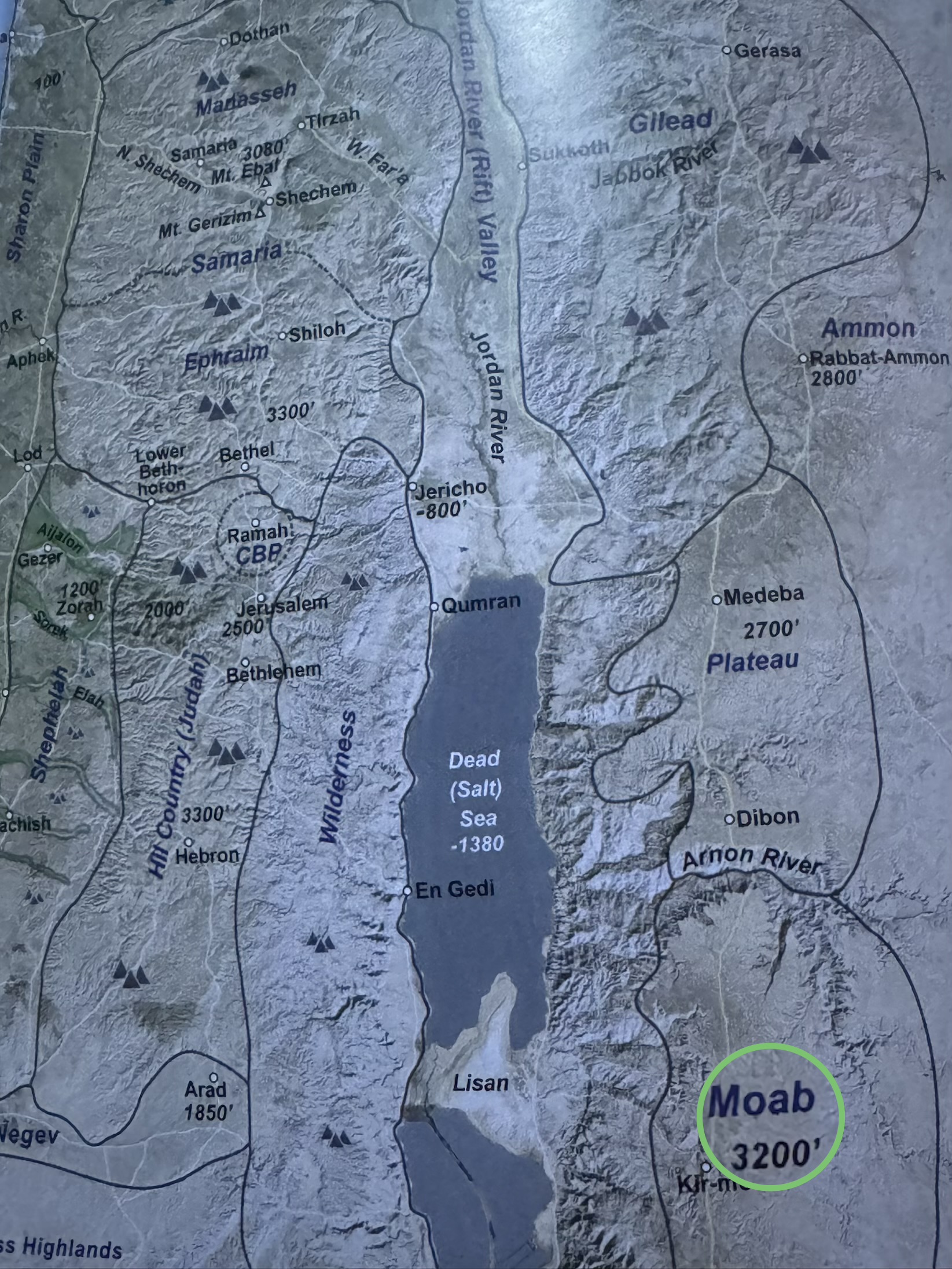
map #1: Moab
Moyses died in the desert and was buried in the vale of Moab. The precise location of his sepulcher was so secret that no mortal man is knowledgeable of the location! The reason for this is due to the Jewry people having of very bad repeatable habit of Idol worshipping. Since the Prophet’s body was held in such divine esteem, along with his greatness and all the miracles he was involved with, can you not see why his body was buried in complete secrecy? i shall discuss this in much more detail once we explore the Epistle involving the demise of Moyses.
Now that you have some background knowledge on who the author is, let us explore his first Chapter in the Book of Life. Coincidentally, the very first Verse begins where life itself began–with HE WHICH IS.
In the beginning God created heaven and earth. And the earth was void and vacant; and darkness was upon the face of the depth. And the Spirit of God moved over the waters.
Tons of stuff to discuss with just these couple of opening Verses. The most popular yet entirely unvalidated theory on how our world began is what’s called, The Big Bang (or Soup Bowl) Theory. Such a theory implies energy detonates a myriad elements that have been meshed together. Genesis provides us with an entirely different yet quite viable alternative. Water–a pair of hydrogen particles blended with a molecule of oxygen–is consistently explored and annotated throughout the entire Bible. Tis my belief water is the starting point for both life and terra. However, it’s not a violent cyclonic detonation of carbon and other essential (and non-essential) elements that’s the impetus. There is no super atomic violent explosion that caused the creation of our universe. The galaxy and earth had gentle and tranquil beginnings. Imagine a fetus inside a woman’s womb. This too is how life began for all the universes. Inside a plasmatic womb fabulously placated with symbiotic water. HE WHICH IS Initiated the creation of life with perhaps a joyful tear from His eye.
How on earth was Moyses able to pen Genesis?
Firstly, Moyses had the excellent gift of prophecy. Therefore, much of his writing was accomplished via revelations from GOD. Secondly, he learned of the traditions passed on by the elders. They in turn learned the historic knowledge from their fathers. Again, up until this era of Moyses, the Church had only traditions of such things as were revealed to special men, whereby, we see the great authority of traditions before there were scriptures. Such traditions {scriptures in written form} are necessary for 3 uniquely special reasons:
In the beginning God made heaven and earth
As i alluded earlier, this first Verse has been an ongoing impetus for debate amongst the learned, ancients, scholarly, and, amateurs. Many expound, allegorically, that the waters above the firmament are understood to be the blessed Angels. Conversely, the waters below the firmament are the wicked Spirits.
All of our magnificently insightful writers confessed such great difficulties in these first Chapters of Genesis: S Basil, S Bede, S Jerome, S Ambrose, S Augustine {twice!}, & S Chrysostom. If blessedly learned men as these, along with various intellectually endowed doctors, had difficulties with the Word of GOD, tis no wonder the 2000-plus Christian religions throughout the world all interpret the Liturgy differently! For, whosoever will look into the holy Scriptures shall find that sometimes it shows in one place that appears contrary to another. Sometimes the letter and phrase are obscure and ambiguous; sometimes the sentences imperfect. Even language translations differ. In fact, this is the prevalent dilemma when it comes to understanding the Liturgy.
The ample speeches encountered throughout the Liturgy can be categorized as follows:
Try to imagine for a minute what writers like Moyses, S Augustine, S Jerome and S Ambrose went through as each strived strenuously to:
There are 4 senses prevalently revealed/used throughout the Bible:
As an example to this 4-Sense Model let’s apply the word, Jerusalem, to it:
There is one final sense that can be periodically applied to the model as well: metaphorical-literal. Using our example, Jerusalem pertains to the Church militant as opposed to the city of Jews, yet other times the Church Triumphant, as with S John’s Book of Apocalypse.
the Spirit of GOD
In the Hebrew-Beresith tongue Spirit of GOD means Father’s Spirit was on the waters to make them fertile. This means the fishes and birds would be procreated. Untranslated, this phrase would read, merahepheth incubabus [fat upon]–meaning, to produce fruit. S Hierome translates the phrase as, from the waters, as a hen by her heat produceth life in the eggs. Both he and Tertullian taught these Words to be a figure of Baptism, which consists of water and HOLY GHOST. For, as water in the beginning of the world received a certain vital virtue of HOLY GHOST to produce living creatures, so also Baptism received virtue of the same HOLY GHOST to procreate new men. This would explain Cain fearing for his life from other tribes–other men. Whereupon, Tertullian called Christians fishes because they are gotten from the waters and thence have their first spiritual life. He also writes: Let it not therefore seem strange that in Baptism waters give life.
With such information from our Holy Fathers & others, recall my view on the formulation of the universe and terra: the universe and earth were not formed from an explosive chance involving a melting pot of various elements and particles. {From herein please refer universe to terra and vice versa. For the purpose of creation infer them as one and the same.}
How the world began…
Envision a spinning droplet of water in an unexplainably yet perfectly balanced and unlit void–a blank firmament or canvas, if you will. After beginning with only seas, land then erupts. A mysteriously plump water bead rolls across a flat desert terrain tightly confined within a steep void canyon. To enhance its echo this restrictive desert canyon is filled and surrounded by smooth rock walls. What began as a glorious droplet of sublime water, perhaps a joyous tear from QUI EST, has now expanded ultra-exponentially and ever so peacefully. There’s now a faint sloshing sound within or about the effect of an inflated rolling bubble. Perhaps all of this unfolds along a very edge of the firmament.
Our bead of water evolves into a revolving floating multi-dimensional water sprout. We hear the sounds of both the building and crashing of methodical waves! The growing and crescendoing spurt of fascinatingly clear water soon levitates with a darker blue added to her color. Or perhaps the tint is a light green. The point is this: our twisting yet magically contained bounty of revolving water becomes graced by HOLY GHOST. Henceforth, the initiation of moving, autonomous, biological life! And just as S Hierom and Tertullian regard such water as Baptismal waters, this same Baptism initiates terra as man’s first Church to HE WHICH IS. i’m in complete agreement with such scholars, if it’s their belief it was HOLY SPIRIT who sanctified these Baptismal waters with grace, light and life. This by the power and anointing of HOLY GHOST during terra’s creation. For, as water in the beginning of the world received a certain vital virtue of HOLY GHOST to produce living creatures, so also Baptism receiveth virtue of the Holy Ghost to procreate new men.
And God said:
be light made.
And light was made. He saw the light was good and He divided it from darkness. God called the light, day: darkness, night. And there was evening and morning that made one day. God made a firmament amongst the waters; and let it divide between waters and waters.
What’s a firmament? S Augustine defines it as all the space from the earth to the highest stars. The lowest firmament divides the waters on the earth from the waters in the air. Thusly, this lower firmament can be identified as, atmosphere.
God created a firmament {atmosphere} and divided the waters under it from those waters above the firmament. God called the firmament, heaven. There was morning and evening that made the second day.
Accepting S Augustine’s definition of firmament, heaven, therefore, can be defined as all the space above the earth. That being stated, we can then divide heaven into 3 realms:
V.9
And it was so done.
God also said:
Let the waters that are under the heaven be gathered together into one place; and let the dry land appear.
It was so done. God called the dry land, earth. The gathering of the waters He called, the seas. God saw it was good.
He further said:
Let the earth shoot forth green herbs, and such as may seed. And fruit trees yielding fruit after his kind, such as may have seed in itself upon the earth.
yielding fruit after his kind
To be his, her, or it, tis the question. 😁 At least half of the English translated bibles illogically & arguably use the term, it. The oldest Beresith versions of Genesis i’ve researched all use he or his, not it. i believe there’s indeed an extremely good reason Moyses annotated it so. As explained earlier, the birth of mother earth occurred in a revolving bulb of confined placental water. This Baptismal water ELOHIM used to Bless terra. QUI EST’s life creations on terra, all which are good, are thereby graced to procreate. As woman births man so too does terra birth trees, birds, bees, flowers, fruits, seeds, &. Yet, t’was man who HE WHICH IS Created first. And since QUI EST Instructs Adam to name QUI EST’s creations, they too, as Adam, begin as masculine–not feminine, neutral, nor plural.
v.20
God also said:
Let the waters bring forth creeping creatures having life and flying fowl over the earth under the firmament of heaven.
And God created huge whales and all living and moving creature that the waters brought forth according to each sort, and all fowl according to their kind. And God saw that it was all good.
And He blessed them saying:
Increase and multiply and replenish the waters of the sea. And let the birds be multiplied upon the earth.
And there was evening and morning that made the 5th day.
God said moreover:
Let the earth bring forth living creature in his kind, cattle, and such as creep: and beasts of the earth according to their kinds.
And it was so done. And God made the beasts of the earth according to their kinds, and cattle, and all that creepeth on the earth in his kind. And God saw that it was good.
And He said:
Let Us make man to Our image and likeness. And let him have dominion over the fishes of the sea, and the fowls of the air, and the beasts, and the whole earth, and all creeping creature that moveth upon the earth.
Let Us make man
The conclusions on this from Saints’ Jerome, Bernard, Augustine and a couple others parallel Brother’s. For better understanding of ELOHIM’S bounty towards us, and stirring ourselves to gratitude towards Him, there are 10 prerogatives of man given to us by our Heavenly Father included in our creation. This especially because man is above all other earthly creatures.
And the earth brought forth green herb, such as: seedeth according to his kind, and tree that beareth fruit, having seed each one according to his kind. God saw it was good. Evening and morning passed: the third day.
God said:
Be there light made in the firmament of heaven, to divide the day and the night. And let them be for signs and seasons, and days and years, to shine in the firmament of heaven and to give light upon the earth.
Light is another one of those heavily debated topics from the Book of Life. Saints’ Thomas and Dionysius declared the lights QUI EST made during the first day were disposed the fourth day in their proper courses for better distinction of times. This makes logical, linear and literal sense.
V.16
And God made two great lights: a greater light to govern the day, and a lesser light to govern the night and stars.
made two great lights
S Augustine elaborates on the sun and moon:
–for though the moon be the least visible star except Mercury, yet it giveth more light on the earth because it’s nearer; so Moses speaks according to the vulgar use of things.
In sum, Augustine alludes to a literal explanation.
ELOHIM Creating two great lights and stars is actually another sticking point for many scholars. Why? If the two great lights (sun and moon, stars inclusive) were made the fourth day and not before, then what was that light, and what subject was it, that was made the first day? S Basil, S Gregory Nazianzen, Theodoret and various learned Priests believe that the light which was made the first day remained (via “accidentally”) without His subject til the fourth day. Although most other doctors think that the substance of the sun and moon, along with other planets and stars, were indeed created the first day. Twas the 4th day HE WHICH IS set the celestial bodies in their particular order and course, which now they retain, with more distinction for signs and the seasons–as well as days and years. Still, tis clear that these same ancient doctors judged it possible that accidents may remain without their subject:
–which a Sacramentary was loath to grant, lest it might be proved possible, that the accidents of bread and wine remain in the blessed sacrament of the Eucharist without their subjects.
Although the above explanation is theologically sound, i believe the interpretation is more complex than Moyses intended. On the first day the Spirit of GOD moved over the waters then light was made. Tis my current thought the Spirit of QUI EST in of Itself was indeed the blessed Light. This had nothing to do with the sun, moon or other heavenly celestial planets or stars. Heaven, during the beginning, was part of terra and our universe. Thusly, i believe earth and Heaven abutted physically. Albeit Heaven still remains a part of the universal systemic life, the distance between the two firmaments (our galaxy/universe inclusive) increased dramatically when the Tree of Knowledge was violated. During the first day of terra’s creation, twas the Light from Heaven, attested by ELOHIM’s Spirit, that Illuminated our planet–not any celestial body. Meaning, day and night initially revolved about the lovely illumination from Heaven. Twas the same with our entire universe. Waters and life created the second and third days were not enhanced or executed by planetary light but by radiance from Heaven.
V.17
And He set them in the firmament of heaven to shine upon the earth, and to govern the day and night, and to divide the light and the darkness. And God saw it was good. And there was evening and morning that made the fourth day.
More can be read of the dignity of man, as well as the benefits of God towards him in his creation, in 99 Psalms and 61 Esai.
v.27
And God created man to His own image. To the image of God He created him: male and female, He created them.
And God blessed them, and sayeth:
Increase and multitude, and replenish the earth, and subdue it, and rule over the fishes of the sea, and fowls of the air, and all living creatures that move upon the earth.
Increase and multiply
No one can be certain as to whether this was a Commandment or not. Brother believes it to be unimportant because of the blessing these sensational words intend. After all, other subsequent Words read: God blessed them and said: increase and multiply. Keep in mind He said the same thing also to the brutish creatures, which are certainly not capable of any precept, but by this were made fertile. From this one can verify Father’s Blessing always to some real effect. Take the reference to fertility here and other places throughout the Bible–the multiplication of loaves and fishes discussed in the New Covenant. The holy Eucharist is yet another excellent example in which CHRIST uses His Father’s Blessing. During the changing of bread and wine into His own Body and Blood, JESUS expressly says: This is my body, this is my blood. Even though QUI EST’s Blessing here is a precept, however, tis not to all men for eternity. Instead, it’s specifically for the propagation of all mankind, which being long since abundantly propagated, the obligation of the precept ceaseth the cause ceasing–Saints’ Augustine, Cyprian, Hierome, others. Thusly, in regards to this statement, increase and multiply, the end to which GOD was referring when He said, and replenish the earth, which being replenished, His Will becomes fulfilled.
v.29
And God said:
Behold, I have given you all manner of herb that seedeth upon the earth, and all trees that have in themselves seed of their own kind to be your meat. And to all beasts of the earth, and to every fowl of the air, and to all that move upon the earth. And whereinthere is life, that they may have to feed upon.
And it was so done. And God saw all things that He had made; and they were very good. And there was evening and morning that made the sixth day.
Every creature in nature is good. This is what the Hebrews of today are so backwards on when they exclude certain meats from their palette. Even in S Peter’s dream of a monstrous boat filled with animals, ELOHIM Instructs him to choose any and eat. But when all creatures are considered together, tis perfect for man’s use and GOD’s eternal glory!
During ELOHIM’s rest on the 7th day, QUI EST continued to Mold terra to His perfection. Pursuant to S Augustine: God createth not new kinds of creatures yet still…
–all things, and createth soules, grace, & glorie of the same kind.
The heavens, therefore, and the earth were fully finished and all the furniture of them. And the seventh day God ended His work which He made and rested the seventh day from all work He had done.
rested the seventh day
He Blessed and Sanctified the Seventh Day because He had Ceased from all His creations.
i concur with S Augustine and others that GOD still worked, but not with the creation of new creatures. He still conserved and governed all things–and created souls, grace and glory for everything He created on earth.
Let’s explore these fascinating creations, which were accomplished in a phenomenally short period. GOD made all these creatures complete and perfect in merely 6 days. As man more often does than not, ELOHIM needed absolutely no additional time. If you’ve created something from scratch, you have at least an understanding of QUI EST’s esoteric miracle. Especially if your creation ended up perfect and under budget. Brothers and Sisters, this is undoubtedly the precise reason HE WHICH IS rested on the Seventh Day.
By GOD’s institution, the 7th Day is a Holy Day because that day remains a tribute to the exact natural perfection of all His works. By man’s institution, Moyses is telling us the 7th Day is the supernatural perfecting of mankind in eternal life, after the Resurrection–which is attributed to the 8th day. For this cause HE WHICH IS Blessed and Sanctified the Seventh Day.
Similarly, this same conclusion applies to the 10 Commandments as well! Pursuant to the Decalogue Given to Moyses, the 7th Day is the day all shall rest and abstain from works. We are to keep the Day festive by occupying ourselves in spiritual exercises, service, and special worship of QUI EST. When is the last time, if ever, you celebrated Sunday exactly like Moyses wrote it? This involves celebrating the Day like the Jewry did, even until CHRIST’s time: praying and hearing the Word of GOD read and expounded on the Sabboath. (Sabbaoth, by the way, is translated as follows: your Oath for keeping the Sabb Day.
Whereby we see that distinction of days pertaineth to religion, the people of God thus observing the Sabboth in memorie of the Creation and divers other feasts. And we now keep the Sunday holy in memorie of Christ’s Resurrection, and other feasts, in grateful remembrance of other Mysteries of Christ’s Nativitie, the coming of the Holy Ghost, and the like. Yea, also feasts of his Blessed Mother, and other Saints, for the benefits received from Christ by them, and for more honour to Christ in them. Understand that the observation of festival days is a religious act, not a Judaical nor heathenish one.
For common objections regarding the above, i add the words of S Basil whereas he explains: the honour of Saints is the honour of Christ, their Lord and ours.
v.8
What happened to the Paradise of Pleasure? Was It destroyed or not? If not, then how can some place so spectacularly magical and mystical be hidden from man all these centuries? Tis it even possible for such a Place to be concealed and even survive GOD’s baptismal Flood? What is certain, pursuant to S Augustine, is that Enoch & Elias are yet living in earth. Tis my belief, though i concur with Augustine, that Enoch and Elias predominantly reside in Paradise. This is how Enoch survived the Flood because QUI EST protected Paradise of Pleasure–as though encapsulating Paradise in an incredible self-contained bubble.
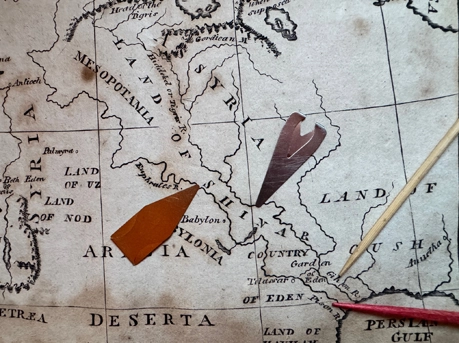
Map #1: 4 rivers of Hevilath
Phison River: red This first river runs throughout all northwest Persian Gulf. The purest gold in the world is here.
Gehon River: plain. This second river compasses Ethiopia.
Tygris River: silver. This third river becomes a major transportation hub for the Assyrian Empire.
Euphrates: brass. This fourth and final river from Paradise becomes part of the northeastern boundary of the nation, Israel
v.15
Our Lord God, therefore, took man and put him in the Paradise of Pleasure to work and keep it.
And He commanded him, saying:
Of every tree of Paradise eat thou. But of the Tree of Knowledge of Good and Evil, eat thou not. For in what day soever thou shalt eat of it, thou shalt die the death.
of the Tree of Knowledge
v.18
Our Lord God also said:
It is not good for man to be alone. Let us make him a help like unto himself.
Let us make him
Our Father’s usage of His plurality is again stated here. Within the first couple of chapters of reading the Word of QUI EST, the reader is informed GOD cannot be compared to or identified as a typical singular entity like any ordinary man, entity, or object. Right away the reader is told there is more than what meets the eye when it comes to identifying HE WHICH IS–thankfully and mysteriously so.

v.19
Our Lord God, therefore, having formed of clay all beasts of the earth and fowls of the air, brought them to Adam that he may see what to call them. For, all that Adam called any living creature, the same is his name. And Adam called all beasts by their names, and all fowls of the air, and all cattle of the field. But unto Adam there was not found a helper like himself.
Our Lord God, therefore, cast a dead sleep upon Adam. And when he was fast asleep, He took one of his ribs and filled up flesh for it. And our Lord God built the rib which He took of Adam into a woman and brought her to Adam.
built the rib
Ever hear it said that brick is made of earth and a house is built of brick? Adam was Made of earth; Eve was Built from a rib of Adam. In regards to the one rib, known as Adam’s Rib, consider this: on one end GOD Built a house of 1 brick, on the other, ELOHIM Fed 5000 men with 5 loaves.
v.23
And Adam said:
This now is bone of my bones and flesh of my flesh. She shall be called, woman, because she was taken out of man.
Wherefore man shall leave his father and mother and shall cleave to his wife and they shall be two in one flesh. And they were both naked, to wit, Adam and his wife, and were not ashamed.
two in one flesh
Not three, four or more, for, then two were changed to another number. This is also where QUI EST Creates the beautiful and blessed sacrament of Matrimony.
Let’s now consider broadly what has occurred with QUI EST’s Creation thus far:
v.1
the serpent also
Learned men like Saint’s Augustine & Jerome describe the serpent as the most crafty Creation to escape harm after injuring mankind. Next to the serpent for such craftiness is the Devil.
v.1 (cont.)
Unfortunately and tragically, this is where sin becomes introduced to man. Twas done so by envy and the Devil’s craftiness in which man consented to the Devil’s suggestions. Keep in mind HE WHICH IS Placed man in Paradise of Pleasure; the Devil resented this and became envious of it. Therefore, He tempted the weaker of the two first-begottens. He does this by beginning its dialogue with a question in order to allure Eve into conference. Twas this query in which the Devil brings the woman into suspicion of GOD’s affection towards His first-begottens. He does this by insinuating QUI EST dealt harshly with Eve & Adam by abridging their liberty without cause. Then, when the Devil attains Eve’s trust, she becomes displeased with the precept. This is revealed when Eve, of her own free will {making the sin more grievous}, adds that they are forbidden to touch the Tree. Additionally, she reports the punishment as being dubious when she says, lest perhaps we die.
Afterwards, the Seducer avouched boldly and falsely that ELOHIM’s first-begottens would not die. In fact, He even charged GOD would be envious of the benefit Eve would attain by eating of the Knowledge Tree. The Devil claimed Eve’s eyes would be opened and be as GOD’s by knowing good and evil. Finally, through persuasion and admiring the fruit itself, Eve took and ate the fruit then persuaded Adam to partake. Understand no sin occurred when Eve was tempted by the serpent–which she couldn’t avoid. The same with Adam when he was tempted by Eve. Both did eventually sin when each consented to the evil suggestions. With mother Eve we see her:
Upon falling for the temptation, Adam and Eve immediately realized they became aware of evil–which was better for them to have not known. Our first parents were ashamed and attempted to cover and hide themselves.
Since then, the Devil has been constantly assaulting the weaker persons and the weaker part of us: our flesh and sensuality. Afterwards, the stronger and superior part of us becomes attacked in order to get consent of freewill, without which there is no sin. As S Augustine wrote: Peccatum adeo est voluntarium, us nullo modo sit peccatum, si non voluntarium. {Sin is so voluntary that in no wise can it be sin, if it be not voluntary.} He also stated: And now in the regenerate, though concupiscence remain, which is the effect of sin past, and occasion of sin in those that yield again to temptations. Yet, it is not sin but punishment of sin and matter of exercise in the just, and if we resist, of merit. In the New Covenant tis S Paul who consistently reminds us to follow and walk in the Light (Spirit), which will allow us to successfully repel sin and the Devil’s earthly temptations.
v.2
To whom the woman answered:
Of the fruit of the trees that are in Paradise we do eat; but of the fruit of the tree which is in the midst of Paradise, God hath commanded us that we should not eat. And that we should not touch it, lest perhaps we die.
And the serpent said to the woman:
No, you shall not die the death. For, God dothknow that in what day soever you shall eat thereof your eyes shall be opened. And you shall be as God’s, knowing good and evil.

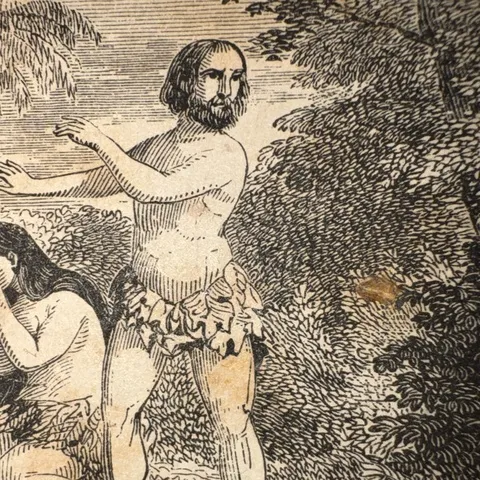
The woman, therefore, saw that the Tree was good to eat and fair to the eyes–and delectable to behold. And she took of the fruit, thereof, and did eat. And gave to her husband, who did eat. And the eyes of them both were opened. And when they perceived themselves to be naked, they sewed together leaves of a fig tree and made themselves aprons.

perceived themselves
S Chrysostome explains that no shame existed with Adam and Eve before their sin, only after they sinned.
Let’s explore the a bit of the evolution of this first sin. When Eve saw the tree of knowledge she came to know pleasures:
There are a couple of other things worth further exploration. Firstly, twas only after sin did man feel ashamed. Secondly, consider why the fig tree was chosen to conceal shame versus all the other leafy and larger deciduous trees in Paradise. Incredibly, there are dramatic comparisons with sin and the fig fruit/tree. Perhaps the fig tree was closest to Adam when he hears HE WHICH IS calling. Maybe the Fruit of the Knowledge Tree resembles the fig in several ways. Whatever and however Adam and Eve were led to a fig tree isn’t a point of focus for this particular discussion–as intriguing as it is.
Have you ever examined a fig tree?
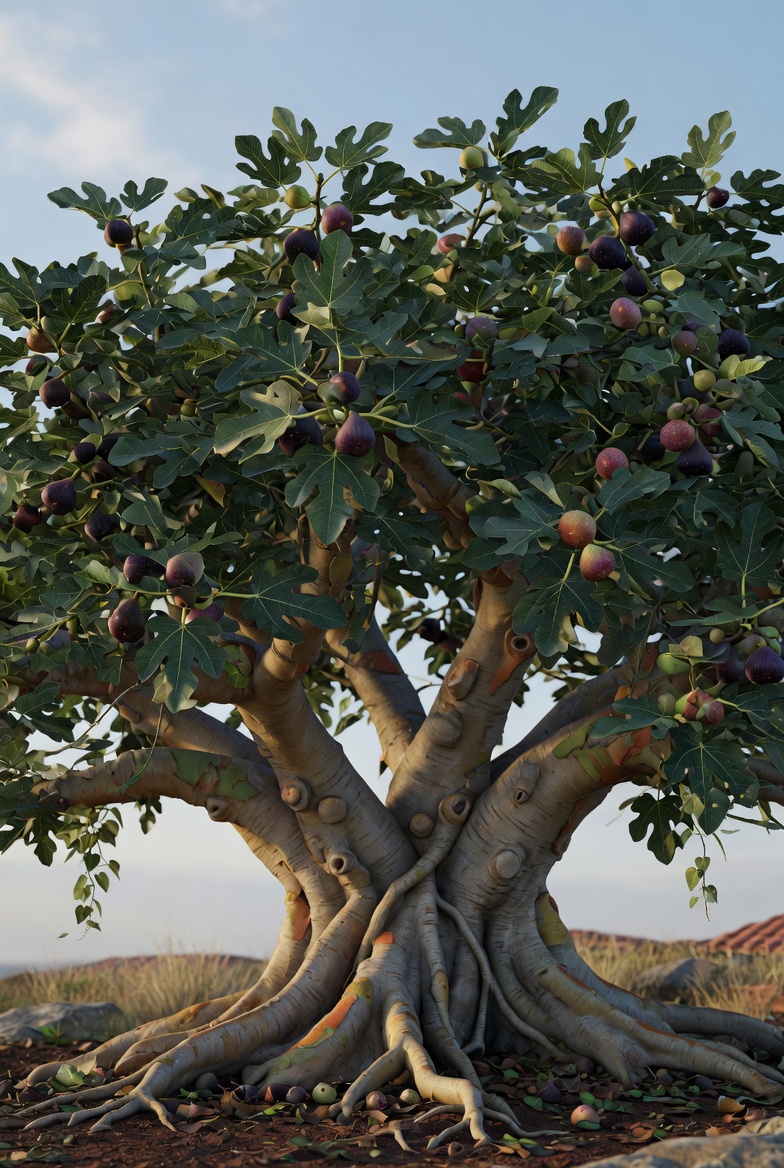
A fig tree has the following characteristics:
With these observations in mind, what comparisons can you make between mankind’s fall from ELOHIM’s Grace and the fig tree?
made themselves aprons
Being that apron is the most suitable English translation, i’ll succumb as well. But one wonders what anatomical parts did these aprons conceal? Was the navel included?
v.8
And hearing the voice of our Lord God walking in Paradise at the afternoon air, Adam hid himself, and so did his wife, from the face of our Lord God amidst the trees of Paradise.
from the face of our Lord God
It seems to me Adam & Eve were originally designed to withstand the awesome heavenly potency of QUI EST. After all, they were both immortal and indeed His children. Why would ELOHIM not want to both walk and talk with His own children? Or, one could conclude HE WHICH IS, Who absolutely knows all, made the immortal bodies of Adam and Eve but still incapable of seeing the glorious face of Father: especially since He knew both would be disobedient to Him and fall from grace.
v.9
And our Lord God called out to Adam, and said to him:
Where art thou?
Who said:
I heard thy voice in Paradise and I feared because I was naked; and I hid me.
To whom He said:
And who hath told thee that thou wast naked; but that thou hast eaten of the tree whereof I commanded thee that thou shouldest not eat?
Tis from this point on that it becomes relatively easy for all man to constantly deflect (falsities) versus consistent admittance (truth). Understand there is no such thing as “a good lie.” QUI EST made it quite simple, which is defined when He Reveals His Commandments to Moyses. There is the complete truth and opposing that is anything that is false, great or slight.
v.12
And Adam said:
Why hast thou done this?
Because thou hast done this thing, accursed art thou among all cattle and beasts of the earth. Upon thy breast shalt thou go. And earth shalt thou eat all the days of thy life.
This Curse of ELOHIM is directed at the Devil Who spoke from within His dutifully sly serpent. Examining the Curse closer we read that the serpent was damned to its belly. This has led many, if not most, to speculate the modern day snake is equivalent to the serpent. Even contemporary periodicals claim this. i and others state differently. i believe the serpent to be more humanoid than reptilian. i, in fact, envision the serpent to be very slight in stature, quite limber, and slyly surreptitious when needed. The head must have been large enough to house at least an 1100 to 1300cc brain for the communication & planning skills it possessed. Only when Father Strikes the creature with His Curse does the serpent’s limbs become multi-jointed. Its pair of arms and legs become much more stubbier to help propel it along the ground on its large yet very flat CHEST.
earth shalt thou eat all the days of thy life
This refers to worldly/carnal or earthly persons.
v.15
I will put enmities between thee and the woman, and thy seed and the seed of her. She shall bruise thy head in pieces; and thou shalt lie in wait of her heel.
I will put enmities
Our heavenly Father wasn’t Expressing His Curse in anger or rage. He stated this with disappointment.
shall bruise thy head in pieces; and thou shalt lie in wait of her heel
Good men resist temptations upon first assaults; thusly the serpent’s head is bruised. However, tis man who endeavors to deceive, especially in the end of one’s life, which is signified by the heel.
ipsa conteret
Unfortunately, there are various Christian religions that do not accept this text as it’s written: she shall bruise. That is, unless the Blessed Virgin should be said in any way to bruise the serpent’s head. So many ancient scholars believed ipsa to be instead, ipsum. Yet Alcimus Autos, Chrisostom, Ambrose, Gregorie, Bebe, Rabanus, Lyra, Strabus and Bernard counter that the Latin word is indeed, ipsa.
 Whether tis read as, she shall bruise, or, her seed, that is, her son, CHRIST, shall bruise the serpent’s head, we attribute no more or no less to CHRIST nor to our Blessed Lady by the one reading then by the other. For, by the text, I will put enmities between the serpent and the woman, and thy seed and thy seed of her, it should be clear this enmity and battle pertained to the woman and her seed on the one party, and to this Devil, that spoke via the serpent, and all the wicked, on the other party, and that the victory should happen to mankind. Which being captive by Adam’s sin, occasioned by a woman, both sexes should be redeemed, though in far different sort, concurring thereto. No matter these interpretations you need to understand Adam was the cause, and Eve an occasion, of man’s captivity. Just as JESUS is the true cause and His Virgin Mother an occasion of our elaborate and meticulously planned restoration. CHRIST, by HIS own power, and His Blessed Mother, by Her most immediate cooperation to His Incarnation (and to other enchanting mysteries as well), did matter-of-factly bruise the head of the serpent–thereby breaking and vanquishing also the Devil’s power!
Additionally, all of these exceptional positive gains far outweigh any and all of mankind’s original losses. Our merciful Father gives us for a terrestrial Adam, CHRIST our Redeemer. And for old Eve, we are Blessed with GOD’s Own Mother. While we’ve merely skimmed the surface of Blessed Virgin Mary, understand this: the Blessed Virgin single-handedly bruised the serpent’s head, in that she vanquished all manner of suggestions of the wicked serpent, never yielding to nor taking delight, in any evil moved by him.
v.16
To the woman also He said:
I will multiply thy travails and thy child-bearings. In travail shalt thou bring forth children. And thou shalt be under thy husband’s power; and He shall have dominion over thee.
i. for boundless pleasure,
ii. to never experience suffering or pain, and,
iii. to be unfamiliar with good and evil, disobedience and sin
With all of the above accepted as valid, how then was woman to give birth? The following points are what i believe to be potentially & logically valid:
Another view would be to accept birth as it is exactly now with the only difference being a complete lack of discomfort or pain. Henceforth, the entire birthing process is pleasurable and comforting.
Because thou hast heard the voice of thy wife, and hast eaten of the tree whereof I commanded thee that thou shouldest not eat, cursed is the earth in thy work. With much toiling shalt thou eat thereof all the days of thy life. Thorns and thistles shall it bring forth to thee; and thou shalt eat the herbs of the earth. In the sweat of thy face shalt thou eat bread til thou return to earth–of which thou wast taken. Because dust thou art, and into dust thou shalt return.
Loe Adam is become as it were one of us, knowing good and evil. Now therefore, lest perhaps he reach forth his hand and take also of the Tree of Life and eat, and live forever.
–for, to keep the way of the Tree of Life.
placed before the
i find the final couple of Verses in III Genesis to be quite pointed, deliberate, and definitive. One can even add sadness or melancholic to the list into the bunch because it is here where we’re informed that Paradise of Pleasure shall be forever off limits to our mortal bodies. We were not only booted from GOD’s Garden but when He Ordered the special Place to be specially guarded, our Father Announced His distrust in us–and deservingly so.
Instead, QUI EST Uses His ministry of Angels and human terror as the only means for ensuring His commands. Otherwise, our Lord simply could have done the following:
There’s one final thing worth mentioning about Cherubins. These are good Angels that adamantly & devoutly hinder Devils of their devious desires! HE WHICH IS intentionally Tasked Cherubin Angels as sentries to ensure no Devil would ever gain access or entry to Paradise of Pleasure. Imagine if the Devil did have access to Paradise of Pleasure. Certainly He would then take the fruit from the Tree of Life and give it to man to prolong man’s life. This would then draw mankind to the Devil’s service, would it not?
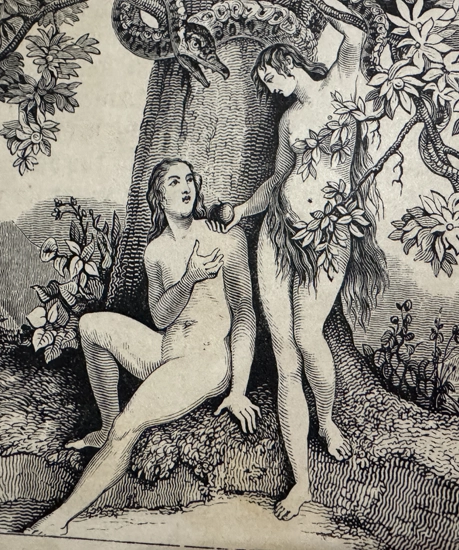

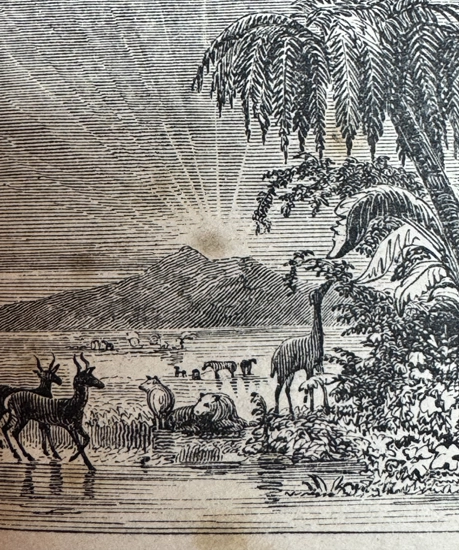
One wonders how woman was to give birth before we fell from Grace. Was procreation even a part of our original design? My assessment is as follows:
i believe the entire process of birth was planned as being pleasurable and without any travails.
The Prophets, also, foretold that external sacrifice should be offered in the Law of Grace and the New Testament, to wit, the same which JESUS instituted, and Left in His Church, to continue to the end of the world. Therefore, this homage of offering sacrifice is so peculiar to heavenly Father that, although many other exterior rites and services are used both to GOD and men (to be bare-headed, to bow, to kneel and the like), either of great humility to of pestiferous flatterie to such as are: homines colendi , venerandi, si autem eis mulium additur, et adorandi (man to be worshipped, reverenced, and if much be given them adored) for the term, adoring, is also applied to men in Holy Scriptures. Yet, sacrifice is due to HE WHICH IS only, and to no creature, no matter how excellent it may appear to be. Like all nations have found it necessary to offer sacrifice, so none durst Sacrifice to any: nisi ei quem Deum aut scissit, aut putauit, aut sinxit (but to him whom they either knew, or thought, or fainted to be God).
Why art thou angry? And why is thy countenance fallen? If thou do well, shalt thou not receive again; but if thou dost ill, shall not thy sin forthwith be present at the door? But the lust thereof shall be under thee; and thou shalt have dominion over it.
Of everything written thus far about this Phrase from QUI EST to Cain, try to comprehend this: All antiquity, universality, and uniform consent of Christian doctors and other learned philosophers, and even reasonable men, hold it for certain and an evident truth, that man, yea, a sinner, has free will. Yet, those such as Martin Luther, the father of the Protestants, so abhorred this agreed upon truth and that he could not at all abide by the word. A brilliant and hard-studying man, albeit misguided significantly, Luther consistently denied that man, in any way, had/has the ability to freely choose, or to resolve or determine, but in all things tied, constrained, and compelled to whatsoever he does, thinks or says. Further, man, in all his actions, is like to a hackney that is forced to go where the rider will steer him. Knowing most of the world was against him, Luther refused to confess otherwise, and concluded with: I have not conferred with any in this book, but I have affirmed and I do affirm. Neither will I that any man judge hereof, but I
About the time of this response is when Calvin joined with Luther to confirm this misaligned theory. Unlike Luther, however, Calvin’s belief was much less deviant: —rather wisheth then imagineth that men also be so mad as to flye from the name of freewill. I neither myself would use this word, and would wish others, if they ask me counsel, to abstain from it. Twas S Hierome who arose to refute these claims by Luther, Calvin, and others with the following: God made us with freewill. Neither are we drawn by necessity to virtues nor to vices; otherwise where is necessary, there is neither damnation nor crown. i find Hierome’s to be relatively straightforward, easily adaptable, and, thankfully understandable.
v.8
And Cain said to Abel, his brother:
Let us go forth abroad.
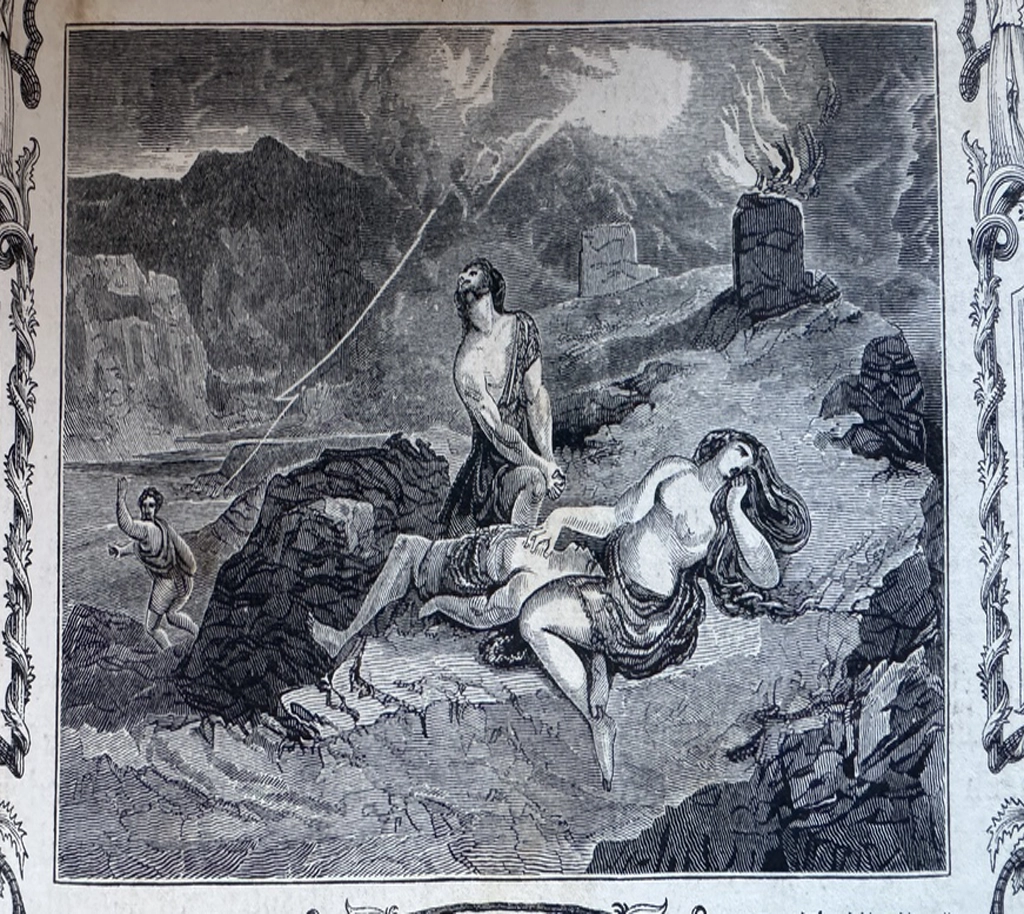
And when they were in the field, Cain rose up against his brother, Abel, and slew him!
And our Lord said to Cain:
Where is Abel, thy brother?
Who answered: I know not; am I thy brother’s keeper?
And He said to him:
What hast thou done? The voice of thy brother’s blood crieth to me out of the earth.
Murder is one of those mortal sins that cries to QUI EST for revenge–never for man to execute.
v.11
Now, therefore, cursed shalt thou be upon the earth, which hath opened her mouth, and received the blood of thy brother at thy hand.
What a fantastically yet fearsomely potent statement made by HE WHICH IS! Think about what He is telling us. Review the early Chapters on the creation of man. Again, HOLY GHOST made it a very clear point for Moyses to write that man was Made by GOD Using a conglomeration of all the muck and wasteful by-products of terra’s creation! This is done to reveal from the start that:
Thusly, if you injure one another, especially if you kill one another, remember this: terra cries out for revenge because you injured or killed a part of her! Once mankind realizes this will he then see a more hospitable planet towards him. HE WHICH IS does and will seek revenge for you or your loved ones if a brother or sister brings harm upon you. Rely not upon the vengeances and justices of man. Live according to the precepts and laws given to us by Moyses and let HE WHICH IS Do the rest.
v.12
When thou shalt til it, it shall not yield to thee her fruit. A rogue and vagabond shalt thou be upon the earth.
And Cain said to our Lord:
Mine iniquity is greater than that I may deserve pardon. Loe, Thou dost cast me out this day from the face of the earth; and from Thy face shall I be hid. And I shall be a vagabond and fugitive on the earth. Everyone, therefore, that findeth me shall kill me.
What men would harm him? i wrote earlier i didn’t have a concrete answer at the time. Now i do. When the Spirit of Life blew from ELOHIM’s Mouth across terra, men and women Created outside Paradise came to life. These are the persons and their tribes to which Cain refers.
v.15
And Our Lord said to him:
No, it shall not so be. But whosoever shall kill Cain, shall be punished seven-fold.
And our Lord put a mark on Cain, that whosoever found him should not kill him.

East of Eden=mallard
Moses, intending to show and describe the perpetual continuance of God’s city, the true Church, from Adam, which he doth by the line of Seth to Noe, and so forward until His own time, would not omit to tell also the progenie of Cain, even to the floud, wherein all his offspring was finally drowned and destroyed, that the true City of God might appear more distinct, more conspicuous, and more renowned. And that indeed the same only [and not anie broken and interrupted companies or couenticles] might be known to be the true Church of God.
v.8
And Cain said to Abel, his brother:
Let us go forth abroad.
And when they were in the field, Cain rose up against his brother, Abel, and slew him!
And our Lord said to Cain:
Where is Abel, thy brother?
Who answered: I know not; am I thy brother’s keeper?
And He said to him:
What hast thou done? The voice of thy brother’s blood crieth to me out of the earth.
Murder is one of those mortal sins that cries to QUI EST for revenge–never for man to execute.
v.11
Now, therefore, cursed shalt thou be upon the earth, which hath opened her mouth, and received the blood of thy brother at thy hand.
What a fantastically yet fearsomely potent statement made by HE WHICH IS! Think about what He is telling us. Review the early Chapters on the creation of man. Again, HOLY GHOST made it a very clear point for Moyses to write that man was Made by GOD Using a conglomeration of all the muck and wasteful by-products of terra’s creation! This is done to reveal from the start that:
Thusly, if you injure one another, especially if you kill one another, remember this: terra cries out for revenge because you injured or killed a part of her! Once mankind realizes this will he then see a more hospitable planet towards him. HE WHICH IS does and will seek revenge for you or your loved ones if a brother or sister brings harm upon you. Rely not upon the vengeances and justices of man. Live according to the precepts and laws given to us by Moyses and let HE WHICH IS Do the rest.
v.12
When thou shalt til it, it shall not yield to thee her fruit. A rogue and vagabond shalt thou be upon the earth.
And Cain said to our Lord:
Mine iniquity is greater than that I may deserve pardon. Loe, Thou dost cast me out this day from the face of the earth; and from Thy face shall I be hid. And I shall be a vagabond and fugitive on the earth. Everyone, therefore, that findeth me shall kill me.
What men would harm him? i wrote earlier i didn’t have a concrete answer at the time. Now i do. When the Spirit of Life blew from ELOHIM’s Mouth across terra, men and women Created outside Paradise came to life. These are the persons and their tribes to which Cain refers.
v.15
And Our Lord said to him:
No, it shall not so be. But whosoever shall kill Cain, shall be punished seven-fold.
And our Lord put a mark on Cain, that whosoever found him should not kill him.
East of Eden=mallard
Moses, intending to show and describe the perpetual continuance of God’s city, the true Church, from Adam, which he doth by the line of Seth to Noe, and so forward until His own time, would not omit to tell also the progenie of Cain, even to the floud, wherein all his offspring was finally drowned and destroyed, that the true City of God might appear more distinct, more conspicuous, and more renowned. And that indeed the same only [and not anie broken and interrupted companies or couenticles] might be known to be the true Church of God.
And Cain knew his wife, who conceived and brought forth, Enoch. And he built a city and called the name thereof by the name of his son, Enoch.
By the increase of Abraham’s seed, by the line only of Isaac and Jacob, besides the issues of Ismael and Esau, in little more than 400 years, to above 600,000 men able to bear arms, it appears the Cain’s progeny in as many years might suffice to people a city, ‘yea, a whole country–S Augustine.
Moreover, Enoch begat:
Who took two wives. The name of the one was Ada, and the name of the other, Sella.
Lamech is the first man to take two wives.

Iabel is the father of tent-dwellers & herdsmen
And Ada brought forth, Iabel, who was the father of them that dwell in tents and of herdsmen.
And his brother’s name was, Iubal. He was the father of them that sing on harps and organs.

Jubal became the father of singers on harps & organs.

Tubalcain became the parent of metal workers.
Hear my voice, ye wives of Lamech. Harken to my talk. For, I have slain a man to the wounding of myself and a stripling to mine own dry blow bruising. Seven-fold vengeance shall be taken of Cain; but of Lamech seventy times seven-fold.
I have slain a man
Adam also knew his wife again; and she brought forth a son and called his name, Seth, saying:

Enos, grandson of Adam and son of Seth, is the first to invocate ELOHIM’s Name.
i’m under the same belief with many of our ancient Fathers/Doctors that Enos’ invocation to HE WHICH IS was done in public, and even together as a family. And wherever this accomplished, the gathering was certainly dedicated to Divine Service. This Divine Service, instituted by Eve and Adam, in the open air of terra eventually evolved, and grown, into a Church. Therefore, besides physical Sacrifice, as apparent by Cain and Abel, Divine Service was equally as important in servitude/thanksgiving/praise to HE WHICH IS.

birth of Cain
death of Abel

V Genesis, video 1

V Genesis
The fifth Chapter of Moyses’ Genesis shall be as exciting as the previous four–with one exceptional caveat. If you are one of the billions who sincerely wonders if there is one, appropriate, Religious faith devoted entirely to QUI EST, His Liturgy, and His Spouse, tis this Epistle that shall provide you with answers. This 5th Epistle will provide you with historical insight into the religion established by our CHRIST in contrast to the 2000+ Christian and 500+ non-Christian religions inundating terra.
🐋 This is the book of the generation of Adam in the day when God created man to the likeness of God made he Him. Male and female created He them, and blessed them, and called their name, Adam, in the day they were created. And Adam lived 130 years and begat to His own image and likeness, and called his name, Seth. And the days of Adam after he begat Seth came to 800 years: and he begat sons and daughters.
he begat sons and daughters
This means all the names that validate the continual succession of CHRIST’s Church are identified in this Chapter. If you belong to a church undirected by JESUS, ask yourself: how far back in succession does your church, or your pastor’s lineage, actually exist? Because i guarantee not one can claim anything or anyone prior to the Flood that baptized this planet. Only the singular Church of JESUS extends this far back. And you will learn which Church that is in GOD’s Liturgy.
v.5
And all the time that Adam lived came to 930 years, and he died.
and he died
By this God’s word is verified saying, that Adam should die, if he should eat of the forbidden tree.
v.6
In Hebrew this is a renowned phrase that means, Enoch lived well and pleased God.
And all the days of Enoch came to 365 years. And he walked with God and was seen no more because God took him.
God took him
The 72 Interpreters, S Paul and myself define this to indicate, GOD Translated him.
was seen no more
In S Augustine’s first book he writes that both Enoch and Elias are yet still alive in human bodily form. Several Latin and Greek Doctors such as Saints’ Ireneus, Iustinus, Hippolitus, Damascen, Jerome, Ambrose, Bede, and Matthew testify to the same. According to scripture Elias still lives but shall be slain along with another, as described by S John in the Book of Apocalypse. In his Book John writes:
Enoch Translated cont’d.
If that explains Elias then what of Enoch? Moyses makes the matter more than probable that Enoch did not experience a mortal death. For, when Moyses wrote about Adam’s other family members he annotated the deaths of all the patriarchs. But for Enoch he writes, he was seen no more. Then, there’s what the 72 Interpreters wrote: and he was not found, for God translated him. This certainly doesn’t imply death. Instead, it means GOD Transported or Removed Enoch to another place or perhaps a different plane unknown by man. Even in Ecclesiasticus tis written: Enoch pleased God, and was translated. Additionally, there’s the wisdom of S Paul: Enoch was translated, that he should not see death, and he was not found, for God translated him. One cannot ignore the plainly written testimony of an apparently remarkable person who did not experience death but was instead translated or conveyed away. Further, i cannot attest Paul was inferring a spiritual death. Enoch’s extraordinary journey, and his longevity after the world’s Flood, conclusively ensures his great father, Adam, is eternally saved and very much preserved from perpetual death. Such an immortal salvation similarly applies to Seth, Enos (being especially most holy), and the rest of Adam’s lineage: that they too were most probably preserved from eternal death.
i, the ancients, ample Priests, and Doctors prove by Scripture that Enoch (and Elias) has not faced mortal death. S Chrysostom affirms with: Though it be not a matter of faith, whether Enoch be now in Paradise from whence Adam and Eve were expelled, or in some other pleasant place, the holy Scriptures say that God translated him, and that he translated him alive–that he felt not (nor experienced) death. There’s also S Augustine who expressed, Non mortuus, sed viuses translaisis est (Enoch is not dead; he’s been translated). The Bishop of Hyppo taught how Enoch’s life was sustained through the many thousands of years on earth and that both Elias and Enoch shall indeed one day experience mortal deaths. The Saint brilliantly elaborates: —seeing Enoch and Elias are dead in Adam, and carrying the offspring of death in their flesh, to pay that debt, are to return to this life and to pay this debt, which so long is deferred.
Here are a couple of other elements that contribute to the Translations of Enoch and Elias:
1) QUI EST Shows, by physical example, as long as one does not sin, one’s body could be conserved from corruption or decaying. Like Adam, Eve, and all of us, we wouldn’t face mortal death just as heavenly Father promises. Instead of facing a mortal death, each of us would, in some good time, be Translated to heaven as immortals.
2) Validation for immortality is offered to us, which is certainly promised after the general Resurrection. i concur with the ancient learned Fathers and Doctors that ELOHIM does Preserve some mortals from all infirmities. We are assured that GOD will Give eternal life of body and soul certainly to His Saints–after they have paid the debt of death and are risen again.
3) Enoch, of the Law of Nature, and, Elias, of the Law of Moyses, are preserved alive to possibly come amongst men again toward the end of the world. If true, both shall appear again before man in order to:
+ teach,
+ testify, and,
+ defend
–the true faith and doctrine of CHRIST against Polarchrist. This shall occur when Polarchrist will most violently impugn and persecute GOD’s Spouse. More candidly, Elias plus one (of which many believe to be Enoch) shall appear to specifically defend the Church of CHRIST. Christianity, Dearest Reader, is verifiably not the Church of JESUS! This is because the term, Christian, has evolved to mean different things amongst mankind in lieu of the genuine original followers of the teachings of JESUS. Elias and possibly Enoch are exclusively going to defend only ELOHIM’s Church and not any of man’s. After all, why would these immortals appear for any finite church of man? By the time you finish exploring the Gospel with Shepherd Corps, you will indeed come to your own knowledgable conclusion regarding GOD’s true Church.
Here are some conclusions concerning Enoch and Elias. For Enoch let’s return once more to the Book of Ecclesiasticus. In this Book it’s written Enoch was translated and that he gives repentance to the nations by his preaching and reducing the deceived that will be drawn to Antichrist. For Elias there is a Prophecy from Malachi that reads: —that he shall come before the great and terrible day of our Lord, and shall turn the heart of the fathers to the sons and of the sons to the fathers. If we break this Prophecy down into segments we get:
The deceived Christians are those persons following religions formulated by mankind, as Prophesied by JESUS, S Paul, S Peter, &. Here are some examples of such deceived Christians: Mormons, Baptists, Presbyterians, Lutherans, Orthodox, and Methodists.
v.25
Mathusala also lived 187 years and begat Lamech. And Mathusala lived, after he begat Lamech, 782 years, and begat sons and daughters. And all the days of Mathusala came to 969 years, and he died.
969 years
By this number we see Mathusala lived the longest of the patriarchs of Adam’s seed. However, consider the extraordinary life of Adam. Since he (nor Eve) had no childhood, he was as strong of body the first day he was created as these others were at 60 years old! The patriarch and matriarch of the children of GOD were birthed as innocuous adults, before which, none are said to have begotten children. With this data included, subtract 60 years from Mathusala then Adam certainly lived en masse longer than Mathusala by 21 years!
v.28
And Lamech lived 182 years and begat a son. And he called his name, Noe, saying:
This son shall comfort us from the works and labors of our hands on the earth, which our Lord cursed.
And Lamech lived, after he begat Noe, 595 years, and begat sons and daughters. And all the days of Lamech came to 777 years, and he died.
And Noe, when he was 500 years old, begat: Sem, Cham, and Iaphet.
It can be certainly interpreted Noe began having his 3 sons at 500 years of age. Or, perhaps this esteemed Prophet had triplets. Maybe it will become clearer as we progress through the Liturgy. 😀

And after that man began to be multiplied upon the earth and had procreation of daughters. The sons of God, seeing the daughters of men that they were fair, took to themselves wives out of all which they had chosen.
sons of God
Professors of the true religion are known as, sons of man. On the opposing spectrum are the followers of the errors of man. There’s a very notable distinction between the two, just as Heretics being compared to Roman Catholics today.
So, who are the Sons of GOD? Answer: the bloodline of Adam through Seth. Those of this bloodline are the true professors of GOD’s religion and faith. The descendants of Cain, on the other hand, follow the wicked and erroneous opinions, which are those man. Observe the world today and you shall see this same conflict in existence, as it remains the oldest global dispute.
Historically, the Sons of GOD and the Sons of Man are two distinct categories that help identify the true Religion of ELOHIM from false ones. Later, the Sons of GOD became called, Jewry or Hebrews, whereas the Sons of Man became known as, Gentiles. Then came mankind’s CHRIST. After the demise of JESUS, Jews became Christians and Gentiles came to be called Pagans. Finally, genuine Christians were known as Catholics (which means, Universal, as in, applicable to all mankind) and all other religions and beliefs were dubbed, Heretics. Following is a succinct overview of the evolution of both of these opposing sides as per the Liturgy:
† Adam (First Sin) –> Cain –> Sons of Man –> Gentiles –> Pagans –> Heretics
† Adam (First Church: terra/Eve) –> Seth –> Sons of GOD –> Jewry –> CHRIST/His followers (Christians) –> Catholics
You will verify and validate these two categories as you explore the entire Liturgy (and the Apocrypha) with Shepherd Corps using the cleanest and most direct translations from Hebrew Beresith and Greek and Latin. Reach out to your nearest Priest or schooled theologian for an appropriate version of the Bible to follow along with us. We cannot stress enough the importance of the appropriate, translated, biblical version.
v.3
And God said:
My spirit shall not remain in man forever, because he is flesh: and his days shall be 120 years.
My spirit shall not remain
These are some of the saddest Words of the Old Covenant. Try to envision our lives if we had not partaken in the Knowledge Tree. On a brighter note… QUI EST lovingly and brilliantly Remedies this dilemma with His Son–the Light–which is explained by reading the Liturgy. Tis the reason the genuine religious live their lives as they do. To such individuals nothing on earth compares to what awaits in vitam aeternam. Thusly, albeit these persons are so frequently mimicked, mimed, misunderstood and tortured… Father never forgets and surely Blesses the meek and devoted.
his days shall be 120 years.
This is another one of those Phrases that is too frequently misunderstood. Upon first read one cannot help but immediately conclude QUI EST shortened the lifespans of man to 120 years. However, as you’ll later read with the bloodline of Sem to Abram, many a man has lived much longer than the stipulated 120 years. So what else could this possibly mean? What can this number apply to?
Firstly, here are examples of those residing beyond 120 years:
Secondly, the 120 years was actually a warning and an expectation for that generation to repent. Here’s proof. Locate a Chaldee Edition of the Old Testament. In this edition are the words, termines cabitur ei centum viginti annorum, so forie convertatur (the term of a 120 years shall be given them if perhaps they convert). What blessed Doctors cannot agree on is whether ELOHIM cut off 20 of these years and brought the flood after a 100. To exemplify, Noe had his sons when he was 500 years of age and the Flood arrived during his 600th year. It can be reasonably stated that perhaps this Warning was given 20 years before any of Noe’s sons were born!
There are so many religions on terra that claim the Scripture is easy to interpret and understand–the Protestants being one such group. i happen to disagree with the Protestants and those other Christians claiming the Word of GOD to be relatively easy to conceptualize. It does seem probable, however, that Moyses, by anticipation, joins the births of Noe’s sons (when he was 500 years old) to the rest of the genealogy of the first patriarchs (see Epistle V), and then tell of this admonition, given 20 years before their births. With this we can conclude ELOHIM Expected the repentance of the people during the entire time of the prescribed 120 years.
v. 4
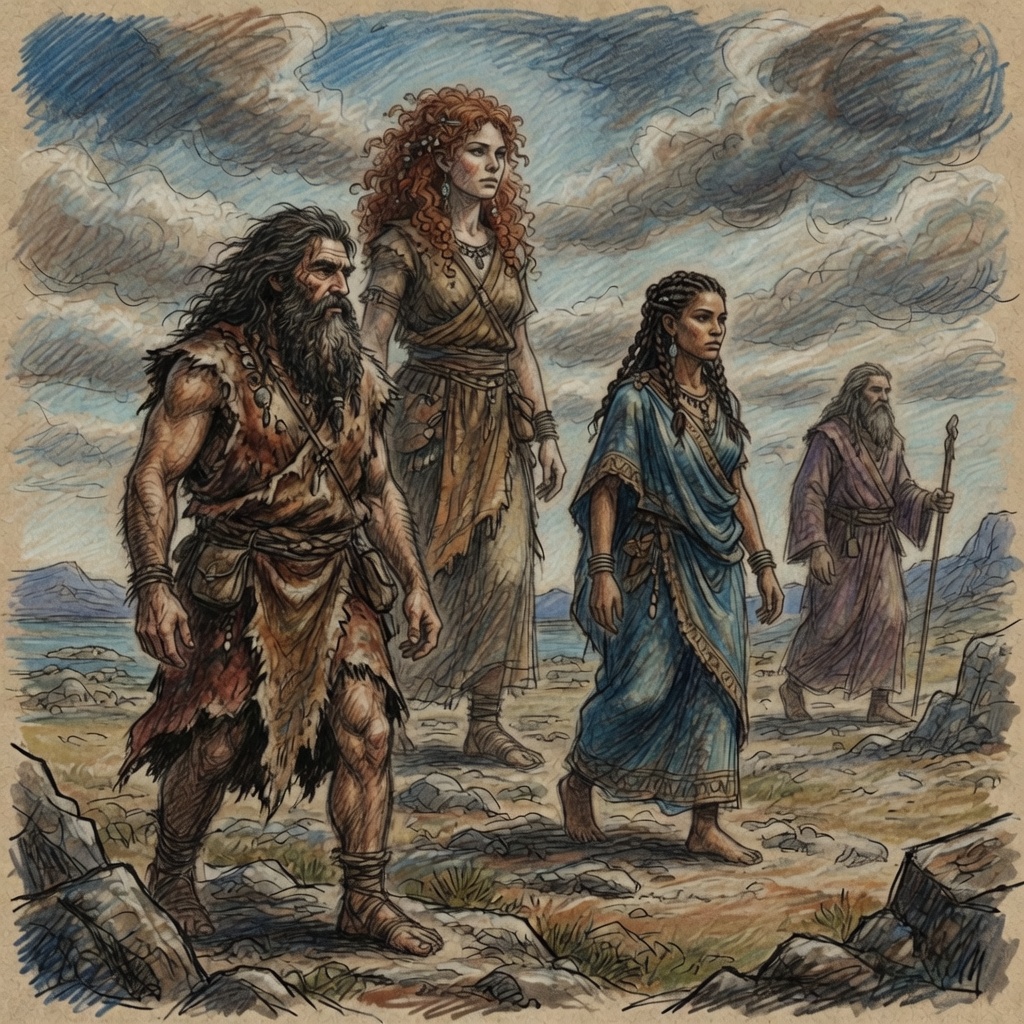
when Giants were amongst us
And Giants were upon the earth in those days.
And Giants
In summation, these Giants were most monstrous not only in size, but in mind as well.
v.4 cont.
For, after the Sons of God did company with the daughters of men and they brought forth children, these be the mighty of the old world–famous men. And God, seeing the malice of men was much on the earth, and that all the cogitation of their heart was bent to evil at all times, it repented Him that He had made man on the earth.
it repented Him
Throughout this blessed Book of Life you shall learn Moyses writes of 4 respects, which reveal just how grievous our sins will aggrandize to become:
First, all flesh hath corrupted his way upon earth. This tells you that wickedness and malice were widespread, and very general. Hence, there is nothing Moyses writes that indicates a specific event or sin caused ELOHIM’s Wrath.
Second, all the cogitations of their hearts were bent to evil. The malice of our forefathers was so great, with similarities you can recognize today, that these outrageously great men committed all manners of wickedness. They did so in:
Third, it was of long continuance and daily iterated. When reading of Cain’s sin and his dialogue with ELOHIM, do you recall reading his apology or him seeking repentance? You won’t read it because neither exists. Once Cain had fallen into damnable (mortal) sin, he, or his seed, never repented! Further, after the deaths of Adam and Seth, and Enoch being translated, many of the faithful within Seth’s progeny fell to the wicked sort. Many others became worse (omni sempore) always, or daily.
Fourth, —and therefore God saved him and his family, bringing in the deluge upon the world. The people of GOD’s planet grew obdurate and stubborn. They didn’t repent in the slightest, even as Noe was building the Ark and preached justice (something S Peter later stresses in the New Covenant).
Given these four factors, ask yourself, how does it aid the arguments of Luther, Smith, and other Heretics? Yes, indeed the malice of man and corruption of flesh were then:
However, was it not so universal but that GOD Himself accepted Noe with the Words: I have found thee just in my sight in this generation. Obviously, all cogitation and all flesh signify there are exceptions. This also pertains to the general propositions that are written later in this Epistle concerning the punishment that would be threatened, comprehending not absolutely all and everyone, but almost all with very few exceptions:
With the above 3 Verses one can conclude these are very general speeches indicating that all should be destroyed. And yet 8 specific persons, who had the same natural flesh as the rest of mankind, were saved! This also includes other living creatures that had living breath. Dozens of pairs, if not hundreds, were saved alive. In regards to the Protestants (and other man-formed religions), the paradox identified above pretty much annihilates Luther’s theory that all actions of man are sins. If you’re aligned with any Heretical belief, ask yourself these same questions and face the same paradoxes identified here. As far as, no man can be just? Again, Luther’s premise has been invalidated here as well. There are simply a myriad scriptures that plainly teach us of many just men! Individuals such as:
† Noe,
† Iob,
† Daniel,
† Zacharias,
† Elizabeth,
† Iudith, and,
† Simeon.
As you explore and read other Books throughout the Liturgy, to include the Apocrypha, you will learn of other just brothers and sisters.
v.6
And touched inwardly with sorrow of heart,
I will,
–saith He,
—clean take away man, whom I have created, from the face of the earth, from man even to beasts, from that which creepeth even unto the souls of the air. For it repenteth Me that I have made them.
Why does Moyses literally pen the presumed emotions of HE WHICH IS? Tis as though the best friend of GOD was portraying Him as somewhat human. Like a man facing conflicting emotions. Yet, i’ve already explained that our Father is an emotionless Entity. Therefore, why do you think HOLY GHOST Directed Moyses to write these Verses? As written it appears ELOHIM had reservations about Creating us because we fouled up so atrociously! Perhaps Moyses writes this to show us HE WHICH IS has an immeasurable love for us. A love that is so beyond compare! Later, in his First Book, Samuel also writes these Words when ELOHIM reveals His disappointment with King Saul. Still again QUI EST doesn’t intend regret or mistake because all He does is good and to many times please His first-begottens.
v.8
But Noe found grace before our Lord. These are the generations of Noe. Noe was a just and perfect man in his generations; he did walk with God.
Noe was a just and perfect man
Here are 4 points to consider:
† S Hierom–Noe, the just man, was perfect in his generations. He did walke with God. Meaning, he did follow His steppes. Jerome instructs there’s a difference between consummate justice [which is of the next life] and the justice of this generation [transitory life].
† S Augustine–Noe was called just in his generation, to wit, not as the citizens of God’s citie are to be perfected in that immortalitie, in which they shall be equal to Angels, but as they may be perfect in this pilgrimage. i find it ingenious how S Augustine refers to our lives here as pilgrimages. But, a disclaimer should be added. From his writings and speeches tis my belief that Augustine, in dealing with man’s journey on terra, intended the term, pilgrimage, to be applied to persons seeking/following the Light. To validate, in a couple of his works, Augustine describes Noe to be a perfect man that runneth without blame towards perfection, void of damnable sinnes, and is not negligent to cleanse venial sinnes by:
† S Ambrose–By the grace [or favour] which Noe found, is showed that other men’s offence doth not obscure the just man. Noe, in fact, is praised not by the nobility of his birth but by the merit of his justice and perfection.
† S John Chrysostom–Saint John Chrysostom [347-407] was probably the greatest early Doctor/Priest who set forth the justice and perfection of Noe. John showed that Noe deserved the name of a man because he, by having vices and following certain virtues, conserved the image of man. Whereas others, beasts, other men, &, were led away and ruled by their wicked lusts. From one of his speeches, S Chrysostom states, Behold, another kind of praise. Noe is called, just, which denomination comprehendeth all vertue. For this name, just, we use to pronounce of them, that exercise all manner of vertue. And that you may learn how he arrived to the very top, which was then also required of our nature, the Scripture saith, he was just–being perfect in his generation. He performed what things soever it behooveth one to doe that embraceth vertue, for such an one is perfect, intermitted nothing, he halted in nothing. He did not well in this thing, but was perfect in every vertue, which was requisit for him to have. Moreover, to make also this just man more conspicuous to us in regard of the time, and by comparing him with others, the Scripture saith, he was perfect in his generation. In that time, in that perverse generation, which declined unto evil, which would not so much as pretend any resemblance of virtue. In that generation therefore, in those times, that just men not only pretended but arrived to that height of virtue, that he became perfect, and in all things absolute. And that which I said before, to do well amongst the enemies of vertue, amongst them that forbid vertue, doth always testifie a greater poyse of vertue, so by this occasion the just man got greater prayses. Neither doth divine Scripture here make an end of praising him, but further sheweth the excellencie of his vertue, and that he was approved by God’s own censure, for besides saying, he was perfect in his generation, it addeth, that Noe pleased God. So great was the renowne of his vertue, that he deserved to be praysed of God, he pleased that eye, that can not be deceived, by his good workes.
† S Gregory the Great–Noe, for all as he pleased God’s examination, was saved alive in the unclean world. After a large catalogue of other just men in confirmation of Gregory’s doctrine, that some were just in the law of nature. Neither is it to believed that only so many were just before the law was received as Moses contracteth in his most brief description.
v.10
And he begat three sons:
And the earth was corrupted before God and was replenished with iniquity. And when God had perceived that the earth was corrupted (for all flesh had corrupted his way upon the earth), He said to Noe:
The end of all flesh is come before me. The earth is replenished with iniquity from the face of them; and I will destroy them with the earth.
Our earlier infamous forefathers and foremothers became so completely infatuated with the earthly life. They obstinately and entirely believed in what they could do, see, and feel in the present: henceforth, temporal & bodily pleasures. Therefore, since man’s sins lie with what he creates from and on earth, QUI EST opts to allow this same earth of promiscuity and sinful joy to be the destruction of man’s sins. In other words, since man sided with a mortal life and became satisfied with what the planet brings and provides, HE WHICH IS allowed this same impetus for the creation of sin to be also the destruction of sin.
v.14
Make thee an ark of timber plank. Cabinets shalt thou make in the ark and shalt pitch it within and without with bitume.
Bitume is asphalt or tar made from petroleum.
v.15
And thus shalt thou make it. The length of the Ark shall be 300 cubits, 50 cubits, the breadth, and 30 cubits tall, the height of it.
A cubit equals ~18″: from tip of the middle finger to the point on the elbow.
300 cubits
Apelles was an old Marcian scholar who branched out on his own to embrace other popular heresies of the time. He ended up rejecting the Law of Moyses as well as the Prophets. Apelles also denied that JESUS possessed true flesh. He impugned the Law claiming it was impossible that in so small a room as was the Ark by this description, the designed pairs of all kinds of beasts, foul, and serpents, should be contained, with the eight persons, and all their provision of meat for a whole year. In brief, Noe’s Ark was simply a fable. Apelles exulted this story to be improbable and impossible to be true.
Minimally, pursuant to the first measurement, the length of Noe’s Ark is one and a half football fields long! Draw this out in the sand of a desert or beach. Then step back and  absorb the vast size of this most phenomenal ship built by only four men and four women! Considering all the lofts and partitions within this massive exodus ship, ask yourself this: could thousands of pairs of creatures from all over the world, along with 8 humans, exist in this craft you just drew?
v.16
Thou shalt make a window in the Ark and in a cubit finish the top of it. And the door of the Ark thou shalt set at the side below; middle chambers and third lofts shalt thou make in it.
Behold I will bring the waters of a great flood upon the earth, that I may destroy all flesh where in there is breath of life under heaven. All things that are in the earth shall be consumed. And I will establish my covenant with thee. And thou shalt enter into the Ark, thou and thy sons, and thy wife, and the wives of thy sons, with thee. And of all living creatures of all flesh thou shalt bring pairs into the Ark that they may live with thee, of the male sex and the female. Of fowls according to their kind, and of beasts in their kind, and of all that creepeth upon the earth according to their kind. Pairs of all sorts shall enter in with thee that they may live. Thou shalt take, therefore, with thee of all meats that they may be eaten and thou shalt lay them up with thee. And they shall be meat for thee and them.
Noe, therefore, did all things which God commanded him.
You’ve just read a quintessential example of a just man. How extraordinary a man Noe must have been for HE WHICH IS to have entered a hallowed Covenant with. One man out of, say, .5 billion inhabitants. Thusly, QUI EST Spares Moyses and his family of seven along with all the beasts of terra. Creatures that shall live with and shall not harm the Prophet’s family. A man who GOD shall Teach to build an Ark–for, Moyses was a husbandry-man by trade. Lastly, all flesh shall be destroyed on the planet except Moyses and the pairs of creatures aboard the Ark. Yes, indeed, Moyses was a uniquely special man.
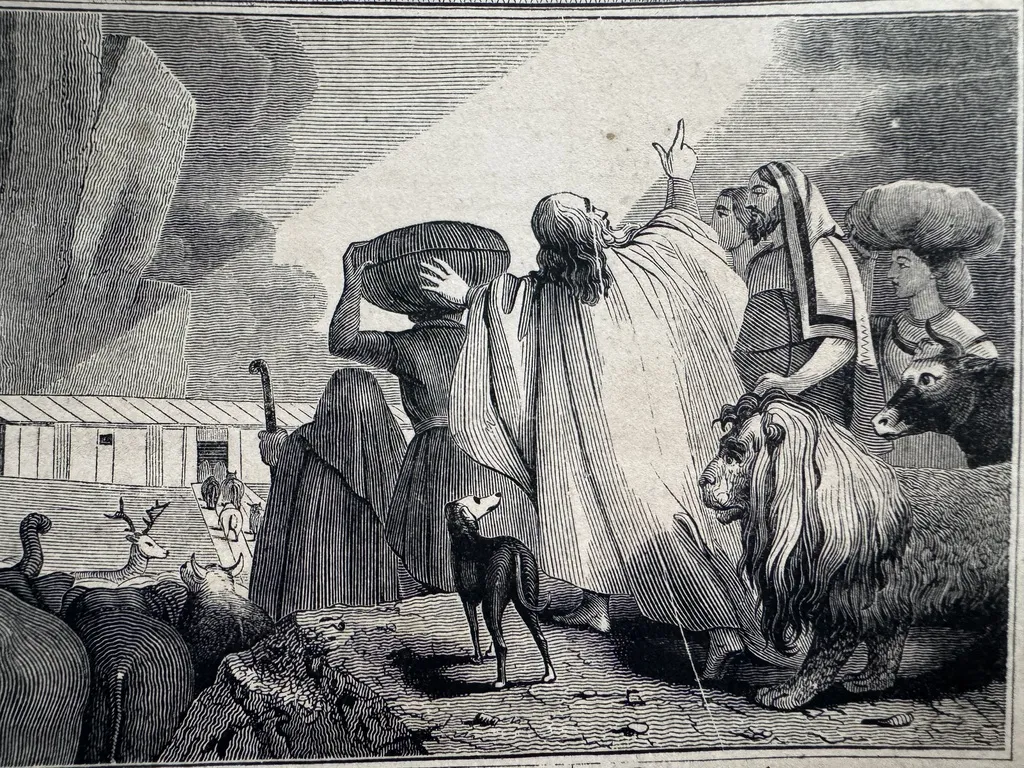

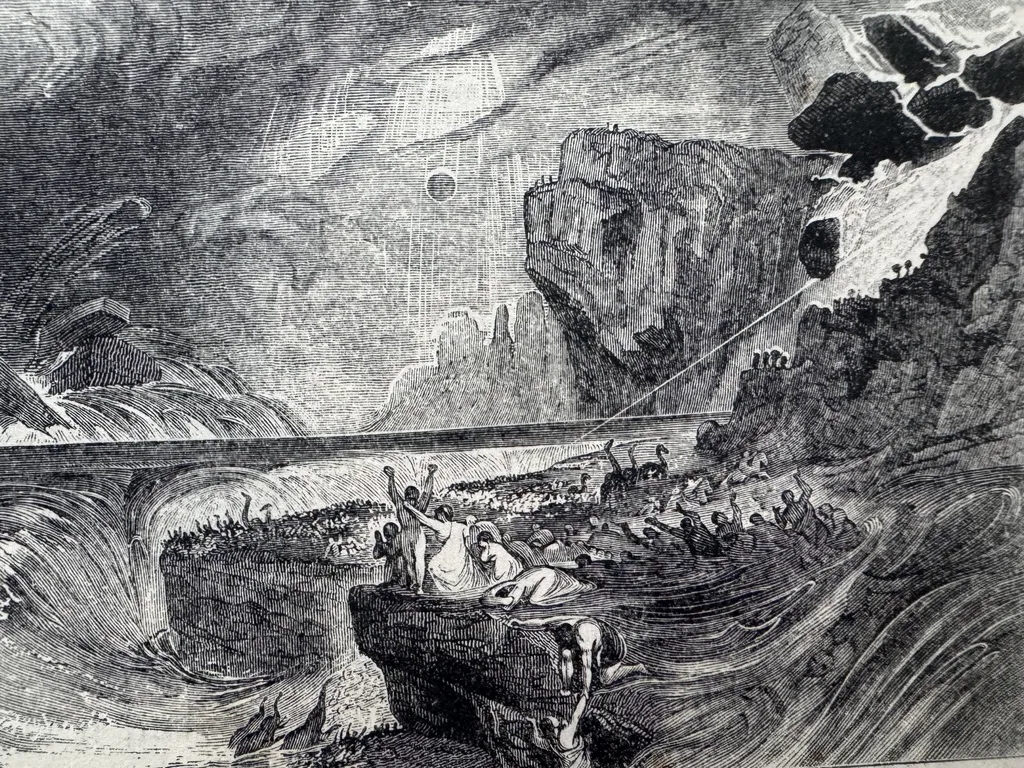
And our Lord said to Noe:
Get thee in, thou and all thy house, into the ark. For, I have seen thee just in my sight in this generation.
in my sight
By the estimation of men, Noe certainly was just. More importantly, Noe viewed as just in deed and before God.
v.2
Of all beasts that are clean, thou shall take seven and seven, male and female. But of the beasts that are unclean, two and two–male and female.
that are clean
Clean and unclean beasts has been a point of contention for quite some time. What exactly does it mean? We shall explore this in much more detail at a later time. For simplicity sake, let’s for now agree that this statement refers to the beasts and creatures of earth prior to the adoption of the Law of Moyses. All creatures and beasts Created by ELOHIM are good–please understand this. When heavenly Father Uses terms like clean & unclean, He is stipulating which animals are deserving of use with anything regarding Him or especially His Spouse, such as sacrifices and pacifikes.
v.3
Yea, and of the fowls also of the air, seven and seven, male and female, that seed may be saved upon the face of the whole earth.
seven and seven
Why the number, 7? Many say 7 were chosen in order to have spares. This is a theory i don’t side with. Why? Because the Ark and everyone and everything inside were under the Protection of HOLY GHOST. Absolutely nothing was going to harm Father’s floating Church! So why seven? Terra became divided into 7 continents, did she not? These creatures became the Adams & Eves of the newly baptized planet.
v.4
For yet awhile and after seven days, I will rain upon the earth 40 days and 40 nights. AndI will clean destroy all substance that I have made from the face of the earth.
Noe, therefore, did all things which our Lord had commanded him. And he was 600 years old when the waters of the flood flowed over the earth. And Noe entered, and his sons, his wife, and the wives of his sons, with him into the Ark because of the waters of the flood.
Did you notice children aren’t mentioned? With the flood persisting 150 days {before the Ark touches land once again}, HE WHICH IS knew His floating Church was no place for children. This was because of the demanding daily and nightly regime required by Noe’s family to tend to the thousands, perhaps millions, of creatures aboard GOD’s most fantastic Ark.
v.8
Of beasts also, the clean and the unclean, and of fowls, and of all that moveth upon earth, two and two went to Noe into the Ark, male and female, as our Lord had commanded Noe. And after the seven days were passed, the waters of the flood flowed over the earth.
–all the fountains of the great depth were broken up; and the flood-gates of Heaven were opened.
great depth
The Hebrew word, thehom, signifies a gulf of water. From thehom sprang forth new fountains of water much vastly than ever before or ever shall be!
flood-gates
Arubbah implies great windows or pepes of massive amounts of water plummeting from the sky. Such an enormous amount of water down-pouring from Heaven.
v.13
And the rain fell upon the earth 40 days and 40 nights. In the very point {noon} of that day entered:
his sons, and
–with them into the Ark. They and every beast according to their kind, and all cattle in their kind, and all that moveth upon the earth according to their kind, and all fowl according to their kind, and all fowl according to their kind, all birds, and all that fly, went to Noe into the Ark, two and two of all flesh wherein there was breath of life. And such as entered in, male and female of all flesh did enter in–as God had commanded him. And our Lord shut him in on the outside.
shut him in on the outside
The bewildering size and scope of the Ark is certainly one of the greatest, yet underrated, man-made wonders of the world! Unfortunately, Moyses doesn’t share with us the amount of time taken for Noe and his family of 7 to execute such a Herculean task. Following are the generic steps in constructing a vessel from wood. Tis my belief several of these steps were Expedited by intercession of HOLY GHOST.
† timber is felled
† timber is dried: soft wood–2 – 4 years, hard wood–3 – 6 years (pending the atmospheric environment: arid, humid, &.)
† lumber is milled
† lumber is cut and shaped
† lumber is treated or preserved
† fitting and construction
No natural or unnatural watercraft shall ever match or overcome the leviathan scope of Noe’s Ark/ELOHIM’s Church. Especially when the entire process for preparation and construction was completed by 8 full-time adults! Since Noe’s family wasn’t the only GOD-fearing people on terra at this time, i do believe they had help from friends, neighbors and paid employees. Additionally, let’s not forget that Noe’s young sons and daughters-in-law were mortals committed to life, to include sins of the flesh. Thusly, incredible discipline must have been achieved for such mission focus. i presume there was very little free time for much partying or celebrating. Noe’s family instead endured phenomenally long hours, month after month, accomplishing an assignment from HE WHICH IS.
What about physical passion? Three, young, married couples certainly engaged in such passion yet, miraculously, no children were born. Even while the planet was being Baptized by GOD… no offspring appeared for Noe’s family. Why? Because human life does not begin with man, as philosophers and others have argued, unsuccessfully, for centuries. No human life was created during the making of or onboard Noe’s Ark because life for us begins with QUI EST… not with mankind. Not one human soul is birthed unless Initiated by ELOHIM. Tis my belief as well that HOLY GHOST Prevented procreation amongst the animals and creatures–or at the very least, limited the act. This because of availability of room, sustenance provisions, and weight capacity of the vessel.
Next, is what i dub, the Ambrosian Thought, in which heavenly Father could have, at any time, Drowned out the entire world. HE WHICH IS could have done this while saving whoever He wished without the help or use of any living creature. Yet, GOD uses only natural and supernatural means during terra’s Flood. For example:
+ the labor involved for the construction of the Ark by Noe’s family
+ new fountains springing forth during the flooding
+ the incredible heaviness of the rain for 40 nonstop dark days
+ the subsequent potent winds to dry the planet
Finally, the doorway to the Ark. The monstrous door was somehow sealed from the outside. Here’s a theory on its size. Given the Ark was 1.5 football fields in length, 75-feet wide and about 45-feet in height spread across three decks, the door and its opening had to be tall enough for the tallest creatures, like giraffes, and yet enough to accept a pair of the widest animals, like elephants.
All of this would make the door anywhere from 10 to 15 feet in height and 8 to 20 feet in width. This door also needs to be strong enough to act as a ramp! A ramp to accommodate the world’s largest land-dwelling animals–giraffes, rhinoceroses, elephants, &. Plus, when vertical, this door needs to be able to withstand the pouncing of some torrential waves! With that, it needs to maintain its incredible seal so the Ark doesn’t flood!
So, how then was this door shut and sealed if Noe and his family were already inside the vessel? By rope, pulleys and tar? Logical, but no. As explained earlier, QUI EST Used natural and supernatural means to Build and Load Noe’s Ark. The animals weren’t in some zombie or drug-induced state while onboarding. Instead, HOLY GHOST Executed rewards and punishments for their behaviors and mannerisms. This divine intercession was the means by which Noe maintained order and control over every single one of the creatures. But what about the door/ramp? For its closing and sealing GOD Used the ministry of His ever-obedient Angels to seal all life inside the Ark–completed with tar!
Conclusively, HE WHICH IS uses 3 wonders for the purpose of Noe’s Ark:
1) natural
2) supernatural
3) miraculous
Henceforth, you’ve now been offered proof HOLY GHOST Uses whatever powers He Chooses, and whenever. Since His love for us (His favorites) is so unfathomably endearing, QUI EST Uses His powers so minimally so as to never overwhelm, control or abuse us: the descendants of Adam and Eve.
v.17

7.5-yards above Mt Everest
And the flood grew 40days upon the earth. And the waters increased and lifted up the Ark on high from the earth! For, they overflowed exceedingly and filled all on the face of the earth; moreover, the Ark fleeted upon the waters. And the waters prevailed out of measure upon the earth. And all the high mountains under the whole heaven were covered. Fifteen cubits higher was the water above the mountains which it covered.
Imagine one terra’s tallest mountains such as Mount Everest. Now envision the peak to this mountain submerged beneath the surface of ELOHIM’s Flood by 7.5-yards of water! Such an incredible onslaught of water that came within 40 days!
v.21
And all flesh was consumed that moved upon the earth: of fowl, of cattle, of beasts, and of all creepers that creep upon the earth. All men and all things, wherein there is breath of life on the earth, died.
i hypothesize one half of a billion citizens, every man, woman and child, along with every living creature that flies, crawls, walks or runs were thoroughly eradicated from the planet! This so terra could be reborn… Baptized. Were all of these people egregious sinners? Certainly not. Nonetheless, it wasn’t just sinners who were killed. Hundreds, maybe thousands, of innocuous lives were lost as well! There were probably dozens of people who frantically swam to the Ark as GOD’s Flood ensued. Twas impossible, however, for Noe’s family to rescue any of them after being Sealed inside ELOHIM’s floating Church. Did Noe and his family experience emotional torment, guilt, and humiliation from the sound of desperately screaming humans? Probably not because the Ark was so solidly built, plus the deafening sound of continuous rain and thunder, that the sound of human cries were most likely masked. Further, because of the astronomical size and scale of the vessel, twas impossible for any person outside to make it aboard or inside Noe’s Ark!
The loss of innocent lives will be a theme repeated throughout the Liturgy. Like the infants killed during the births of Moyses and SON OF MAN. Such martyrs are not nor ever forgotten by Father. The first thing JESUS does after His mortal death is Descend into Hell to Judge and Lead such innocents to Heaven!
v.23
And He clean destroyed all substance that was upon the earth, from man even to beast, as well it that creepeth–as the souls of the air.
Not even winged creatures were spared from GOD’s baptismal Flood. No flying animal or creature could withstand such a monumental deluge. And no flying soul could remain airborne for 40 straight days without perching. There was no place anywhere to perch except Noe’s Ark–Father’s Church.
v.23
And they were destroyed from of the earth; but only Noe remained–and they that were with him in the Ark.
only Noe remained

v.24
And the waters held on above the earth 150 days!

The time from GOD’s creation of terra up until the era of Noe’s Ark and the Flood equals 1656 years. The 7th Chapter of Genesis brings about the end of the First Age of Mankind. To help with this discussion i refer to the works of S Augustine and another writer i’m introducing: Targhum Hierosolimitanum.
⇰ innocency
⇰ original justice
⇰ reasoning & deduction
⇰ highest intelligence
⇰ an elite will
⇰ passive obedience
With these gifts and several others a Rightly Order was formed in Paradise, pursuant to Targhum, which i’ve simplified below:
man obeys QUI EST ⇨ all creatures obey man

a tiger hunts for Adam (man)
What this means is we were part of a quintessentially balanced plane in which everything necessary for our survival was remedied. As an example, a tiger would obtain meat for man. Upon his wish this feline would speedily hunt game just for a human! This is what life was like for us in the infallible place, Paradise of Pleasure. Let’s say you wanted to be elevated to a mountain top. A creature would transport you there at your command!
This most fantastically balanced relationship began at man’s birth. At our birth, our minds, wills and even reason were all obedient to HE WHICH IS. Believe it or not, one’s flesh and body obeyed one’s spirit–just as CHRIST’s Body obeyed His! Further, all earthly creatures obeyed us. Still yet, our Father Ordained us with excellent natural and supernatural knowledge. Although our bodies were made of corruptible substance, yet it and all our posterity, if we had not sinned we would have been conserved without death. We would have been translated to everlasting life. (Thanking our heavenly Father, JESUS’s life and temporal death provide us now with an opportunity to recapture vitam aeternam). In fact, through CHRIST’s Church is the only way to return to heavenly Father’s bosom–as shall be validated throughout the Liturgy.
From the first couple of Chapters of Genesis we learned Adam was Placed in Paradise. Eve, his partner and wife, was made from a rib of his side. This is why homosexuality has absolutely no relevance in our extraordinary Creation. Continuing with Targhum’s premise, Eve was an inseparable companion to Adam especially as his wife. They were blessedly United in Matrimony by GOD and were Given His blessing for multiplication. This tells us that ELOHIM Designed & Created a most perfect entity when it came to His favored first-begottens. Unfortunately, man later entangled himself with endless questions because the Devil envied his perfect felicity. Shrewdly and unabashedly the Devil deluged Eve with questions and lies. After being seduced and deceived by the pawn of Satan, Eve finally allured Adam to the transgressions of our Creator’s commandment. The result of this transgression was mankind losing, what Targhum and others dubbed, Original Justice. As the alpha for all men and women, Adam received Original Justice not only for himself but for all of mankind as well!
After the loss of Original Justice, natural propagation is what created the children of wrath. Additionally, all persons born from Eve and Adam contracted Original Sin. We became slaves of the Devil by being subject to temporal death, and forever excluded from automatic glory and heavenly bliss. Eternal bliss could only be regained by CHRIST’s glorious Redemption. Tis only through the Light can bliss and glory be restored. And both are restored to grace and justice on earth:
This can be a tad confusing, especially if you’ve been taught Adam and Eve’s encounter with the Devil resulted in Original Sin. i concur with Turghum, S Jerome, and others who stated Eve did not, by herself, eat from the Forbidden Fruit. Instead, she was coaxed, deceived, and manipulated. You have to understand Eve was so extremely innocuous and naive that she succumbed to everything the devious Devil was selling. She had no reason to doubt Him and thought everything He told her was the truth. This, therefore, is called, Actual Sin, not Original.
iii. Faith. In his natural state man already knew many things about himself and this existed because of faith. Faith is an instrument each of us is born with. Here are some examples of this faith:
† the natural internal inclination not to do harm to another
† the natural instinct to care for one who is injured
† the innate belief in a power higher than ourselves
Faith is the foundation for man knowing he was made from the slime of the earth. Have you ever burned yourself? The purifying scent that’s released from burning flesh validates our bodies being made from terra’s slime. Mankind also naturally knew his soul was not produced from things already known or made. Instead, he knew his soul was created out of nothing and that it existed eternally. {Additionally, the soul of Adam was induced with grace and justice. He fell from eternal happiness by yielding to temptation thereby breaking GOD’s Law of Abstinence. Because of the Actual Sin of disobedience, all of us are subject to death and calamities.}
iv. Redemption and Restoration. During the First Age of Mankind, our ancestors believed in a Christ, which is transliterated to, a Savior. A Savior of mankind who is promised to be born from the womb of man–womb-man→woman→the seed of man. The ancients understood that by the demise & resurrection of this Christ, the wicked and devious Serpent would finally be conquered. Our forefathers knew CHRIST would be Promised to us to Deliver mankind from captivity, thereby restoring him to spiritual eternity–or life for both body and soul. Tis because of this prophecy there exists eternal enmity {hostility} between woman and serpent. A tenacious rift between Eve’s seed, which is the spiritual children of CHRIST, and those of the Serpent’s seed {this includes the whole company of the very bad}. This is especially true of the Blessed Virgin, whom CHRIST took flesh through. Tis through the womb of Mary CHRIST became of flesh.
At this point you should have a general understanding of the terms, Faith and Religion. Tis been explained how they apply in the midst of our temporary “rulership” (for lack of a better word) of earth during the First Age of Mankind. The scholarly writings of Targhum Hierosolimitanum shall further enlighten us… hopefully. Hierosolimitanum was a most distinguished and scholarly individual who boldly proclaimed: There shall be remedy and health to the children of women, but to thee, O Serpent, there shall be no medicine. Yea, they shall tread thee under their feet in the latter days by the power of Christ, their King.
In the second Epistle of Hebrews, about Verse 16: He gave man a remedy but none to fallen angels. How about that for validation to Targhum’s brave proclamation! This Verse affirms how truly special you are to HE WHICH IS.
v. External Sacrifice. The true servants of QUI EST in the first days of mankind’s existence did not only believe in the heart {what’s in one’s heart}, but, they also held their faith and religion by way of external rites–namely in offering of Sacrifices. Sacrifice is the most spiritual homage and service to QUI EST that mankind can offer. Nothing is greater. The traditions of sacrifice are testified in the following examples:
+ Epistle 4 of Genesis
+ the bloody Figure in CHRIST’s Passion
+ the unbloody Figure of the Holy Eucharist
Also, recall the sacrifice offered by Abel being Accepted by QUI EST; yet Cain’s insincere sacrifice, GOD Rejected. This was revealed by external signs. As a result, Cain disdained and envied his brother’s good work and through straightforward malice killed Abel.
vi. Public Prayer and Other Rites. Besides sacrifice mankind also had other religious rites in public assemblies: praying and invocation, being two. Invocation of GOD’s name in a most solemn manner began during the time of Enos. The end of Genesis Chapter 4 records the son of Seth (Adam’s third son) doing such. Hierosolimitanum also emphasizes that there is no doubt Adam, Abel and Seth also prayed and called upon QUI EST. Therefore, Enos brought forward some addition or increase of solemnity in the service of God. Moreover, there were other ceremonies practiced by our first Patriarchs:
+ The seventh day was particularly Blessed and Sanctified by heavenly Father. Adam and his family kept the day holy by abstaining from meats as Abuen Ezra writes in his commentaries discussing the Ten Commandments. For, it seemeth the more godly sort did eat no flesh before the flood, which was afterwards permitted.
+ Observation of clean and unclean beasts for Sacrifice.
+ Of peculiar places dedicated to Religious uses where people met together to pray–e.g., Excelses, which Samuel writes of in I Samuel.
There were many other things in the First Age that were figures of Christ’s Sacraments. Figures of Baptism include:
† Spirit of GOD Giving powers to the water
† Noe’s Flood. The Flood becomes the primary reason why Shepherd Corps evangelizes to beasts and other creatures of nature. They too are the descendants of the Baptized. They are precious creations of GOD and deserve His Word.
† Holy Matrimony. Besides holding sacred the seventh day, marriage also was practiced since it was instituted in Paradise between Adam, Eve & GOD. Thusly, holy Matrimony is a Sacrament in the Church of CHRIST where one man and one woman are lawful. The wedding of two men or two women is the absolute and gross invention of man and positively not of ELOHIM’s Blessing. Twas JESUS who reformed what was tolerated in the Law of Moyses–along with the hardness of men’s hearts, avoiding murder, putting away one wife to take another, &. In the beginning this first institution called Matrimony involved two in one flesh, not three or more.
† Penance. The repentance of Adam and Eve was a perfect example of the sacrament of Penance. Adam and Eve were ashamed, covering their nakedness and holding themselves, which showed then grief and sorrow for the sin committed. Most persons today would cover their bodies for shame and embarrassment for being seen nude. This wasn’t the case for Eve and Adam. Their action was a movement of sorrow, not humility, which may difficult for some to differentiate. Further, Adam and Eve confessed their fault and the means by which it happened. Under the Examination by QUI EST, Adam answered truthfully and simply when he said: the woman which thee gavest to me to be my companion gave me of the tree and I did eat. Similarly, Eve confessed with, the serpent deceived me and I did eat. HE WHICH IS Granted them Penance with the following:
☀ Eve should, in pain and travail, bring forth her children.
☀ Adam should eat his bread in the sweat of his face.
Church & Religion During the First Age of Man (cont.)
Thereafter, QUI EST Cast them from Paradise of Pleasure but not from His favor. This is proven by HE WHICH IS Creating garments of skins for Adam & Eve. This action by Heavenly Father granted them, and their posterity, the entirety of earth in which to live and labor in but undoubtedly excludes the kingdom of Eden. GOD Granted this to our first parents mainly so as to serve Him and to execute Penance with admonition to remember that of dust man was made and into dust he shall return. Everything thus far identified were signs of love from our Creator and that finally, and only through GOD, will we be returned to eternal salvation.
Lastly, an Ash Wednesday reference: because of ELOHIM’s Penance Offered to Eve & Adam, some Christians now celebrate ashes via Ash Wednesday. This special day didn’t become formalized until the Volume of the New Testament.
vii. Priesthood. The first-born males/male heads of families were also the dedicated Priests. This procedure existed from the era of the Law of Nature until Natural Law was changed. Twas later during this First Age, according to Hierosolimitanum, HE WHICH IS Accepted Priests only from the seed of Aaron, the older brother to Moyses. The rest of the Levites were chosen to assist Priests with their functions. Aaron and his sons thou shall appoint, saith our Lord, over the service of Priesthood, for I have taken the Levites of the children of Israel for every first-born. According to S Paul the changing of the Priesthood and of the Law occurred together. This showed, evidently, that every lawful community or commonwealth under GOD possessed an external Priesthood. Hierosolimitanum & Paul explain that if there had been no distinct order of Priesthood in the Law of Nature, or during the Law of Grace period, no Law or Order at all would exist for mankind–an elaboration in which i wholeheartedly concur. For, Homo sapiens contained neither the wherewithal, foresight, or altruistic blueprint for which to establish such orderliness. In the Laws of Nature, understand, the concept of law does not exist.
In today’s world of a myriad religions, so many brothers, and even sisters, strap on a clerical collar claiming to be a Priest or pastor of HE WHICH IS & His Church. When you attend a Mass with such a shepherd, tis imperative for your soul and body to ask yourself the following: what Order of Priesthood does this shepherd belong to? For, the Order of the Priests of CHRIST has a very distinct, reputable and verifiable history with a clear tradition. Women, for example, are automatically excluded from this because there is positively no tradition, precedence or blessing Provided by GOD to enact such an Order. Yes, there have been Prophetesses and even a woman Judge but never has QUI EST Allowed for a woman Priest. Anything contrary is the complete fabrication of mankind via irrational & emotional provocations and thoughts.
viii. Good Works are Necessary. External offices or ministries without a well disposed mind, or sincere virtues, producing good works did never justify any man. On terra today a plethora of the various religions use precisely this methodology to claim some sort of dominance over the Spiritual realm. Cain’s sacrifice was offered with a perverse mind; hence, twas not respected by GOD. Abel’s sacrifice was which made Cain more malicious. QUI EST sharply reproved Cain’s anger and envy, which was conceived without just cause, saying: If thou dost well, shall thou not receive again; but if thou dost ill, shall not thy sin forthwith be present at the door? In a general perspective this reveals that everyone shall receive according to one’s works–and rightly so! These first 7 Chapters of Genesis that we’ve explored reveal, oftentimes, sin is executed stealthily–in private. ELOHIM, on the other hand, is exactly the opposite. Everything about Him is very apparent, not sneaky like the serpent. Heavenly Father is quite open about rewards and punishments for both obeyers and sinners.
ix. Freewill. The envy and subsequent actions of Cain reveals something else, too: the freewill in a wicked man. Cain’s expostulation {express disagreement with} had never been uttered by our Creator, Who proved to be constantly most reasonable. Henceforth, Cain had not been deprived of freewill. Otherwise Cain could’ve very well excused himself, and would have been excused by GOD, if he had been forced to do what he did. And doth further inculcate that he had, and should have power and freewill over his lust, to correct the same if he would, saying: the lust thereof shall be under thee, and thou shall have dominion over it. So that no sinner, be ever so wicked, much less a just man, lacketh freewill. Brothers, Sisters, Children… unlike the creatures of terra, we as Homo sapiens have absolute dominion over our sexual appetites. With absolute control Granted to us by QUI EST, i plea for you to guard, guide and protect your chastity with everything you have. This sin of the flesh is the greatest amongst all mankind. Be the master of your body not a slave to your temporal desires. And lastly, intellectuals such as Luther and Calvin seemed to have abhorred freewill, even wishing it vanquished from the entire planet. And one can understand why when it comes to sin. No freewill means less sin, assuming our actions to be directed by GOD.
x. Temporal Pain due for Sin Remitted. Temporal punishment is proved to be due for sin remitted by and by the particular punishments laid upon Adam and Eve confessing their faults. Death and other penalties are inflicted by God’s justice upon man after justification.
xi. Purgatory. A subject of much contention even today, as many Christian religions disbelieve its existence. Yet, Purgatory is proved by, once again, the Justice of GOD. What is Purgatory? When someone dies in a state of being penitent and has not made full satisfaction for one’s sins, he or she must suffer for that after death. The objective of Purgatory is to be purged from all sin before one can enter Paradise. I further believe there’s a particular realm of Purgatory where the Purged souls remain until being Judged by ELOHIM. Like with those before JESUS, none of us shall enter Heaven until we are Judged. And Judgment shall not occur until our King Returns to earth. This remnant of death was, in fact, referred to by our blessed Savior as, the last farthing. The last farthing must be paid, pursuant to JESUS. Even the Jews, by tradition, hold true the doctrine of Purgatory. Consequently, they pray for souls departed to GOD but also to the ancient Patriarchs {invocation of Saints} in the following words: Yea, Father, which sleep in Hebron, open to him the gates of Eden, that’s of Paradise, which was planted in Eden.
xii. Patriarch Sepulchers and Burial. Hebron, aka Cariath Arbe, you’ll learn, is where Adam was buried–which is 900-some miles west of Eden. His sepulcher was religiously concerned in the time of Joshua–more than 1500 years after Adam’s demise. This sepulcher happens also to be the place purchased by Abraham to bury his wife, Sara. Hebron, Palestine is also the burial place for Abraham, Isaac and Jacob. From Josephus we learn the 12 sons of Jacob/Israel were translated from Sichem, Palestine to Cariath Arbe. Not to under-value Sichem, even this Palestinian city became specially honored because such persons like the sons of Jacob had been buried there. This according to S Hierom who, in fact, witnessed such burials during his time. However, the religious care of burying the dead in this First Age didn’t apply to Enoch. The son of Jared of the Seth bloodline, Enoch was known to be Translated alive, and not to be dead. According to S Paul and the 70 Interpreters: Enoch was not found, which importeth that they sought diligently for him and that his body could not be found, for, God Translated him (Translated is defined as, walks with GOD).
xiii. Angels and Saints. Firstly, let’s define Communion of Saints as the mutual offices and communion of good works amongst good men, alive and dead. Angels didn’t lack offices, for, HE WHICH IS Set Cherubins to keep the gate of Paradise. This was so Ordered to prevent man from entering because he was justly expelled for sin. Devils were also barred, as S Augustine brilliantly notes, lest they should take fruit of the tree of life and giving it to man, allure them to more sin.

Tree of Light
The Tree of Life {TOL} stands in Paradise, Eden along with the Tree of Knowledge {TOK}, which Adam and Eve {and now us by sinning daily} plucked the fruit from. i’ve been exploring the possibility the TOL is not an actual tree at all. i believe the Tree is actually a sun-bright light that, when stared at, focuses as a peculiar image resembling a tree. This Light represents the Spirit of JESUS that is active and indeed alive within Paradise of Pleasure! For further refinement, the Spirit is HOLY GHOST. And because of the innocency of Eve and Adam, they saw this Tree but couldn’t comprehend Its full potency & potential. The reason? Because there was no need! There was no need for any Salvation, in other words. Adam & Eve internally knew and felt nothing but complete good when walking by this gorgeously striking Light. This same Light that’s Rooted in Paradise resides also in mankind. Because of this you should be exuberantly proud to be alive.
Saints are those spirits that have been exalted to the glory of Angels. They too are Rewarded with honorable offices toward other men. Yea, the blood of Abel, unjustly shed by Cain and justly to be revenged by God, showeth the peculiar honor which God bestoweth upon the Saints for their virtues and merits in this life, especially in their death, Psalm 125. Precious in the sight of our Lord is the death of His Saints.
xiv. General Judgment. Throughout the Liturgy, and even today, tis common to see good persons being afflicted while the bad oftentimes prosper, but temporally. Because of this there exists another court of exact justice, along with another Day of Reckoning, in which everyone shall receive according as they have done good and evil. i hold this to be an absolute truth and have been Blessed to know this since childhood. None of us can return to the Kingdom of QUI EST until Judgment Day. Eremites, Angelicas, Priests & true Evangelists constantly pray for this Day to speedily arrive. As you shall later learn, the result of Judgment Day is this: we shall either be rewarded or punished in the next eternal life. Finally, it was Enoch who prophesied: touching the wicked, which thought there was no judgment to come, nor judge to be feared.
When you read Shepherd Corps’ exploration of the Books of Salomon, you will learn this incredible King traveled everywhere and did everything in order to seek eternal felicity. In his Book of Ecclesiastes he shares his most insightful conclusions. This from the most intelligent man to ever walk this planet; therefore, it would be wise for all of us to learn from him.
Turghum Hiersolimitanum Conclusion
We learn from Turghum that during the First Age of Homo sapiens the state of the Church was always visible. i’m in absolute agreement with this. GOD’s Spouse consisted of men, both good and bad, with a continual succession of rulers or leaders–spiritual and temporal. We’re taught the first-born of our forefathers were both Priests and princes in every family. Amongst these families existed one chief presiding over all. Such noble and honorable lineage is what Cain excluded himself from when he ventured from the face of our Lord (represented by an Angel). The blessed writer of Genesis, Moyses, identifies this same bloodline in a Monarchial succession of one chief and supreme head. The Prophet begins this succession with Adam. Then via the line of Seth, Adam’s third born, he writes:
ELOHIM’s best friend also shares with us the progeny of mankind, represented by Cain’s bloodline. Within the lineage of Cain existed a Schismatical, Heretical, conventicle (unlawful or nonconformist) community opposite the City of GOD. Cain initiated the conventicle platform by denying our Lord’s providence when he protested to Abel that there was no justice, judge or other world than this. Cain insisted there was no reward for virtue, nor was there punishment for sin; therefore, out of desperation he killed his brother. From these negative principles fathered by Cain came forth other similar detestable opinions, as well as a most wicked lifestyle. One consisting of savage and barbarous cruelty and all sorts of impiety.
Throughout varied places of time, many persons remained in true faith and unity with the Church. However, by simple conversation miscreants evolved. This became especially true via marriages between the faithful and Infidels. From this, nearly the entire world became corrupted in manners; yet Noe remained just (and there were unnamed others) and perfect. Because of these great and enormous sins, ELOHIM Punished the inhabitants of His planet with a baptismal Flood! This Flood destroyed all of Cain’s progeny along with all the other Infidels. From this global catastrophe the true Church became purged with only Noe and his family of seven (along with QUI EST’s creatures) preserved within Her.
Lastly, tis by Noe that the same true Church of JESUS persevered; and the world, yet again, became replenished with mankind. And being the only couples were of one family, close cousins married initially. HOLY GHOST allowed this to reveal, yet again, how each of us are interrelated. Each of us are indeed and without question brothers and sisters. Unfortunately, this is a fact most of the world’s population tends to forget today. Have you?

terra repopulated from Noe’s family


by HOLY GHOST & Moyses
As we begin this 8th Epistle of the Book of Life so too do we begin Age II of Mankind.
With this Chapter also begins part three of Genesis, which entails a new increase & multiplication of all life on terra.
And God remembered Noe, and all the beasts and all the cattle which were with him in the Ark, and brought a wind upon the earth; and the waters decreased.
With this incredible one-of-a-kind Baptism of GOD’s planet, man and beast now begin a new age of rapid and awesome expansion of each’s species: multiplication. The special Wind across the waters is that of HOLY GHOST. And think about why. The Spirit doesn’t Blow the waters just to dry the earth. Tis done for all living souls because a new path for our souls has been provided–Redemption. Using the imagery of water (Flood) and dry wind, we see this redemptive path must begin with Baptism and the Breath of ELOHIM (a Priest exhales/breathes three times over the baptizee).
v.2
And the fountains of the depths and the floodgates of Heaven were shut up. And the rain from Heaven was staid. And the waters returned from the earth, going and coming; and they began to decrease after…
And the Ark rested the…

map #1: Armenia. This is an approximation of where Noe’s ark grounded. Other theories have its location farther north. The actual remnants of Noe’s ark have been located, assumingely, in the Turkish mountains.
–upon the mountains of Armenia. But the waters for all that were going and decreasing until the…
For, in the…
–the tops of the mountains appeared.
Recall previously GOD’s Flood filled the earth nearly 8-yards higher than the tallest mountains!
v.6
And after that 40 days were passed, Noe, opening the window of the Ark which he had made, let forth a raven, which went forth and did not return til the waters were dried upon the earth.
a raven
In other Biblical versions this bird is translated as a crow. i’m aligned with the raven because in my worldly experience i find the raven to be more powerful, and even somewhat smarter, of a fowl than the crow–and Noe would know this. Noe had no idea how far land was, if it indeed existed yet. Thusly, 10 months out at sea on board a colossal ship, with no land in sight anywhere, Noe {and his family} certainly acquired more knowledge on their passengers than ever before! Perhaps even more than Adam, who is mankind’s first scientist. Another reason why i believe the bird to be a raven is because Noe was no fool–nor was he ignorant. After all, as revealed by Turghum, Noe is both the Priest and prince of the changed & Baptized world.
did not return til the waters were dried
Note the wording. The raven didn’t return to Noe acts as an indicator of dry land about. Another bird is actually used for that. The raven returned only after land was discovered. As written, this bold black bird didn’t return to Noe and the Ark but rather returned upon it. This actually becomes another reason why the raven being used makes more sense than the crow. With the Baptism of terra, thousands of lands will now lay undiscovered. Therefore, through Noe the HOLY SPIRIT Selects the raven first specifically because a dynamic parallel is drawn to man and exploration. With these new lands appearing, seven continents, i hypothesize, also evolve. From a logical stance the lands themselves were birthed when GOD Created terra. However, the 7 continents were unified, more or less, to some extent. All land masses were much closer just as terra herself was adjacent to Heaven. After our fall from grace, Heaven not only became distant to terra’s universe but Paradise was barred to us as well–at least until Judgment Day, as explained by S John in the Apocalypse.
i believe HOLY GHOST pre-cautions man about discovery of this newly washed world. In fact He Destines man to one of two fates when exploring new lands:
It doesn’t matter the banner being flown or even the backing of such an expedition. What matters is the sincerity of the explorers and their bona fide devotion to HE WHICH IS. Greed, no matter how slight, and personal accomplishment have absolutely no place in GOD’s realm or path–this pertains to all including clergy, rulers, and explorers. With all of this in mind, is there any nation, land mass, body of water, &, that has been explored by a person completely unified with QUI EST over temporal obligations?
v.8
He sent forth also a dove after him to see if the waters were ceased yet upon the face of the earth. Which finding not where her foot might rest, returned to him into the Ark. For, the waters were upon the whole earth. And he stretched forth his hand and caught her and brought her into the Ark.
her foot might rest
The raven is identified as he in the Hebrew text; it symbolizes man. Man accomplishing anything for the sake of man, which is life under the sun, is known as,
The way of the raven is a life of earthly gain lined in uncertainty and disappointment.
The dove symbolizes the Spouse of QUI EST–the Church. As King Salomon reveals in Ecclesiastes, life under the sun is not a sure route to eternal felicity. Only the spiritual life can certify this. Pursuing exploration, or any worldly goal, for that manner, via the spiritual path guarantees a reward of glory, life, and riches. So only can a woman provide birth to new life, with Heavenly Father’s Flood the dove represents a new birth for terra as well as a new place for ELOHIM’s Church.
v.10

dove returns to Noe
And having expected yet seven more days again let forth a dove out of the Ark. But she came to him at eventide, carrying a bough of an olive tree that had green leaves in her mouth.
The first time Noe sent out the dove it was after the raven–after which man has already discovered. Tis interesting when the dove is released on her own accord, and on her own separate day, what happens? After 7 days land is found! Draw a parallel to QUI EST: on the 7th Day He Rested. Blessed be the splendiferous Spouse of GOD.
v.11
Noe, therefore, understood that the waters were ceased upon the earth. And he expected yet, nevertheless, other seven days; and he sent forth a dove, which returned not any more unto him.
The dove didn’t return to Noah or the Ark.
v.13
Therefore in the
–the waters were clean diminished upon the earth.
601st year
Consistently keep in mind Moyses writes Genesis around the blessed bloodline. The six hundred and first year means the six hundred and first day of Noah’s existence, not the existence of terra.
first moon, the first day of the month
A fresh start after the baptismal Flood. A spectacular new beginning for ELOHIM’s world, man, and creature. One that begins with a new year. A new year for the planet while another year approaches for Noe. Tis also a new continuation for the Church as She’s transitioned from the Ark back to earth, where She began with Eve.
v.13 (cont.)
And Noe opening the roof of the Ark, looked and saw the face of the earth was dried.
the earth was dried
Everything that was staining Father’s creation has now been purged. Since terra, by way of Eve, was GOD’s Church as well as man’s residence, twas man who besmirched Her with his sins. The evil and unholiness of man’s actions have now been washed away.
v.14
In the second month, the seventh and twentieth day of the month, the earth was dried.
second month
How long was Noe’s Ark afloat? Let’s break the numbers down for simpler convenience.
† On day one of the Flood, the rains fell and the waters arose on the 17th day of the 2nd month of Noe’s 600th birthday.
† After 7 days of downpours and floods, Noe’s Ark began to float–rise with the waters.
† The Ark remained afloat for 150 days, or 5 months. At that point the Flood began to recede.
† 90 days lapse when finally mountain tops are seen.
† 40 days more pass when Noe releases the fowl.
† After 7 more days the dove returns with a branch.
† Another 7 days pass when Noe releases a dove but she doesn’t return to Noe or the Ark.
† On the 601st year of Noe’s life, which is also the 1st day of the 1st month of a new year, Noe opens the roof.
† On day 27 of the 2nd month of this new year, terra is dry: 57 days into the new year earth becomes dry.
† Noe’s Ark rests in the mountains of Ararat (Armenia on ancient maps) 7 months and 27 days after the Flood began.
v.15

exiting Noe’s Ark
And God spake to Noe, saying:
Go forth of the ark, thou and thou wife, thy sons and the wives of thy sons, with thee. All cattle that are with thee, of all flesh, as well in fowls as in beasts, and all creepers that creep upon the earth, bring out with thee and go ye upon the earth: increase and multiply upon it.
upon it
Some biblical versions have the noun, earth, in lieu of the pronoun, it. i’ve not found a respected version using the pronoun, her, which Moyses earlier referred to terra as, appropriately so. Perhaps it’s because a new virgin world awaits mankind, being terra has just been Baptized.
v.18
Noe therefore went forth, and his sons, his wife, and the wives of his sons with him. Yea, and all cattle, beasts, and creepers that creep upon the earth, according to their kind, went forth out of the Ark.
At a traveling circus there’s a lot of work, practice and rehearsal {and abuse} involved when it comes to the animal companions. Yet, here, with literally every species on the planet holed up in one place, these creatures and animals aren’t sprinting to the door on a rampage for being caged! Instead, and miraculously, all of these beasts and critters file out of the Ark in a remarkable orderly fashion. First to exit are the humans. Then went the animals, in pairs, according to their kind. Every animal, insect, fowl and creature left Noe and the Ark never to return. Their subsequent obligation was to replenish terra with life. And they did so throughout all 7 continents as per the Command of HE WHICH IS.

Noe constructs Altar for Holocausts to QUI EST
v.20
And Noe built an Altar to our Lord; and taking of all cattle and fowls that were clean, offered Holocausts upon the Altar.
built an Altar
Noe hastily offered Sacrifice to ELOHIM without commandment. The Prophet offers the Holocausts because he, his family, and the creatures with them4 were spared the general deluge of the world. Here are six ways in which Noe’s sacrifice is commendable:
v.21
And our Lord smelled a sweet favor, and said:
I will no more curse the earth for men. For, the sense and cogitation of man’s heart are prone to evil from their youth. I will no more therefore strike every living soul as I have done. All the days of the earth, seed time and harvest, cold and the heat, summer and winter, night and day, shall not rest.
Recall that during the 5 months {generally, the year} of the Flood, there was no sowing, reaping, planting, &, nor were there any good times. This was a period in which terra was desolate and miserable. Thusly, for encouragement Moyses writes at the end of this Epistle that GOD Promises reasonable times ahead.
Increase and multiply, and replenish the earth.
This Commandment/Blessing was elucidated in 1Gen28.
v.2
And your terror [fear] and dread be it upon all the beasts of earth, and upon all the fowls of the air, with all that move upon the earth; all the fishes of the sea are delivered to your hand. And all that moveth and liveth shall be yours for meat. Even as the green herbs have I delivered all to you.
all that moveth and liveth
Saint Chrysostom, Saint Justinus Martyr & several ancient doctors reveal flesh was lawful to be eaten before the Flood. However, due to man being much stronger, yet other creatures and beasts being more forceful, the better sort of man {like Seth’s bloodline} abstained from meat. After GOD’s Flood, flesh was found to be more necessary; therefore HE WHICH IS Altered that custom of abstinence. He Changed it with a limitation and Commandment: that they shall not eat blood.
Saving that flesh with blood you shall not eat.
flesh with blood
Abstinence from blood was sometimes commanded–but not always–at least up until the Laws of Moyses.
blood you shall not eat
This very positive precept served well to compel men to significantly abhor the killing of other men. For, as per the Law of Nature, man slaughter is forbidden. This precept also drastically threatened revenge. Yet, this precept was specially given directly after the Flood as well as in the Law of Moyses to exercise men in to obedience. One could say such a precept became a form of control: the control of sin.
The same was renewed by the Apostles in order to appease a prevalent controversy that existed in the primitive Church. Those Jews that converted to CHRIST couldn’t endure to see such an observation [custom] broken by themselves, or other Christians. And since it was no great burden for the Gentiles, it was decreed that all should maintain the observation. Peace was made once the Apostles succumbed to this.
However, this custom was abolished when the cause came to an end. Such changes, you must understand, whether you’re a proponent for a particular alteration or not, is the privilege of the Church. Why? Because CHRIST’s Church has the authority to decree, and again to disavow, an observation of a thing of itself that is particularly indifferent–like the eating of flesh. As far as every moving thing being food for man, bug or beast, all that creeps and crawls is a gift from heavenly Father for our sustenance. As long as there’s existence of creatures, there’s no place on terra that lacks food. This by the Grace of GOD. It is our own preconceived notions and personal peculiarities that prevent us from, for example, eating the thorax of the grasshopper for protein versus starvation.
v.5
For, I will require the blood of your souls at the hands of all beasts: and at the hand of man, at the hand of each man, and of his brother, will I require the soul of man.
To eat of living flesh and drink of living blood is so taboo to our Father that Moyses certainly elaborated on the repercussions. Reader, don’t mess around or even experiment with this! Heed this warning from Moyses. After all, QUI EST is quite direct on the repercussions of such disobedience. Consume the blood from what was once a living soul then you shall become fodder from any animal or beast, your neighbor or a stranger, and even from within your own family.
v.6
Whosoever shall shed man’s blood, his blood shall be shed. For, to the image of God man was made. But increase you and multiply, and go upon the earth and fill it.
Here it is, simply written and comprehensibly direct: do not kill each other. Don’t bring harm to your fellow man in any way. Mankind is the most precious jewel to ever be Created. The Maker of such an esoteric jewel is our Heavenly Father. QUI EST singularily Owns the patent, copyright, license, trademark & brand to mankind’s existence. Therefore, this specifically gives only Him the right, ability and power destroy one of his designs… children. ELOHIM has never ever Provided permission for any of us to harm a fellow sister or brother in any way–especially murder.
v.8
Thus also said God to Noe and to his sons with him:
Behold, I will establish my Covenant with you, and with your seed after you, and with every living soul with you, as well in all souls as in cattle and beasts of the earth that are come forth out of the Ark–and in all beasts of the earth.
and in all beasts of the earth
These last 7 Words tell us not every creature that’s alive today had forefathers in the Ark. Tis axiomatic those creatures or beasts that dwelled in underground caverns, &, or beneath the waters survived the Flood, if Allowed by HE WHICH IS, and thereby potentially exist today. Leviathan and Ennoch, discussed pointedly in the Apocrypha, are a couple of such entities. {read the book, Being Something for a sensational fantasy blended with fact that explores this pair of unknowns}
v.11
I will establish My Covenant with you; and all flesh shall be no more destroyed with the waters of a flood. Neither shall there be from henceforth a flood to waste the earth.
So many persons make promises with little thought! Thusly, endless promises of man are unkept. When ELOHIM Makes a promise, such a covenant is maintained 100% of the time. When is the last time you made a promise then broke your word on it and thought nothing of it? If HE WHICH IS can make and keep a promise, don’t you think you, as His first-begotten, should be able to do the same? Did Moyses not write we were Created in GOD’s image? To not keep a promise like our Creator is selfishly & mindlessly appalling! The simple solution is this: keep your promises or do not make them. We’ll discuss vows in more detail with Joseph, the second youngest son to Jacob.
v.12

ELOHIM Seals His vow with all life on terra with the image of the rainbow
And God said:
This is the sign of the Covenant which I give between Me and you, and between every living soul that is with you, for perpetual generations. My bow will I set in the clouds. And it shall be the sign of a Covenant between Me and between the earth.
Who hasn’t smiled upon seeing the glory of a rainbow in the sky? Let’s discuss its relevance.
Firstly, understand the rainbow has been in existence since ELOHIM Made the earth, the clouds, and the sky. However, it wasn’t always a sign.
Secondly, Heavenly Father could have Selected anything to finalize His Covenant with all living souls; but He Chose the variegated rainbow. Unlike the majestic bright sun, the rainbow can be easily and endlessly gazed upon by the naked eye. Do you not think this was intentional?
Thirdly, as you will learn from this site, man’s spirituality can’t seem to exist unless there’s a physical presence of something. Spiritual examples: the dove, water, Flood, palms, Altar, &.
Fourthly, QUI EST Created everything in existence today–man, earth and everything upon her. His sacred Flood destroyed not only man but everything on the planet. Thusly, GOD Vows a Covenant not only with Homo sapiens but with all of earth as well!
v.14
And when I shall cover the element with clouds, my bow shall appear in the clouds. And I shall remember my Covenant with you and with every living soul that beareth flesh. And there shall no more be waters of a flood to destroy all flesh.
This spectacular event becomes one of the very few rare times in which ELOHIM Establishes a reminder for Himself. Yet, i don’t believe Moyses wrote this for GOD’s benefit. The intelligent Prophet wrote this for us to acknowledge a humane side to HE WHICH IS, especially since we were Created in GOD’s image. Therefore, Moyses writes this to reveal how soulful, endearing, and just GOD is when it comes to us {along with His other creations}.
v.16
And My bow shall be in the clouds and I shall see it. And I shall remember the everlasting Covenant that was made between God and every living soul of all flesh which is upon the earth.
And God said to Noe:
This shall be the sign of the Covenant which I established between Me and all flesh of the earth.
The sons, therefore, of Noe that came out of the Ark were:
† Sem
† Iapheth
† and Cham, he is the father of Chanaan.
These three are the sons of Noe; and of these was all mankind spread over the whole earth.
This validates my earlier point in which i stated no other offspring or grandchildren were born on Noe’s Ark. i also believe HOLY GHOST ensured no offspring were birthed by the beasts and other creatures during the Flood–or their procreation was strictly limited.
I shall remember the everlasting Covenant that was made between God
The reader can view these Words in one of a couple ways:
v.20
And Noe, a husbandman, began to till the ground and planted a vineyard. And drinking of the wine and was made drunk, and naked in his tabernacle.
made drunk
Firstly, some definitions of terms.
Husbandman is a term for, man or person of the earth.
Tabernacle can be referred to as a tent.
Drunk inebriated, usually from alcoholic consumption.
The term, drunk, however, implies something much different than what most conclude. i align myself with the ancient Fathers who believed Noe didn’t intentionally fill himself with wine just to become euphoric or intoxicated. Instead, the Prophet didn’t realize how potent the alcohol content was when he consumed wine in a celebratory Rite. This is especially true because he was on the water for a year and alcohol was an unnecessary beverage for his family. The ancient Fathers go on to state that Noe only drank water his entire life. Thusly, with his Altar to QUI EST, this was most likely the first time Noe consumed an alcoholic beverage!
Saints’ Augustine and Cyprian wrote:
This external rebuke and worldly disgrace happened to Noe, in figure of Christ naked on the Cross.
Rupertus, Eucherius, and many others then and even today, did not welcome this comparison to our Savior. i have embraced the metaphorical and literal comparisons between Noe and the Ark with JESUS our King. The pair of Saints also declared:
Sem and Iapheth are figures of the Church–Jew and Gentile. Cham symbolizes the heretics and other infidels that deride the infirmities which our Lord sustained.
Augustine wrote:
Go to now object calumnies to the ancient holie Scriptures, doe so, yea children of Cham, to whom naked flesh seemeth vile, by which yourselves were begotten. For, neither could yet by any means have been called Christians, except Christ, as He was foretold by the Prophets, had come into the world, had drunke that cup of his vineyard, which could not pass from him, had slept in his passion, as in drunkennes of folie, and so the infirmitie of mortal flesh had become naked, by the secret counsel of God, which infirmitie, unless the word of God had taken upon him, the very name Christian, whereof yea also glorie, had not been at all in the earth.
v.22
Which when Cham {Ham}, the father of Chanaan, had seen to wit that his father’s privities were bare, he told it to his two brethren abroad. But indeed Sem and Iapheth put a cloak upon their shoulders, and going backward, covered the privies of their father. And their faces were turned away and they saw not their father’s privies. And Noe, awaking from the wine, when he had learned what his younger son had done to him, he said:
Cursed be Chanaan, a servant of servants shall he be unto his brethren.
Why is Chanaan cursed?
i’m uncertain as to precisely how much time has lapsed since the landing of Noe’s Ark on Mount Armenia. Since the Ark’s grounding, Noe built an Altar and planted a vineyard. Enough time must be allotted for the pressing and fermenting of grapes for wine. Unless, of course, wine was brought aboard the Ark before her sail, which is doubtful, as i wrote earlier. Additionally, Noe’s sons now have children. For the sake of argument let’s presume a decade has passed.
Next is Chanaan. There’s a specific reason Moyses writes this in Genesis. i concur with S Theodoretus, and ample Hebrew Doctors, that Chanaan, a grandchild of Noe, had already been born at this time. Thusly, it was this child, Chanaan, who saw Noe naked in the huge tent. Then, Chanaan, in turn, immediately fled back to his father’s tent to report to Cham what he had just seen. Conclusively, twas Cham and Chanaan who caused the offense. And since Cham’s other children weren’t involved, their specific bloodlines weren’t cursed. Only Chanaan and his posterity were cursed by Noe.
But why wasn’t Cham cursed?
Recall when Noe and his 3 sons exited the Ark QUI EST Blessed them. Therefore, GOD couldn’t very well Bless them in one instance then turn around and Curse any of them in another. So, twas Noe who cursed Chanaan who, in wickedness, was like his father, Cham. Twas S Gregory who brilliantly used this as an example of wicked persons escaping punishment in this life but punished in the next {and in their posterity following their vices}.
Gregory continues with:
What meaneth is that Cham, sinning, Chanaan, his son, had sentence of revenge but that the sins of the reprobate prosper here in this life, unrevenged, and are punished afterwards.
Reader, if you don’t know this yet you shall learn later that the Chanaan’s most wicked posterities were subdued in the end. Most of the Chanaaneites would be destroyed by the children of Israel {who were of Sem’s lineage} under the conduct of the Captain-General Prophet, Iehosua. All of this will be as according to Noe’s Prophecy: the blessing of Sem along with the cursing of Chanaan.
v.26
And he saith:
Blessed be the Lord God of Sem, Chanaan be his servant. God enlarge Iapheth and dwell he in the tabernacles of Sem; and Chanaan be his servant.
God enlarge Iapheth
An amazing Prophecy is identified here! You shall understand why this Prophecy is so tantalizing when we explore more of Genesis and other Books of the Old Testament. For now understand the blessing aimed at Iapheth was both literal and mystical.
↦ Literal – Iapheth’s name means latitude or enlargement. Hence, his plentiful seed became ingrained in most countries around the globe–this includes continents as well as islands.
↦ Mystical – The blessing had effect when the Apostles, who were Jews of Sem’s race, first built the Christian Church. But, the majority of Sem’s bloodline refused to dwell in this new Church. The Gentiles, on the other hand, entered the Church in groves and therefore became the main inheritors.
↦ Chanaan is the servant to Sem and Iapheth – Heretics under the Church’s jurisdiction, both of Jews and Gentiles, serve to stir up the Catholics’ diligence to more exact knowledge of all truth–and their patience to more glory and merit.
v.28
And Noe lived after the Flood 350 years. And all his days were in the whole, 950 years; and he died.


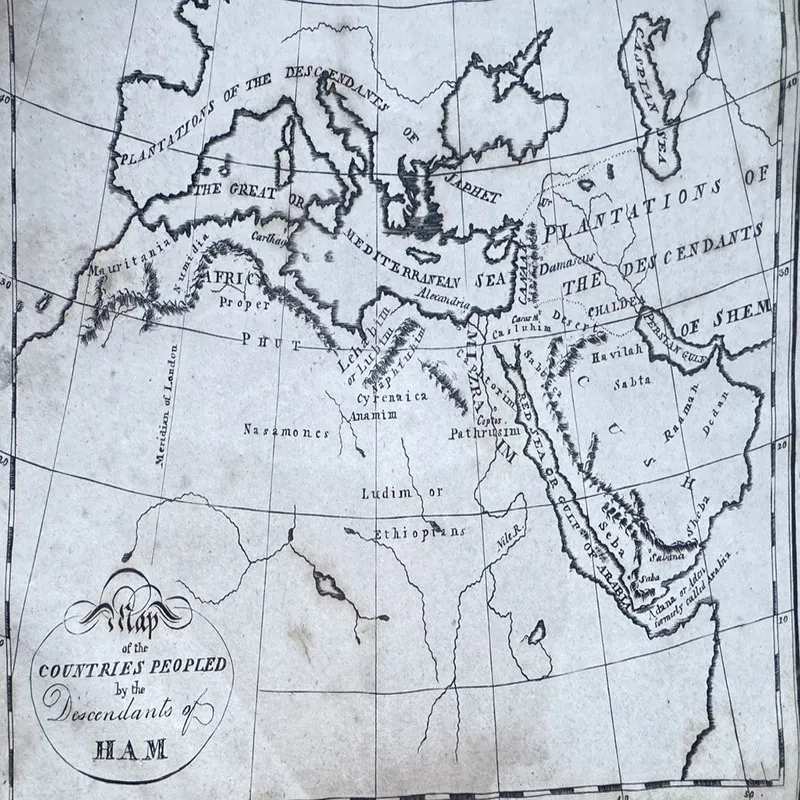
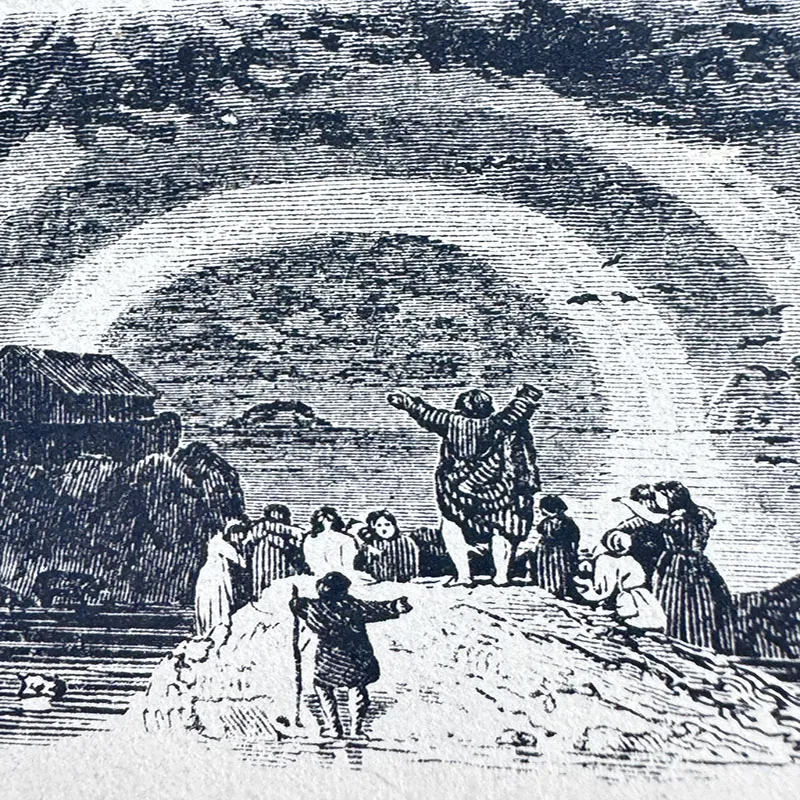
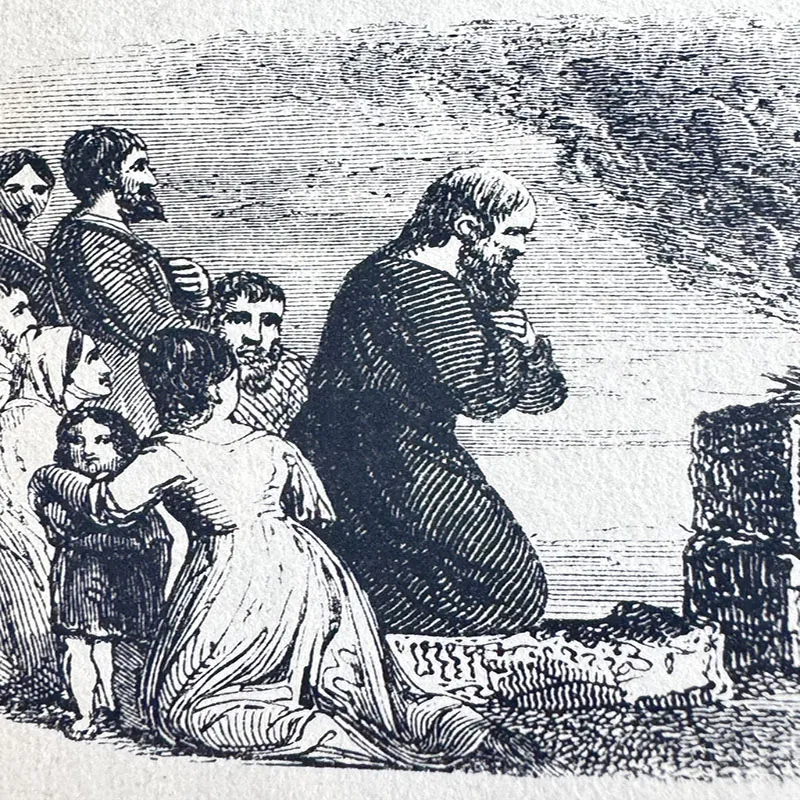
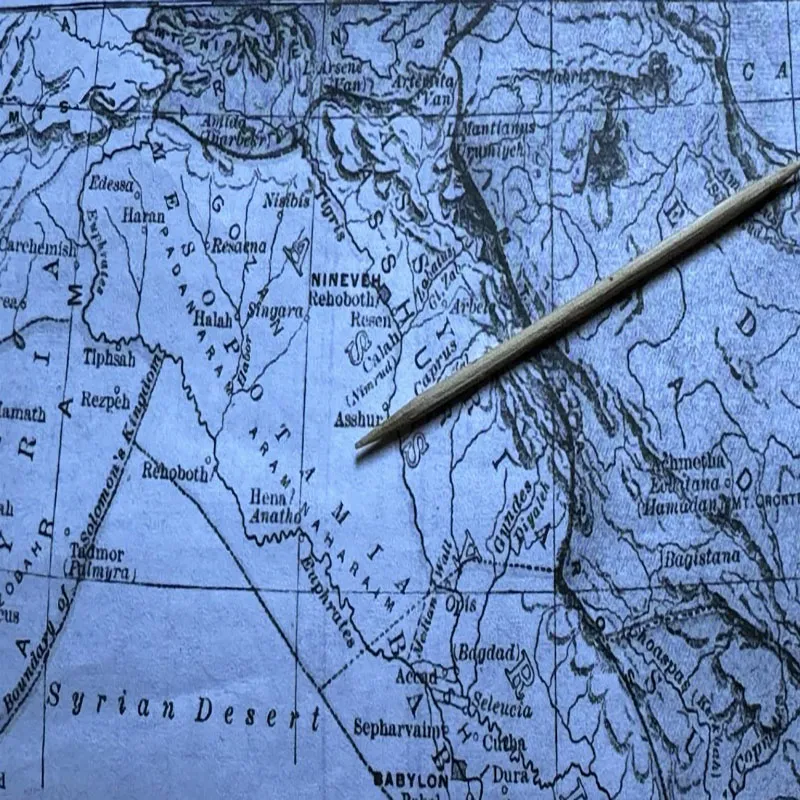
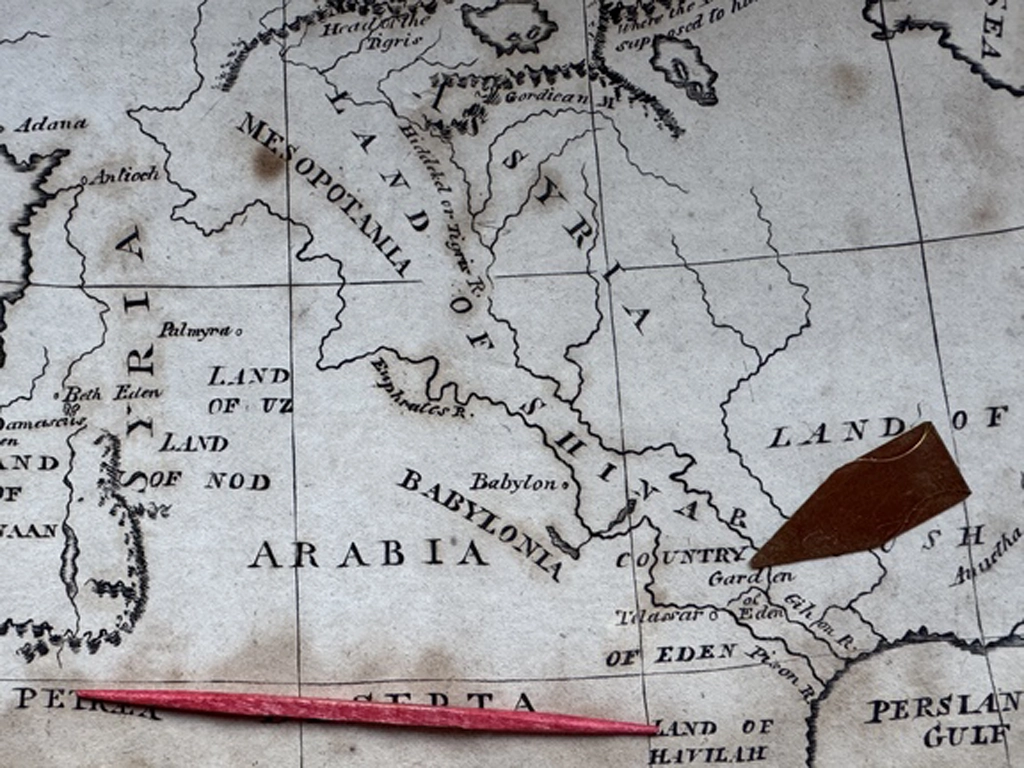
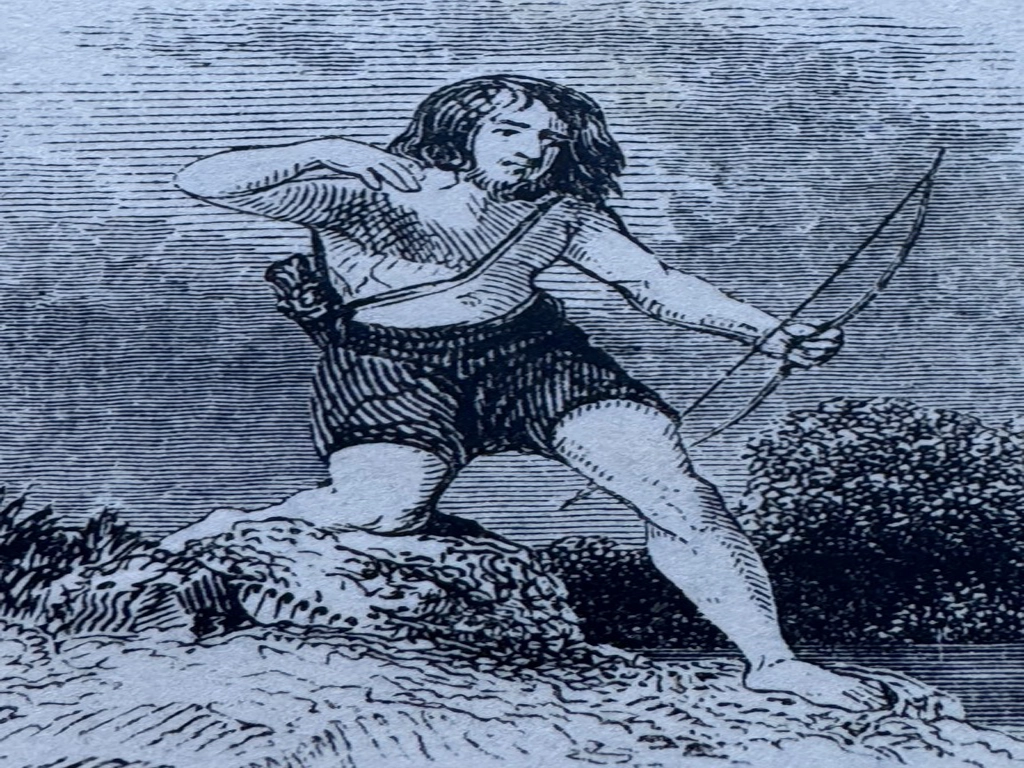
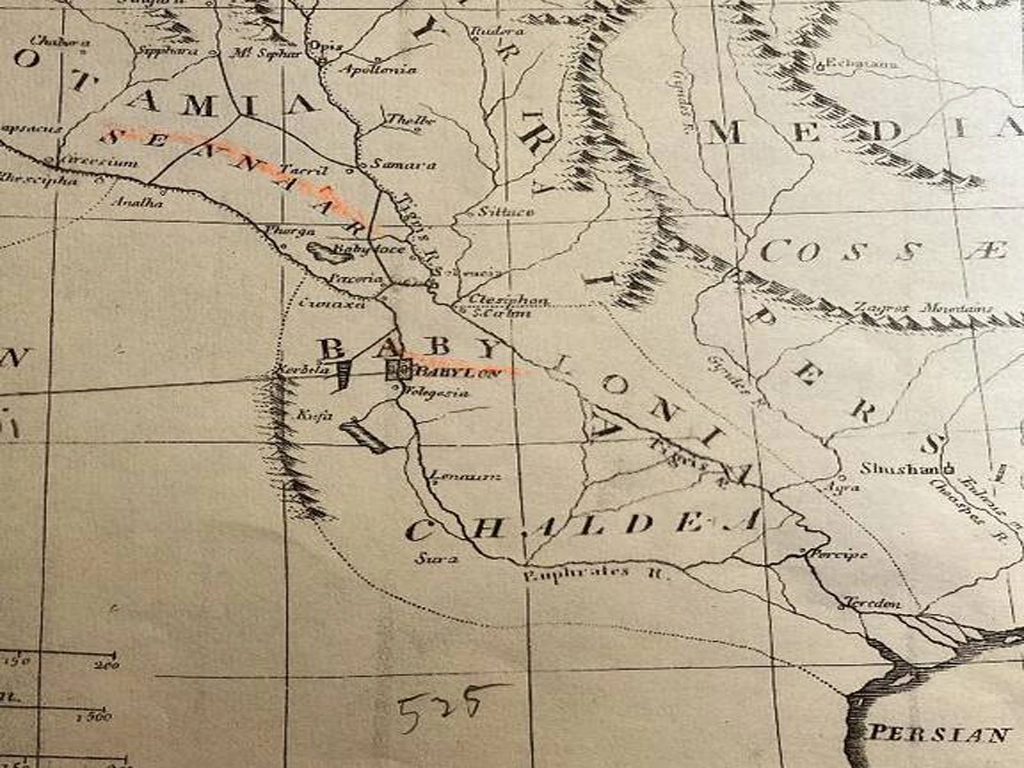
Dearest Readers: do take special notice here. In this Epistle lies your family tree! You, Dearest Child of ELOHIM, are a direct descendant of the line of Noe and his family and of nowhere else. Your bloodline begins somewhere here. Absorb and learn this undeniable fact.
v.1
These are the generations of the sons of Noe:
And children were born to them after the Flood.
The children of Japheth:
Moreover, the children of Gomer:
And the sons of Iauan/Jaran:
Of these were divided the Isles of Nations in their countries, each one according to his tongue, and their families, in their nations.
Isles of Nations
The Isles denotes the coasts of the settled nations, otherwise known as, Gentiles.
according to his tongue
Nemrod’s Babalian Tower was not the birth of different languages. Tis this Epistle in which we are taught the difference in languages originated when the descendants of Noe separated farther from each other across the globe: thusly, the birth of different languages.
v.6
And the sons of Cham/Ham:
Chanaan shall be a name repeated throughout the Liturgy as well as the Apocrypha.
v.7
And the sons of Chus:
The sons of Raamah/Regma:
Moreover, Chus begat Nemrod. He began to be mighty in the earth; and he was a valiant hunter before our Lord.
before our Lord
Meaning, in the sight of HE WHICH IS, who absolutely cannot be deceived.
Chus begat Nemrod

map #1: presumed locales of Eden and Havliah, the 4 rivers, Babylon
Who was Nemrod? Have you ever been called a nimrod, or heard someone being called the name? Tis defined as someone who thinks and executes big, very big, only to fail in the end. As best as i can piece together, for now, generally, Nemrod is:
Twas Nemrod’s belief Babylonia would be a nation that would not have to cater to QUI EST, or His Commands, or His Princes. Babylonia would also provide a safety line for Nemrod and his followers in case HE WHICH IS decides to Flood terra again.

map #2: Mt Ararat=lt blue, Tigris R=blue, Babylon=yellow, Persian Gulf=red
Nemrod became known as a valiant, or a, violent hunter. This giant-of-a-hunter falsely and forcefully brought many people under his dominion and command. Through his speeches Nemrod was able to arouse pride in hundreds of people. He was also able to stir contempt for GOD. This valiant pounded into the brains of the weak-minded that they were not beholding to ELOHIM for current happiness. Nemrod avouched mankind was beholden to only his own virtues. And, if the people would fall from heavenly Father, Nemrod would offer himself as their leader. He would even help against a new Flood!
As citizens succumbed to the words and promises of Violent Hunter, thusly began the first reign of tyranny on terra. With his dramatic increase in popularity, Nemrod decided it was time for him to be identified under a new moniker: Saturnus. Twas then Saturnus accounted hisself as a god equal to QUI EST!
After the rule of Saturnus, his son would then grasp the reigns. His son was known as, Beius Jupiter. The reign of Beius was 65 years.
Ninus would follow Beius. Ninus became the first king of Assyria {see our story on Judith via the Apocrypha for more info on the Assyrian empire}.
i believe the primary motivating factor for this giant of a man is the creation of a city opposite to the City of GOD after the flood. i’m not mainly inferring geographically. Even though, if the City of GOD is located northwest of the Persian Gulf where the 4 Rivers begin–or even father south to what’s known as, the Land of Havilah, which is directly west of the northern Persian Gulf–then the land of Babylonia is indeed geographically opposite. For, Babylon is precisely northwest from the City of GOD about 350 miles. And, being Noah’s incredible ark grounded in the Gordiean Mountains of Armenia {today, this territory is a part of Turkey}, then all of this monumental activity by Nemrod in Babylonia takes place about 275 miles south of where the Ark landed! Most certainly the Hiddekel River, better known as the Tigris, was the primary route of travel for Nemrod, et al. {BTW, there is a Babylon in northern Egypt but it’s not part of Babylonia and she’s certainly not the city to which Moses refers–for, Babylon, Egypt had not been founded yet}
v.9
Thereof rose a proverb: as it were Nemrod the valiant hunter before our Lord.
quasi Nemrod robustus venator coram Domino
san ton Nevród, énan dynató kynigó enópion tou Kyríou
even as Nemrod the stout hunter before the Lord
This adage of the time most certainly writes and sounds better in the 3 ancient tongues. Have you ever hear or been called, crazy as a loon, or strong as an ox? These sayings are brief and memorable because they were initiated in the English tongue. Henceforth, during the Second Age of Homo sapiens, specifically the era of Nemrod, an equally memorable saying was, even as Nimrod the mighty hunter before God. i’ll put this in context for you. Let’s say you’re a young lad with instructions to till an acre of the family farm inundated with nasty shrubs. You’re also directed to finish this chore in 3 days instead of a week. Thusly, you go out there with your food, drink, mule, and trade tools because you’re a motivated son who will do what you can to save time–even taking your meals with you to work. Your family comes out there about 2 days later to see you removing massive shrubbery about! Your mother tells your siblings: See that? Your brother’s tearing through that field even as Nimrod!
Is it not so interesting knowing the details of your roots, and of which of Noe’s 3 sons your bloodline is from?
v.10

map #3: Babylon in the territory of Sennaar
And the beginning of his kingdom was:
–in the land of Sennaar.
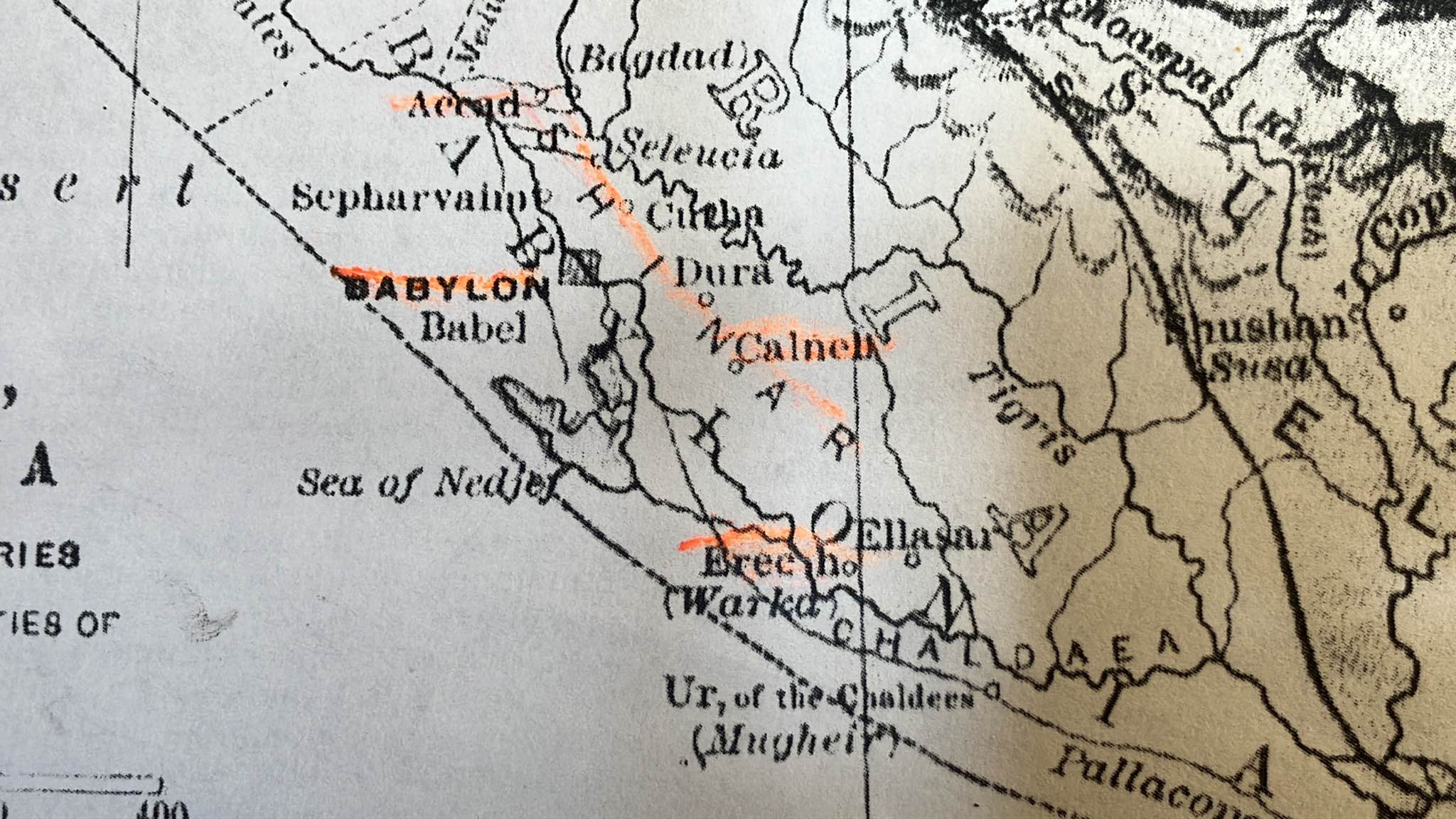
map #4: Babylon, Accad, Erach and Calneh
Map #3 reveals the nation, Sennaar/Shimar, which becomes the first nation developed by Nemrod. Tis Shimar that acts as a bridge between Mesopotamia and Babylonia. Note the bottom right corner of map #3 where the Persian Gulf lies. Closer examination reveals the mighty four Edenite rivers branching out of the northern Persian Gulf. This region is the supposed location of the City of GOD. As one can see, Nemrod was dead certain on creating a civilization opposite ELOHIM’s City: physically, morally, socially, spiritually, and, economically.
About 750 miles south of where Noah’s ark grounded is Babylon. Tis here where a great grandson of Noe, Nemrod, the sensational orator and motivator, migrated an army of people to. To support this future city Nemrod smartly secured a few neighboring communities (map #4):
Accad – north of Babylon about 100 miles
Erach – south of Babylon about 220 miles
Calneh – east of Babylon about 75 miles
As you can see Nemrod had the incredible foresight to carve out his own niche in order to rule within the territory he staked a claim to, Shinar. The area of Babylon, Accad, Erach and Calneh covered, minimally, an impressive 620 linear miles! This bullish tyrant, now known as Saturnus, has acquired a taste for power; yet his rulership is just getting started!
v.11
Out of that land came forth Assur and builded Nineveh and the streets of the city, and Chale. Resen also between Nineveh and Chale–this is the great city.

map #5: Nemrod’s incredible empire
Assur and builded Nineveh
On map #5 you’ll find Nineveh in the kingdom of Assyria. Rehoboth is south of Nineveh. Resen is south of Rehoboth. Lastly is the fantastic city of Calah, which is below Resen. Examine these cities more closely. Nemrod wisely chose their specific location because they are all along the splendiferous Tigris River. The Tigris was vehemently used for commerce, trade, transportation, and later for mobilization of an army. To have all of his cities unified on the same river is a tactical stroke of genius. Nemrod was certainly a thinker and an unmatched planner.
In the original tongue Liturgies, this Verse is written as:
De terra illa egressus est Assur, et aedificavit Niniven, et plateas, et Chale.
(Out of that land came forth Assur, and builded Nineveh, and the streets of the city, and Chale.)
Did you note the discrepancy? In the Book of Judith you’ll learn that it was Assur of Assyria who built the fabulous bustling city of Nineveh, not Nemrod. So, who’s correct: Moyses or the author of Judith? Tis pretty difficult to side against Moyses, personally.
So… who built Nineveh, Assur or Nemrod? Or maybe even Ninus? This is yet another point of dissension and even acrimonious debate amongst writers, doctors and other learned persons.
The next obvious query would be, who is Assur?
You’ll later learn Assur is the son of Sem. A group of scholars and writers ascribe to the following: Assur built the city & put it on the map. Afterwards, the ruler of the Assyrians about this time would be, King Ninus, of Cham’s race, enlarged, enriched, and even changed its name to, Ninuni. Another group of learned individuals claim: Assur signifies the king of the Assyrians. Ninus is the son of Belus. Pursuant to conclusive Greek and Barbarous histories, Ninus was first to reign over the entire land of Asia. Being he was amongst the Assyrians, Ninus built and dedicated an entire city in his name, Ninum.
The Hebrews referred to Niniue by another name: Nineveh. Thusly, t’was Ninus who established a monarchy of the Assyrians and became renowned as, The Golden Kingdom. The Golden Kingdom remained intact for an astonishing 1,240 years! During this era Ninus established his father, Belus, as a god to be honored. With that, Babylonia became the birth place of false gods.
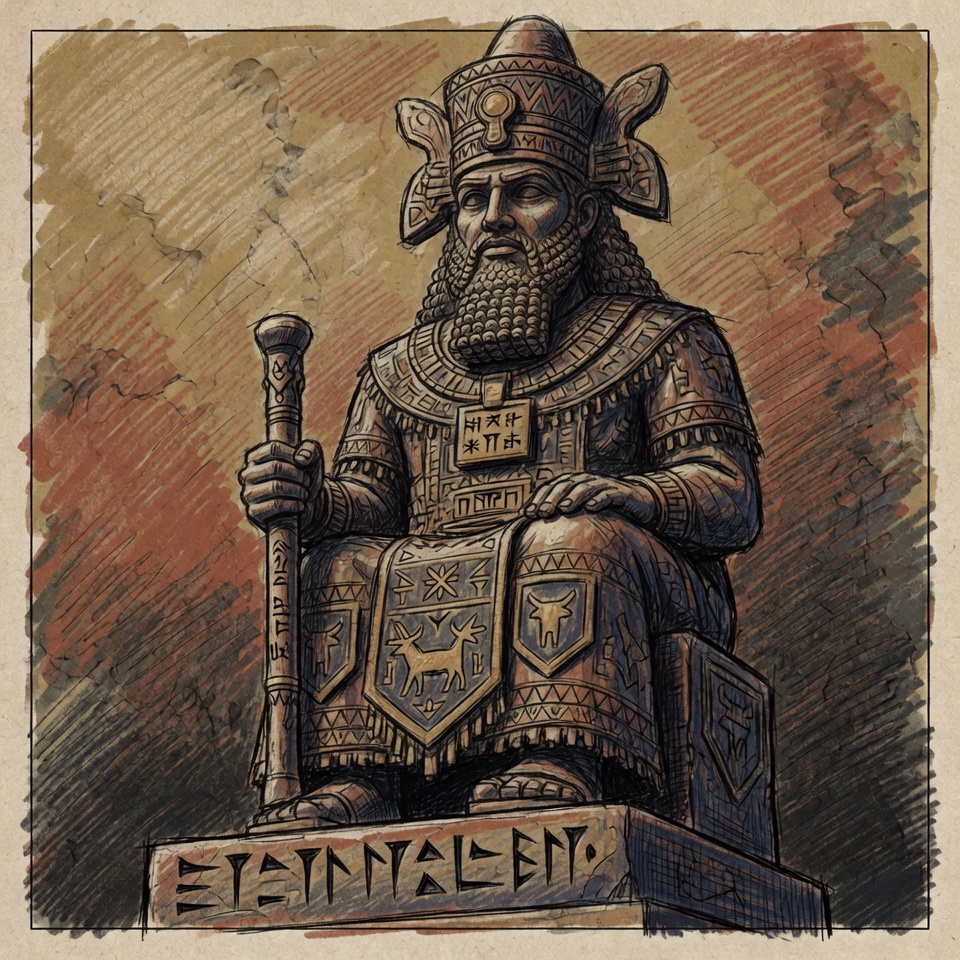
Babylonian god, Bel or Belus
During the time of the Golden Kingdom, Babylon became the swiftest growing city with the erection of altars, statues and temples. They were constructed to celebrate and praise the god, Belus, or Bel. However, you must understand that Bel was not the only false god to be worshipped by the Babylonians.
Other Heretical gods during the Second Age of mankind included the following:
Like a spark igniting a dry valley of grass, Bel’s implementation spread relentlessly to other peoples in other nations. Each one copying the other’s Heretical worship. This theological infection repeated itself yet again when mankind developed his own forms of religions based on the life and teachings of JESUS CHRIST. i validate this with the practice of over 2,000 Christian religions and another 500 non-Christian beliefs abounding terra today. Yet, understand not one of these men-invented beliefs has the longevity of QUI EST’s Religion nor do they have the historical documentation and traditions of Heavenly Father’s Spouse–not one! Mankind is stubbornly too obstinate to learn from his historic mistakes regarding QUI EST.
v.13
But Mizraim also begat:
Mizraim is Ham’s second born; whereas Canaan (below) is the 4th son to Cham.
v.15

map #6: the 7 primary nations of Chanaan
And Canaan begat:
–and afterwards were spread the people of the Chananites.
Noe’s Prophesy:
Cursed be Chanaan, a servant of servants shall he be unto his brethren. And he saith, Blessed be the Lord God of Sem, Chanaan be his servant. God enlarge Iapheth and dwell he in the tabernacles of Sem; and Chanaan be his servant.
Examine map #6 and you shall see the 7 primary nations that comprise the land of Chanaan. Albeit the number alters between 6-7 throughout the Books of Moyses and afterwards, these nations become enemies to HE WHICH IS, His earthly Church, and to His followers–mainly the descendants of Iacob. With Noe’s curse on his grandson, take note to identify which of Chanaan’s 11 children shall become enemies to Heavenly Father:
Chanaan and 5 of his sons, sadly & tragically, not only besmirch the bloodline of Noe but become antagonists to the one Individual that is exclusively responsible for them being alive: QUI EST. And because the Perizzites referred to those persons who dwelt in the open country, i’m most certain Chanaan’s other children, at least one of them, were amongst these citizens. Perhaps the Liturgy shall later provide us evidence of this hypothesis.
v.19

map #7: Chanaan limits. Sidon=lt blue, Gaza=purple, Gerar=pink, Sodom=red, Gomorrah=orange, Seboim=aqua, Adama=green, Lasa=blue
And the limits of Chanaan were from:
These are the children of Cham in their kindreds, and tongues, and generations, and lands, and nations.
limits of Chanaan
Refer to map #7:
↳Sidon–is very north along the Great Sea shoreline. Sidon is the birthplace of Chanaan begun by Cham and his sons.
↳Gerar–is opposite of Sidon as it’s all the way south and inland from the Great Sea’s coast.
↳Gaza–one of the most renowned southern cities of Chanaan.
↳Sodom, Gomorrah, Admah, Zeboim–the precise area of where these cities were located is unknown. The map reveals the generally agreed upon locales of these cities about the Vale of Siddim.
↳Lasha–along the Jordan River on the northern tip of Vale of Siddim. Lasha is excluded above because she is generally agreed to be farther removed from the Salt Lake but along the river Jordan. Albeit the specific location of the 5 cities is unknown, one can travel to Syria and witness for yourself human statues of salt and carbon–in Syria not adjacent to the Siddim Vale! Still, other researchers have these cities located similarly to Lasha along the Jordan.
v.21
Of Sem also, father of all the children of Heber, the elder brother of Iapheth, were born.
father of all the children of Heber
S Augustine deduces the people of Israel were called, Hebrews, because of Heber.
v.22
The children of Shem:
The children of Aram:
And Arphaxad also begat:
And to Heber were born two sons:
Heber’s first son, Peleg, was birthed when the earth’s languages became significantly divided, not naturally and progressively as before. Therefore, the son was named Peleg because it’s defined as, division. Peleg=Division.
v.26
The which Iectan begat:
All these were the children of Joktan. And their dwelling was from Messa as we go on as far as Sephar–a mountain in the east.
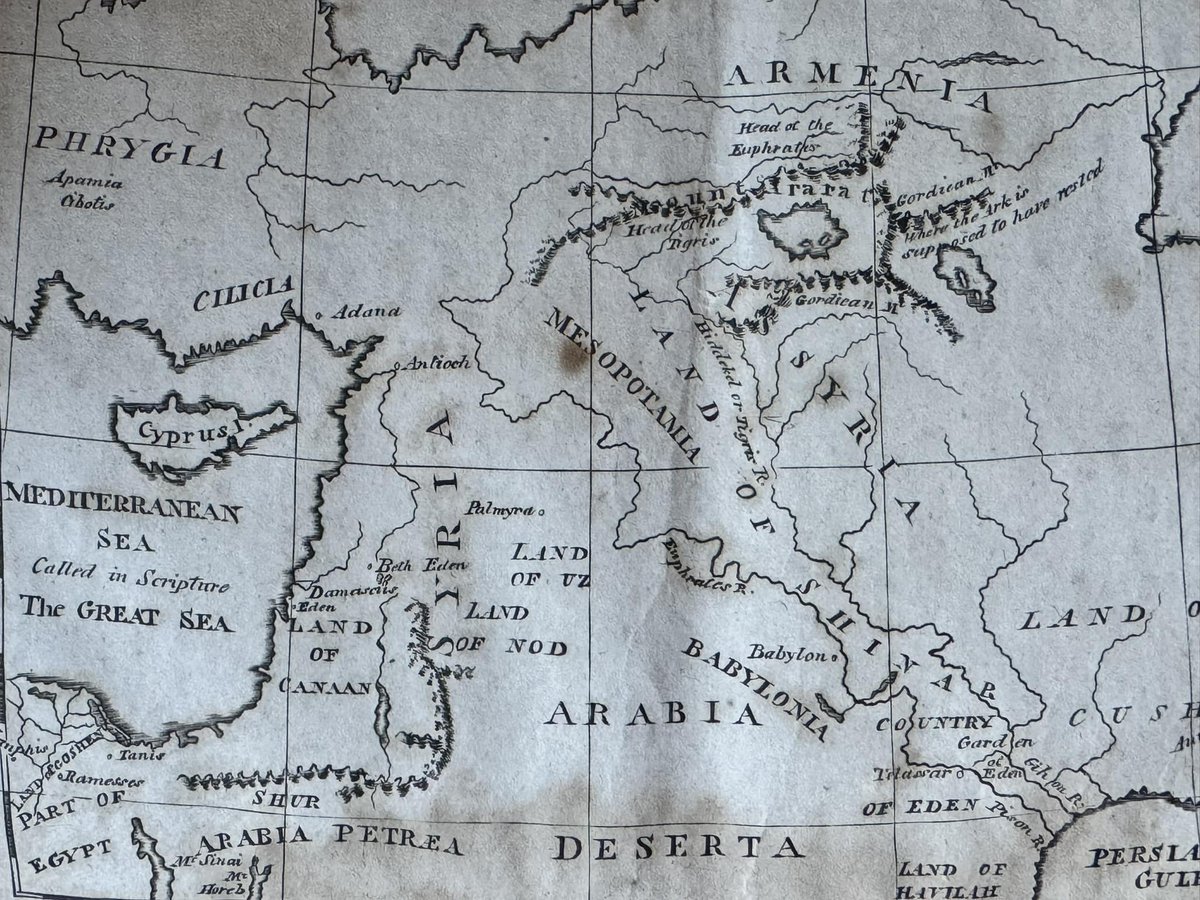
map #8: Land of Sennar
Map #8 offers a glimpse of the Sennar territory with Messa being west of the Saphar mountains in the Sennar territory. Tis Joktan, Peleg’s brother, who is the father of the 13 offspring who dwelt here.
v.31
These are the children of Sem according to their kindred, and tongues, and countries in their nations.
These are the families of Noe according to their peoples and nation. Of these were the nations divided on the earth after the flood.
children of Sem
Sem, recall, is the first-born of the Prophet, Ark builder, and husbandman, Noe.
nations divided
HOLY GHOST phenomenally Blessed Noah with an extensive flourishing seed. Verse 31 evokes a few points worthy of discussion. We begin with the 13 male-infants begotten by Joktan. The Gospel shall later enlighten you on the 12 Tribes of Israel. For now, amongst these 12 Israeli Tribes one of them, Manasses, will be split 50/50 to form 2 separate families. Henceforth, Joktan’s 13 seeds could very well act as a harbinger to the 12 Tribes of Israel. This especially since half from the 13th son, Iobab, along with another half from one of the first 12 sons equals a complete dozen.
The aggregate of offspring from Noe and his sons tallies, 72. This total could represent the number of languages formed at Babylon. Writers and biblical scholars have been at odds with the number of nations and languages that instantly formed after the fall of Babylon’s tower. Whatever that number it’s certain there were just as many languages as their was nations. But to clearly calculate 72 tongues is difficult. One reason is this 10th Chapter does not identify 72 languages. Nonetheless, 72 nations and languages may probably be calculated using this Epistle and others throughout Genesis. Let’s quote S Jerome:
Nevertheless, if we add certain that began distinct Nations afterwards, til Jacob with his children went to Egypt–in whom only the Hebrew Nation and tongue continued to Christ’s time, the number will come right.
Let us ourselves calculate to see what number we sum. As stated earlier there’s contention as to whether or not 72 nations are correctly calculated. Most biblical experts feel the number of languages and nations, 72, can be here calculated, along with other places in Genesis. One can validate this as we explore the Book of Life–Genesis. Until then, let’s engage in some addition:
Shem also fathered 4 other sons, who were the initiators of more nations:
Let’s now summarize the tally:
This adds to 66. Later in Genesis the others will become apparent. For now, i present a general overview of the remaining 6 nations:
66 + 6 =72. You’re now cognizant of everything the experts know about the sons of Noe and the first 72 Nations. Whether this is what Moyses/HOLY GHOST intended remains to be discovered.
©2026, Brother Sebastian of Shepherd Corps.
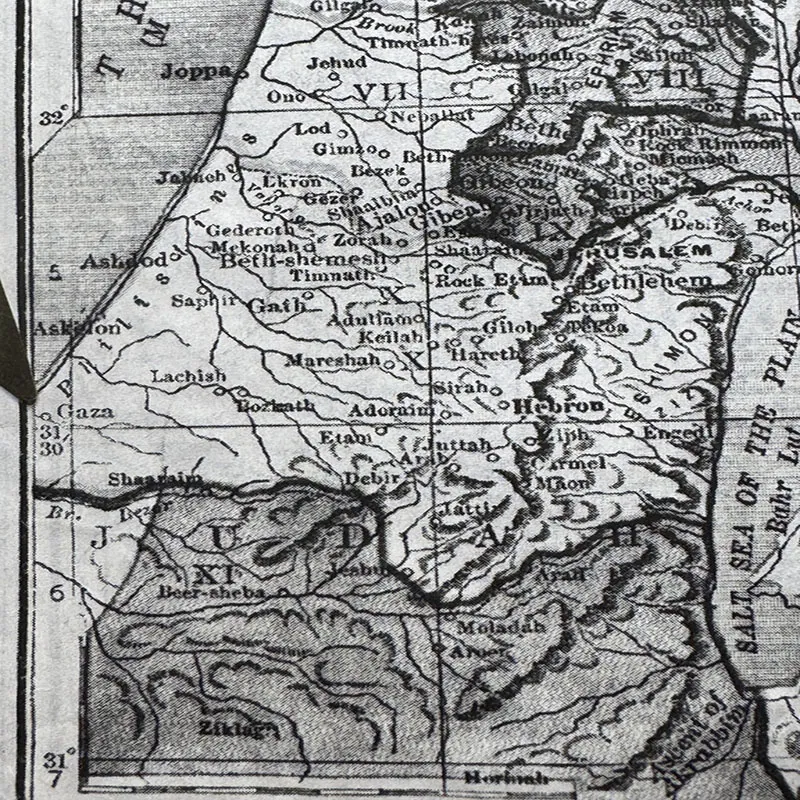
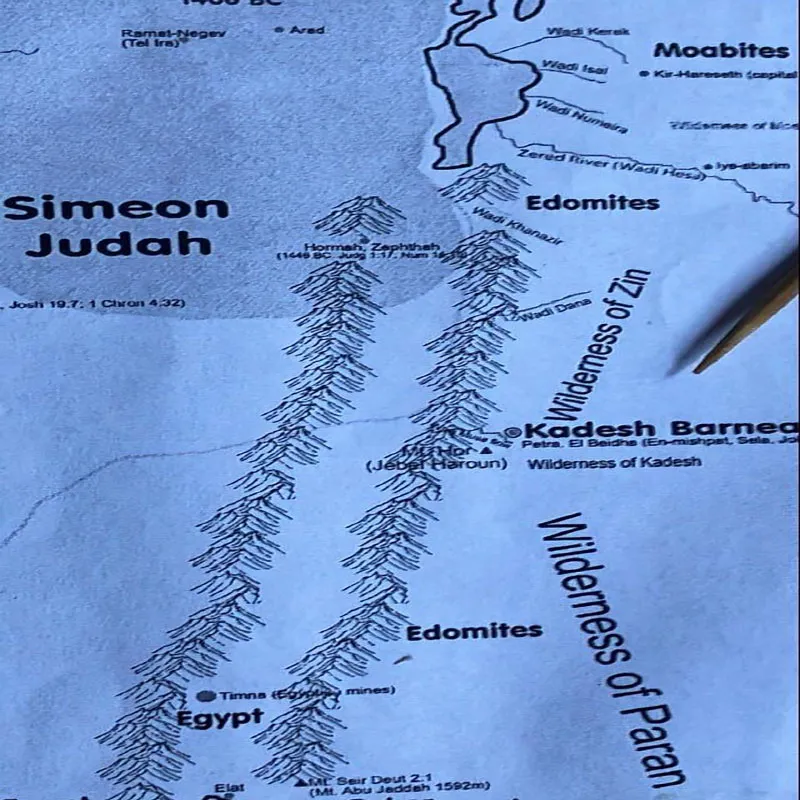
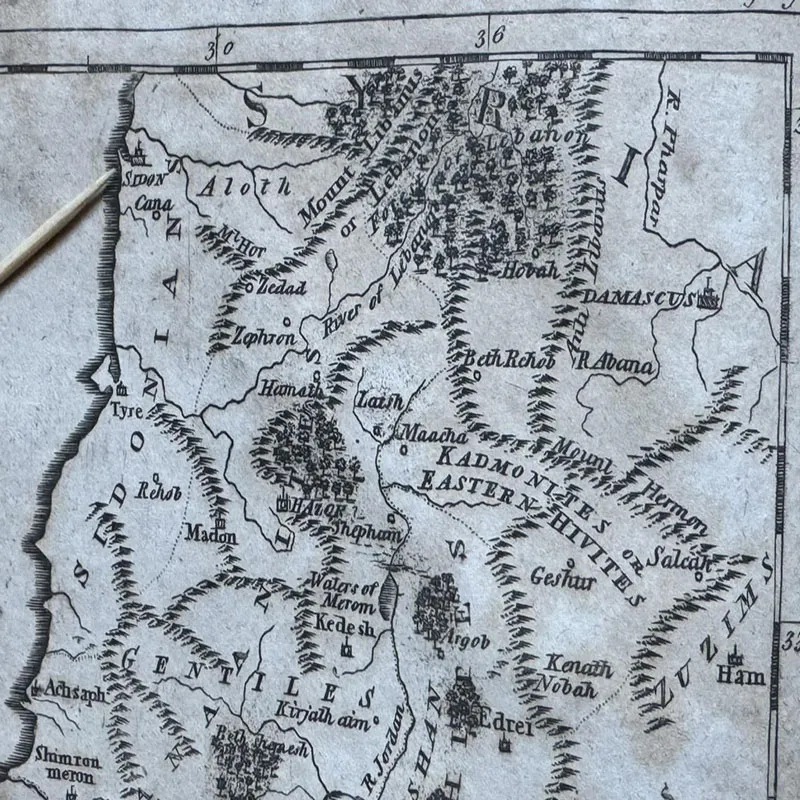
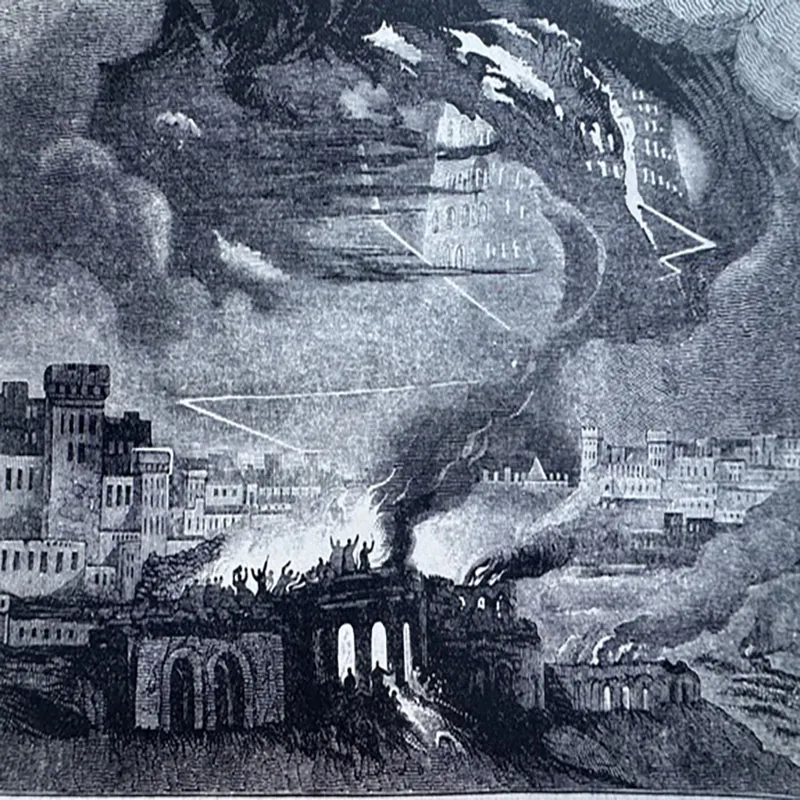
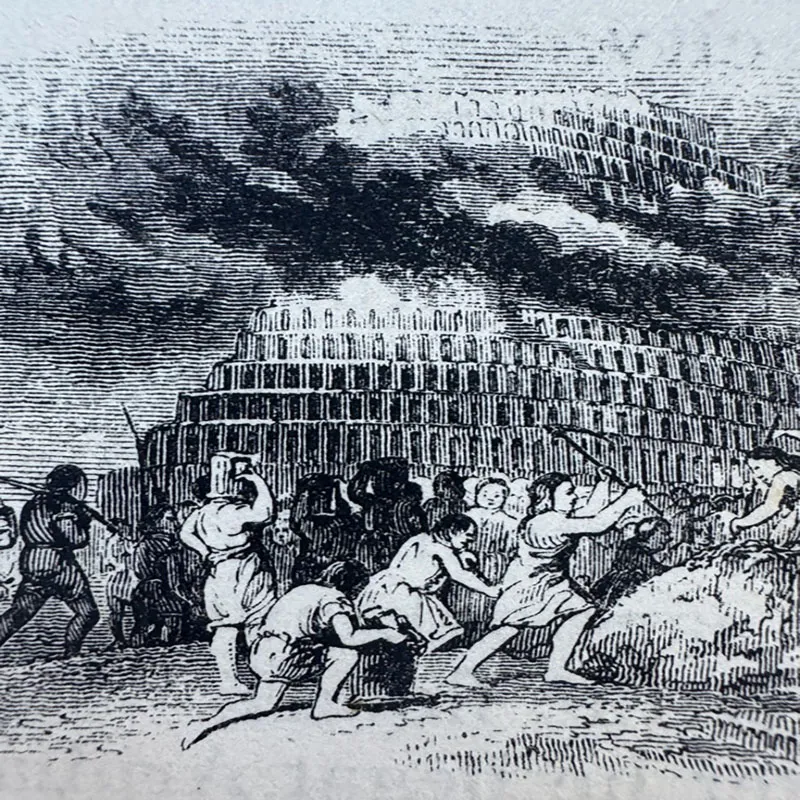
The Second Age of Mankind reflects an era spanning 368 years. It begins with the Flood and ends with Abraham going forth of his nation. Herein i shall attempt to portray the state of Religion during these three and a half centuries. In conjunction with this i’ll also include the continued existence of GOD’s Spouse. A Church which began ruggedly, yet simply, with Eve and terra. Henceforth, this same earthly Church seeded by Adam and Eve during the First Age continued, undoubtedly and uninterruptedly, through the Second Age. Such a nonstop existence, however, under the following considerations:
All of this is accepted for the sincere professors of the true Religion of HE WHICH IS. Similar to the First Age, here i shall again identify the driving points of Religion both practiced and professed during this Second Age.
Admittedly, the continuation of Father’s Church during Age 2 is conspicuous. However, what is practiced in this era is represented by a continual, known, visible company united in one mystical body. And, as Religion and Church progress, albeit rockily, they in fact do grow, strengthen and mature. Concomitantly, be advised, so too does darkness! Meaning, whatever maturation and growth that occurs with Light in this Age, the same unfolds with Darkness. A universal equilibrium, so to speak. After all, to comprehend the Liturgy one must learn about Darkness as well as Light. This so you can recognize and identify the difference between the two. Such recognition shall allow you to freely and wisely choose the path you have the free ability to choose–no matter the form of man’s government you reside under/in.

Light vs Dark
As the unification in one unworldly mystical body was constantly building throughout the Second Age, mankind was offered an alternative. This was an invention by man that provided an alternative to fearing QUI EST, or another Flood by an Entity mankind can’t see or hear. This actually shall be a redundant theme that will occur throughout the Old Testament. A temporal pattern in which Homo sapiens {past-present-future} constantly push alternatives to the Word of GOD. The various religions plaguing terra today is a supreme example: from Protestantism to Neo Judaism to Islamism to even Satanism. Each one exults to be right and the others wrong because man is foolishly stubborn, vain, gullible, and prideful. Ever since Nemrod mankind has been so easily swayed by the new thing no matter how contrary to the flawless Word of ELOHIM. Yet, every religion initiated by man pales in longevity to that of ELOHIM’s! Such temporal alternatives for mankind have become the primary reason the wicked emerged everywhere at an alarmingly rapid rate–and in vastly incredible numbers! And as Evil was doing His very best to anchor earthly footholds whenever and where ever, He also strived to oppress good–to stop the Light. Even though Evil did succeed at oppression, It failed, nonetheless, at suppression. Which leads me to share with you a dictum worth remembering:
Evil will always oppress; through JESUS It will never suppress.
And herein now i share with you a physical sign… a salute, if you will… for which we, as Evil Suppressors, can recognize one another:
Cover your heart with your right hand and display three fingers.
XI. Abstinence from Blood
During our Second Age of humanly existence the heavenly Precept to no longer eat blood was provided.

draining blood from the meat to be consumed
XII. Clean and Unclean Beasts
Noe observed the distinction between clean and unclean beasts, as he wouldn’t have made it a point to identify these beasts as they entered the Ark. i suggested before, one of the reasons seven pairs of certain creatures were loaded into the Ark could have been due to the seven continents that would be formed after GOD’s Flood. Nonetheless, the most endearing reason for seven is because of the Sacrifices that were to be made by Noe as QUI EST’s Priest. Such Sacrifices were peculiarly and deliberately made prior to the Flood; therefore the same would be required after the blessed global catastrophe. This would mean Noe was commanded to take more of the clean beasts, which was seven, onto the Ark than unclean–five. Keep in mind clean and unclean is not the same as good beasts and bad beasts. Clean from unclean strictly pertains to what heavenly Father Considers to be which of His living creations are the purest for sacrificing to Him. It has been misinterpreted by Hebrews and others today as what to sort of meats can be ingested to remain pure in spirit. This is absolutely false and i shall provide proof as we advance through both Testaments.
XIII. Penance
Much attention was directed to sin and wickedness in the previous Epistles. It shouldn’t be a shock that Noe, known as the Preacher of Justice, admonished all sinners towards repentance. After all, the Prophet did punish his son, Cham, and grandson, Canaan, through his curse during their future posterity–which was so divinely predicted. And let’s recall QUI EST’s Exchange with Cain: He specially threatened to exact the blood of man unjustly shed. Consequently, GOD did so with Cain and just as He is doing so with Noe and his family. There is also some punishment Inflicted upon the builders of the Babal tower in the form of confounding their tongues and scattering the human race to the four winds.
XIV – XV. Resurrection and Judgment
Which punishment in part, and threats of more, import a general resurrection & judgment, where all things shall be exactly discussed and judged.
XVI. Eternal Felicity or Pain
What follows after mortal life is either eternal life to the good or everlasting pain to the damned.
XVII. Clear and Visible Church
An interesting fact is that the 16 previous points were all taught by Noe and his sons! Therefore, this positively validates a visible and clear Church. A Church consisting of both the good and the bad, precisely like today. Additionally, there is one continuous element the Liturgy does address: the bad, as it exposes mankind’s weaknesses, for a temporal life. Noe, on the other hand, remained the same, good, spiritual liaison (Priest) between HE WHICH IS and man after the Flood precisely as he did before It. Sem and Japheth were both blessed and condemned for doing well. Ham was blamed and cursed in his posterity. With these factors presented, keep in mind nothing in Scripture, or authenticated testimony, reveals any of the offspring of Ham succumbing to Heresy–or infidelity. Of all the events that you shall digest from the Liturgy, both wonderfully good and treacherously bad, no matter how dark the times came for Father’s Church, always some good arose. The Heber {of which the term, Hebrew, is birthed} kin, in fact, is one family in particular who Moyses commends. Although Sem had a multitude of other carnal children, it was Heber’s family that became the true spiritual children of Sem. Of course, there were certainly other innocents during this Age {just like innocents existing during the Flood}. As a matter of fact, only Heber and his descendants retained the same language and dialect after QUI EST Cursed Nemrod and his followers! Further iteration is provided by Saints’ Chrysostom, Augustine and Gregory:
—the family of Thare, albeit not all, or not always, yet ever some of them, and Abraham continually, with Sem, Heber, Phaleg and many others not mentioned by Moyses, were just and kept the true faith and undefiled Religion of our Heavenly Father.
Sensationally eloquent, yes? Not being recorded in any history is meaningless to ELOHIM! Make no mistake of this as GOD already is omniscient. After all, who else do you truly have to impress other than your Judge… your Father… your Creator?
XVIII. Arch-Heretic
The Arch-Heretic during this Age is the son of Chus, who also is Cham’s nephew: Nemrod. And as written earlier, Nemrod is described as the following:
The 11th Chapter begins section four of Genesis by HOLY GHOST & Moyses. Herein we explore the division of nations and languages.

map #1: Noe’s family migrated to Shinar
And the earth was of one tongue and all one speech. And when they removed from the east they found a plain in the land of Sennaar, and dwelt in it.
when they removed
They refers to the family of Noe. The Noe family of eight were the only humans alive on terra, as penned in the previous two Epistles. Moyses writes that Noe’s family traveled east to the Shinar plain. Because of where Noe’s Ark grounded, i believe the direction of travel is more accurately described as south easterly {as in the direction of the Eden nation} than easterly.
v.3
And each one said to his neighbor:
Come, let us make brick and bake them with fire.
And they had brick instead of stone, and bitume (tar) in lieu of mortar.
And they said:
Come, let us make us a city and a tower, the top whereof may reach to heaven. And let us renown our name before we be dispersed into all lands.
let us make
i will identify the steps taken by Nemrod that elevated him as a source to be reckoned with by man:
Understand that it didn’t matter what Nemrod and his captains told potential followers because their primary intent was to make themselves famous, great, and strong for the present and famous to posterity. This precise reason is actually the seed of the 2500+ Heretical religions plaguing earth today. Every single one of these man-formed religions began with pride then inflated to a sense of self-importance, and on and on and on.
QUI EST’s Spouse has withstood the tolerance of time and the wickedness of man both within and beyond Her bounds. The thing to remember is what happens to these leaders in the end. And we have recorded history to resort to. In the end, for so many Heretics like Nemrod, GOD overthrows them, neither suffering them to build up their imagined castle of strength, nor to be praised for their work, but made them infamous to the world’s end. Heretics and egregious citizens prosper for a while but are certainly confounded in the end. 😉
As i wrote earlier, disobedience was the first sin that dwelled heavily in mankind. And it’s disobedience that, yet again, resurfaces during the era of Noe which leads to earth’s destruction by way of a Flood. With this renewed life through a baptismal Flood, man became guided by a sin that remains prevalent today: pride. Pride is the guaranteed cause and impetus for Heresy and Schism. Nemrod’s tower is an overkill example of such pride but one that certainly garnished the attention of our heavenly Father. One could say t’was Nemrod who became the ultimate parent of Schism and Heresy via pride.
Readers, know that with children and adults alike disobedience overwhelms society. Younger generations continue to ignore and disobey older or wiser generations. Look about your own community or even your state rep. If only such wisdom and experience would be heard and obeyed. With Nemrod we can see the absolute most common causes of Heresies–even the manner of which such Heretics proceed. Nemrod, the Great Hunter, possessed a subtle, proud and aspiring mind. And like a cult or Heretical religious leader today, his or her greatest influence is over the simple-minded. Don’t believe me? Do a character study on the participants of any contemporary false preacher or cult.
v.5

ELOHIM Visits the constructions of Nemrod and his followers
And our Lord descended to see the city and the tower, which the children of Adam builded, and He said:
Behold, it is one people; and one tongue is to all. And they have begun to do this? Neither will they leave off {become restrained} from their determinations til they accomplish them indeed.
ELOHIM Himself did not engage in this. Twas probably one or more of His most elite Angels who did this. Remember, as you comb and read through these discussions of the Bible, where GOD and man communicate, that no man, alive or dead, has seen the Face of QUI EST. That includes Heavenly Father’s best friend, Moyses. The closest this glorious Prophet was able to see was the back of ELOHIM’s head. And he did this being Protected by GOD and surrounded by impenetrable rock.
QUI EST’s last line in the above Verse you should find most engaging. GOD is Telling us He is already cognizant of man’s capabilities, stubborn mindset, and prideful ambitions. And since the time of Nemrod’s tower, ask yourself as you look around your home nation, or even the world… if much has changed since then.
v.7
Come, ye, therefore, let Us go down and there confound their tongue that none may hear his neighbor’s voice.
let Us go down
The Hebrew Linear Text capitalizes Us, whereas, the Catholic Bible does not. For, many believe, to include ample Hebrews, it was HE WHICH IS who descended upon Nemrod’s tower–3 Entities, 1 GOD. Tis my belief twas Angels that were Dispatched by QUI EST. GOD, in Dissipating this vain work of men, would use the ministry of Angels to Execute this.
Come, ye, therefore, let Us go down and there confound their tongue
i’m aligned with Augustine, Origen, Gregory and a few other biblical scholars when it comes to this Verse. These most insightful writers draw a point to GOD’s singular wisdom, justice, and mercy, with:
—so punishing the offence, that he turneth it to his own glorie, and the profit of all men: showing his power and souveraigne Majestie by two great miracles.
What these blessed scholars project to you is this: HE WHICH IS Turned man’s offense into something good. So, what are the two Miracles?
For the plethora of new languages Cursed upon the Babelites, the citizens instantly understood it, could speak it, and could even write it. The people did this as though each particular new language had been in the family for centuries! With this being affirmed not one person was given more than one language. HE WHICH IS did not Bless any one Babelite with the ability to comprehend more than one’s own newly assigned tongue. Not until HOLY GHOST Visits CHRIST’s Apostles does ELOHIM offer a key to this Curse identified here in XI Genesis. i share this to bestow upon you how precious the Apostles were to our King and how potent the HOLY SPIRIT is–nothing is impossible for QUI EST.
So, why did heavenly Father compel this division amongst Homo sapiens? i propose this query because division is a useful and profitable tool among evil persons. Just look at the divisions unfolding in all industrialized nations today because mankind did not heed the laws, precepts and traditions taught to us by the super Prophet, Moyses. And just after our forefathers became befuddled by QUI EST’s language Curse, they could do nothing but flee one another! They parted into sundry coasts of the earth, which they inhabited and replenished with distinct Nations, having {incredibly} the same Angels {as} their spiritual Patrones and Protectors, which had severally changed their language. Division, like war & conflict, is and has always been extremely profitable to especially spirited evil men. And since the age of the Living Testament, our Creator has not Granted such a division to any nation on this planet. Nearly every conflict since the time of JESUS has been thoroughly creation and confirmation of man.
Opposite of war and conflict, tis also extremely profitable for persons who have lived good & charitable lives. For, such good people have been, and are still today, constantly oppressed by the unification of many evil people and/or groups, but became relieved when their persecutors became d-i-v-i-d-e-d. Such good people and goodness included the family of Eber {Heber}. You see the Eberites, and GOD-fearing families like them, weren’t Punished as a group. Instead, ELOHIM Cursed only those who offended Him. For example, the change of tongues was inflicted for punishment, though it appeareth that Heber and his familie were innocent of the vaine attempt, whose tongue was not changed but remained the same. Further, of Heber evolved the Hebrew tongue for the sake of distinction sake, especially after there were many tongues which before had no distinct name: being the only original tongue of all men.
Like it or not, Reader, your ancestor spoke the same language as your neighbor, and so on. And that original tongue for all mankind was ancient Hebrew (Beresith). And since the Heberites chose not to help build Nemrod’s tower of Babel, we are provided with a superior example of only the offenders being Punished. With the rest of the citizens attempting to order each other around indiscernibly–of course, this is at GOD’s perfect conduction–fear and confusion drove these citizens away from each other and into different directions. S Chrysostom wrote:
If they had there more increased in number and strength, they would without doubt have attempted worse things.
S Gregory and others shared:
–and infinite man slaughter would have been committed amongst so many, for possession of that one city and tower.
The Church benefits from the gift of tongues. The same exceptional Fathers quoted above along with Saint’s Jerome, Augustine and other incredibles before us, go on to state that:
—as God wrought here much good by division of tongues, so he wrought much more by communion of tongues given to the Apostles, thereby enabling them to gather one Church of all tongues and Nations.
More exceptional proof that no man can ever know the Actions and Wisdom of HE WHICH IS! You see, a Curse from GOD doesn’t necessarily mean an evil thing bestowed upon man. Like with the Babelian tower event, GOD’s Curse forced a division amongst man. Yet, this cursed division eventually leads to a blessed unity–a unification of QUI EST’s Church. Because of our Savior, JESUS, GOD’s Church finally becomes the perfect Institution for all mankind. Nonetheless, the reason there are over 2000 Christian Heretical religions today has absolutely nothing to do with JESUS, His Apostles, or His Disciples. In fact, our King forewarned us such religions would evolve. CHRIST, our King, Created and Established but one Church only. Tis man who always complicates things with his stubbornness and inventive conclusions. And he has done this by copying, miming and exploiting the one true Religion begun with Adam and Eve and became finalized for all with CHRIST. Tis up to you to ascertain which Religion that is. Tis my hope the works of Shepherd Corps shall aid you in seeking your answer as we comb every blessed Word of Scripture.
v.8
And so our Lord dispersed them from that place into all lands; and they ceased to build the city.
In reference to an earlier discussion on the particular wording of a Phrase, come let us confound, if the Hebrews & others are correct that the Entity indeed was ELOHIM {the Trinity} and not Angels that descended upon Babel, then certainly either the HOLY SPIRIT or GOD would be written here, no? Instead, Moyses writes, —so our Lord scattered them, which allows one to conclude: t’was Angels that descended upon Babel and reported to our FATHER. Thusly, it was after the Angel’s report that our Lord Issues His ultimate command.
v.9
And therefore the name thereof was called Babel because there the tongue of the whole earth was confounded and from thence our Lord dispersed them upon the face of all countries.
because there the tongue
In fact, today the term, babel, is a verb in the English tongue that means: one that speaks confusingly and without understanding of what is said.
v.10
These are the generations of Shem:
Shem was 100 years old when he begat, Arphaxad, two years after the flood.
generations of Shem
i believe Moyses, here, is revealing the patriarchal succession from Shem to Abraham as he also did from Adam to Noe. Moses identifies this incredible and beautiful succession because this fantastic bloodline are the roots to CHRIST’s Church! You are now becoming familiar with the sensational beginnings of GOD’s Spouse–the Church of our most beloved Savior.
v.11
And Shem lived after he begat Arpaxad 500 years and begat sons and daughters.
Moreover, Arpachshad lived 35 years and begat Shalach/Sale.
begat Sale
Still, there are others that conjecture Chanaan should not be in the text of the Hebrew ancients. Pursuant to Hebrew and Latin renditions, along with the majority of prestigious Latin Doctors, Canaan is indeed omitted in this place as well as the Paralipomenon. Of most noteworthy is S Jerome, who exceedingly combed the Hebrew texts and concluded no mention at all of this difference. Tis a pity the Greek texts did not reach Hierom before he died. Even to this day this argument ensues. Nonetheless, officially, but for so much as all copies–Latin and Greek–along with S Hierom’s edition of S Luke’s Gospel, do have Canaan listed. The outstanding difficulty is this: there is the version of Moyses and there’s S Luke’s rendition. So how does this dubiety get resolved? Even Venerable Bede couldn’t reach a conclusion as he explains that S Luke uses rather the Greek testimonies versus the Hebrew. Whereof happeneth that I much marvel at, and for dullnes of wit, being strucken with great admiration, I cannot thoroughly scan, seeing in the Hebrew veritie are found only 10 generations from the flood unto Abraham, by what means S Luke, who {HOLY GHOST governing his pen} could in no sort write false, would rather set down 11 generations in the Gospel, Canaan adjoyned according to the 70 Interpreters. S Bede, in sum, with all humility could not understand. For being assured HOLY GHOST guided the pens of both Moyses and Luke, and that his isn’t contrary to himself, it must needes be true which each of them writeth, though other learned men can’t reach the profoundness of some difficulties that occur. And thusly here is where the Heretical English editions differ in this point in which Beza took the extreme by entirely removing Chanaan from S Luke’s Gospel! He then wittingly and impudently scribed in his notes: non dubitauimus expungere {we doubted not to put it out}. The previous English versions, though corrupt in several places, have Chanaan in S Luke’s Gospel but their latter translations were in this point pure Bezites {nothingness}.
v.13
And Arpachshad lived after he begat Sale, 303 years, and begat sons and daughters.
Here lies another point of great deliberation as it accidentally ties in with the previous conversation. As per our Hebrew texts and half of the other Old Testament translations Arpachshad lived 403 years after the birth of Shalach. Yet, with the other biblical translations it’s 303 years. i brought this up with a few different Priests but not one had an appropriate answer, as most referred me to other reference books. Reading other works of man is an avenue i refuse to engage as i’m only interested in physical discourse or divine inspiration. Thusly, dearest reader, i shall continue praying and reading in hopes of obtaining HOLY GHOST intervention one day. At this point my conclusion is this: es macht mir nichts. Why? Accept for the possibility of the entire lineage of Shem being off by 100-200 years, it’s not detrimental to our explanation of the Light or of CHRIST’s Church. Further, such intrinsic differences aren’t even mentioned in the many Heretical Christian beliefs that evolved after the 1400s.
v.14
Sale also lived 30 years and begat Heber.
And Sale lived after he begat Heber, 403 years, and begat sons and daughters.
Whether Arpachshad lived 303 or 403 more years… i find it coincidentally bizarre that Sale also lived 403 more years, this being identical to Arphaxad.
v.16
And Heber lived 34 years and begat Peleg/Phaleg.
And Heber lived after he begat Phaleg, 430 years, and begat sons and daughters.
Phaleg also lived 30 years and begat Reu.
And Phaleg lived after he begat Rey, 209 years, and begat sons and daughters.
And Reu lived 32 years and begat Sarug.
Reu lived also after he begat Sarug, 207 years, and begat sons and daughters.
And Sarug lived 30 years and begat Nachor.
And Sarug lived after he begat Nachor, 200 years, and begat sons and daughters.
And Nachor lived 29 years and begat Terah/Thare.
And Nachor lived after he begat Thare, 119 years, and begat sons and daughters.
Reader, remember this: you are literally learning the seed to your family roots. One of these families of Noe is indeed yours! Your neighbor is also included somewhere here. This is why JESUS repeatedly Told everyone that all of us are more related than one physically cares to realize, ascertain, and understand. Henceforth, there is absolutely no room for hate or disparagement in the humility of mankind. Each of us is incredibly special to QUI EST and it’s a pity we refuse to truly realize this.
v.26
And Thare lived 70 years and begat Abram, and Nachor, and Aran.
Tis stupefying most of these notable men began fathering offspring after about 3 decades of life. But certainly this isn’t the case for Thare, son of Nachor, who begat 3 sons at 70 and older. Although Abram and Sarai will have difficulties birthing a child, when they are finally blessed with a son both Abram and Sarai will be advanced in age. So many seeming impossibilities revealed throughout the Old Testament which shall prove that absolutely nothing is impossible for QUI EST! Whatever daily dilemmas you face, they are trivial to our Creator. Try asking Him, sincerely, for help.
v.27

Thare leading his family to Chanaan.
And these are the generations of Thare; Thare begat:
Moreover, Aran begat Lot.
And Aran died before Thare, his father, in the land of his nativity in Ur of the Chaldees.
According to the 70 Interpreters and Josephus, Ur is located in the Chaldean territory.
v.29
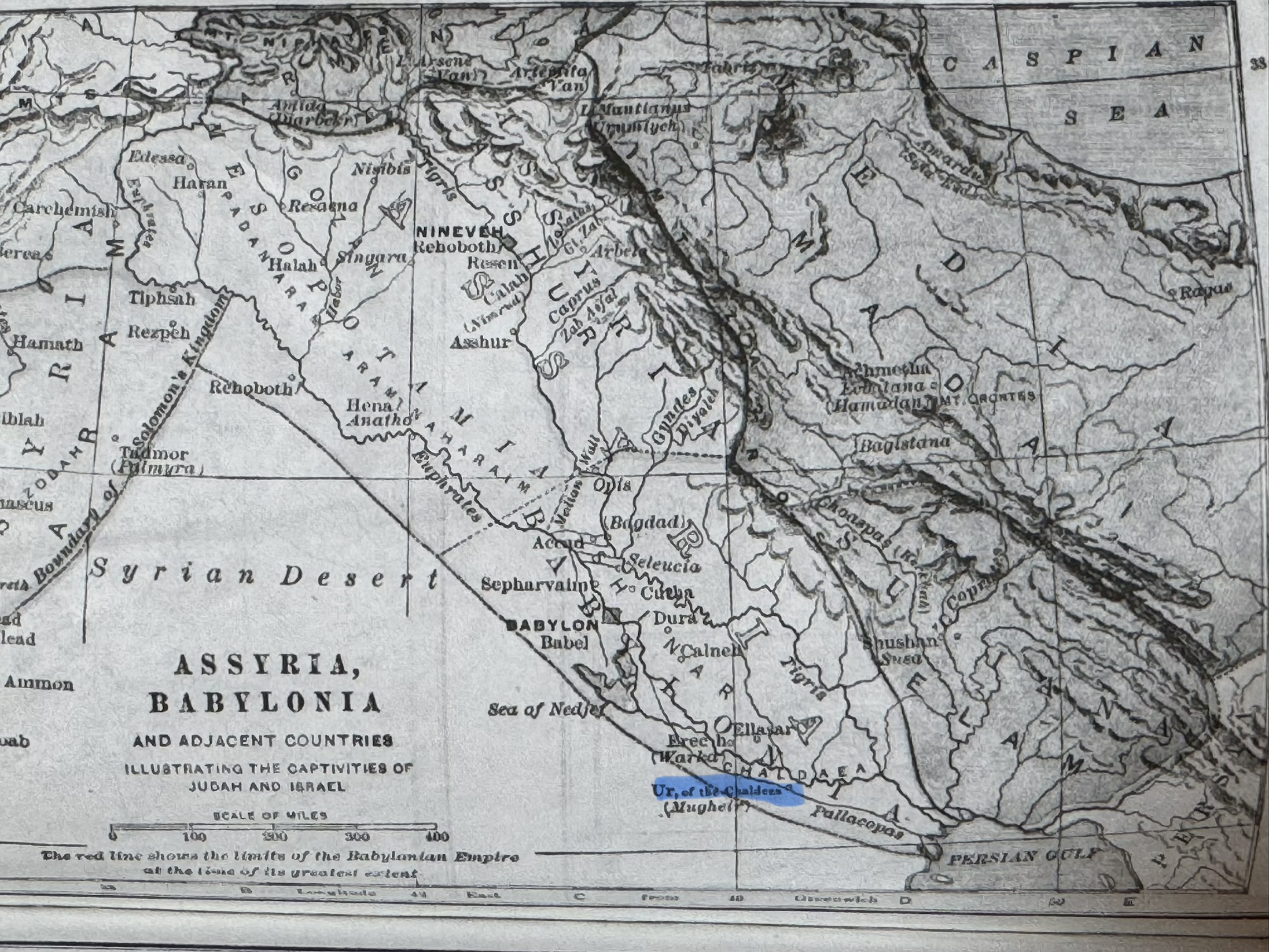
map #2: Ur of Chaldea, presumed locale=blue
And Abram and Nachor married wives. The name of Abram, his wife, was Sarai. And the name of Nachor, his wife, Melcha, the daughter of Aran, the father of Melcha and the father of Iescha/Iscah. And Sarai was barren; neither had she children.
Thare, therefore, took Abram, his son, and Lot, the son of Aran, his son’s son, and Sarai, his daughter in law, the wife of Abram, his son, and brought them out of Ur of the Chaldees, for, to go into the land of Chanaan.
You shall later learn in the Old Testament that twas Abram who was Commanded by ELOHIM to venture to Chanaan. In this current Verse Moyses writes about Thare because he is the central character in the story here.
And they came as far as Haran and dwelled there.

map #3: Aran of the Chaldean territory. Abram’s father, Terah, packed up his surviving two sons and their families and the son of the 3rd son, Aran, who died, and traveled west-northwest to the land of Chanaan.
And the days of Thare came to 205 years; and he died in Haran.
Tis my belief Aran didn’t exist in or adjacent to the land of Chanaan. i believe Thare was able to locate some land that offered promising growth & rich soil for a family. Thare and his sons then bordered the territory, settled with neighboring nations, to include contacting Chanaan officials. Twas then the unnamed area was thereby recorded by Thare as Haran, named after his youngest son, Aran, who died in Ur, Chaldea.
This now closes the Second Age of Mankind
end 11th Chapter of Genesis
© 2022-2026 Brother Sebastian of Shepherd Corps. Any works borrowed are listed elsewhere.
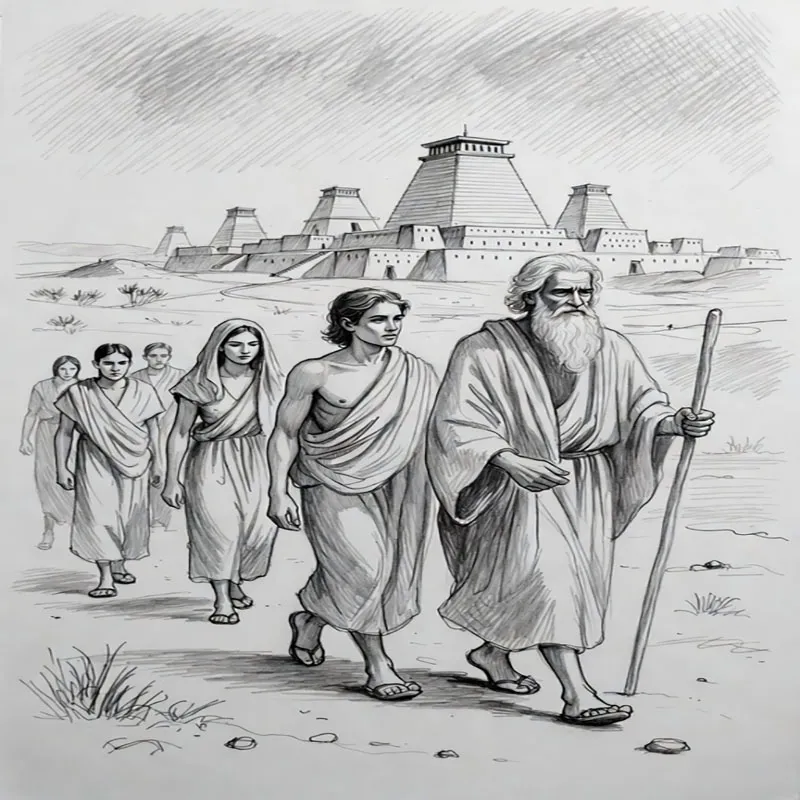
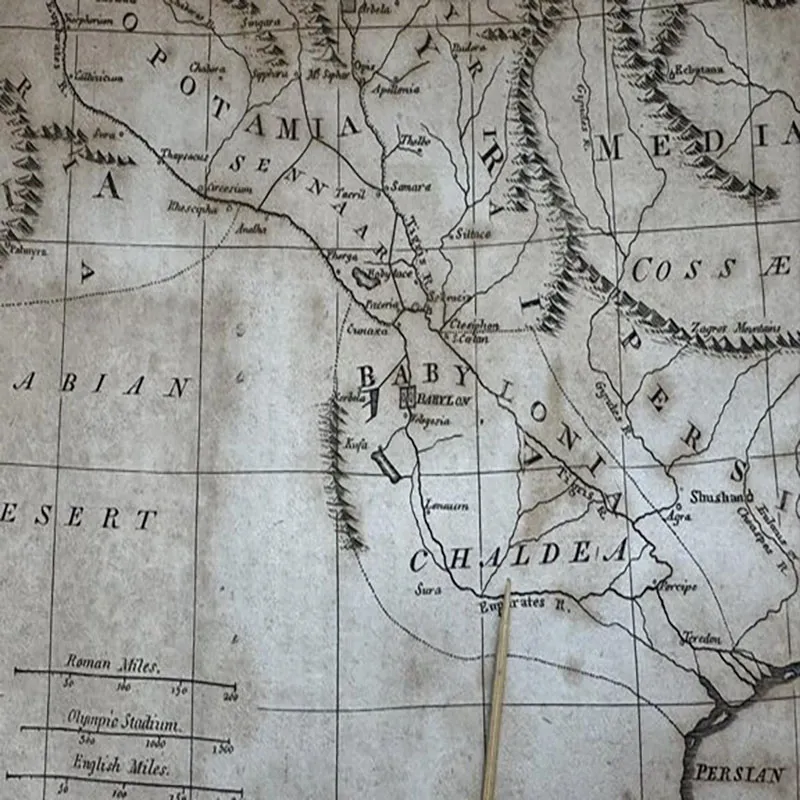
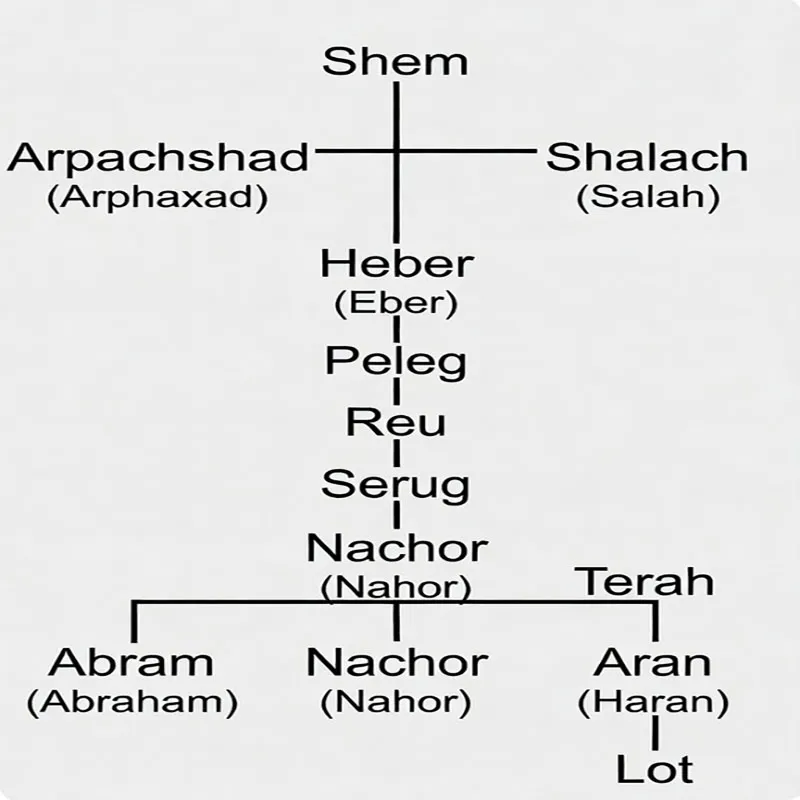
As we begin Chapter 12 there are a couple of things to take note of. First, with this Epistle begins the Third Age of Mankind. And next, part five of Genesis begins. In this 5th section the following occurs:
v.1
And our Lord said to Abram:
Go forth of thy country and out of thy kindred and out of thy father’s house, and come into a land which I will show thee. And I will make thee into a great nation. And I will bless thee and magnify thy name great; and thou shalt be blessed.
Herein are some incredible points deserving elaboration:
How about the last blessing, huh? Literally, Abram’s name {Abraham} shall actually become a blessing! Not even King Salomon or alpha-Prophet, Moyses, shall possess such an unprecedented tribute. His soon-to-be changed name will be a blessing that shall be equivalent to a blessing of fertility, tenacity and/or strength. QUI EST, because of Abram’s most unflinching and exceptional faith, shall Award the Prophet with a name indicative of a bona fide blessing.
v.3
I will bless them that bless thee and curse them that curse thee. And in this shall all the kindreds of the earth be blessed.
Can you fathom having Heavenly Father as your permanent protector or bodyguard? Try to recall a previous time HE WHICH IS Swore a Curse on a first-begotten. Allow me to help: with Cain! Due to Cain’s egregious sin upon his brother, he then feared for his own life. Being envious, Cain feared others would harm him for the sake of vengeance. That’s when QUI EST Commanded an earthly Curse against any first-begotten who would bring harm to Cain. To emphasize His Curse, GOD Marked the young sinner.
i picture Abram as an overly exceptional humble man. So meek was the father of nations that he most certainly had no idea how much faith ELOHIM already had in him. Abram just wasn’t cognizant of how super special he truly was to GOD. This was a portrait of his super humility.
curse them that curse thee
This means it’s just not physical harm. QUI EST Exults that harm includes even hating Abram! Personally, having our Heavenly Father Curse me would absolutely be the most very last Entity i would want a Curse from!
in this shall all the kindreds
This becomes the very first prophecy of the coming of the CHRIST, JESUS. Born of Abraham’s seed, tis through JESUS all nations are blessed. Further, if you’ve been baptized into CHRIST’s singular Church, and have soulfully accepted JESUS as your only key/path into Paradise, then you too have become part of Abraham’s seed–as Blessed by HE WHICH IS. On a universal perspective this means no one has, or shall ever have, a greater family than the seed of Abraham–excluding the seeds of Adam and Noe.
v.4

map #1: hypothetical route to Sichem & Oak of Moreh (noble vale)
Abram, therefore, went out as our Lord had commanded; and with him went Lot. Seventy-five years old was Abram when he went forth out of Haran. And he took Sarai, his wife, and Lot, his brother’s son, and all the substance which they had possessed, and the fowls which they had gotten in Haran, and went forth to go into the land of Chanaan. And when they come into it, Abram passed through the country unto the place, Sichem, to the oak of Moreh {as far as the noble vale}: and the Cananite was, at that time, in the country.
To thy seed will I give this land.
Who builded there an Altar to our Lord, That had appeared to him.
Abram dedicated Altars to QUI EST in places where he Received promise or benefit from Him.

Abram built Altars to honor QUI EST
v.8
And marching on from thence to a mountain that was on the east side of Bethel, there he pitched his tent–having Bethel on the west and Hay on the east. He builded there also an Altar to our Lord and called upon His name.

map #2: Bethel & Hay (Ai)=marker. Look east where you can make out the words, “The Rock: Rimmon”. The open area to the left of these words indicates a mountain. North are the words Ophrah Ephriam. My estimation indicates this area as to where Abram built an Altar to ELOHIM. Recall the primary function of GOD’s Priest is to Sacrifice to QUI EST.
And Abram went forward going and proceeding on to the south. And there came a famine in the country.

Abram takes his family AEgypt
v.10
 And Abram descended into Egypt to be as a pilgrim there–for, the famine was very severe in the land!
And when he was near to enter into AEgypt, he said to Sarai, his wife:
I know that thou art a fair woman and that when the AEgyptians shall see thee, they will say, She is his wife, and they will kill me and reserve thee. Say, therefore, I pray thee, that thou art my sister. That I may be well used for thee; and that my soul may live for thy sake.
All men are bound to do their lawful endeavors and then commit the rest to HE WHICH IS. Abram, concealing his wife, is something i can’t quite fully fathom as to why specifically Moyses included this unless to reveal the Prophet as a less-than-perfect man who sins, via lying, as all of us do. However, at the most, Abram lied not in saying Sarai was his sister, as he also called Lot his brother even though he is his nephew. Further, Sarai is his brother’s daughter. Be it as it may, Abram prevented danger with this deception of his own life. He used such lawful means that were available to him, thereby committing Sarai’s chastity to ELOHIM’s protection: such protection Abram himself could not provide. Tis this explanation i am more at rest with. In which case, if Abram had not planned this endeavor, he would instead be tempting GOD in lieu of trusting Him. And so QUI EST preserves Sarai even when she’s within Pharaoh’s house. No matter the explanation, Abram is planning a sinful lie with his spouse. And one could arguably conclude that his preparation seems cowardly and on the verge of tempting our heavenly Father.

Sarai taken before Pharao
v.14
When Abram, therefore, was entered into Egypt, the Egyptians saw the woman that she was passing beautiful. And the Princes told Pharao and praised her to him. And the woman was taken into the house of Pharaoh. And they used Abram well for her sake. And he had sheep, and oxen, and he-asses, and men-servants, and maid servants, and she-asses, and camels.
This is a continuation of our previous discussion as to why Moyses includes this particular story involving Abram. i offer a more direct angle. As a man Abram was absolutely scared for his life. However, as long as his fright is genuine yet his faith (in QUI EST) remains unshakable, ELOHIM does Protect and Maintains a promise to the Prophet’s bloodline–to Protect and Support.
v.17
And our Lord scourged Pharaoh with very sore plagues, and his house, for Sarai, Abram’s wife!
Lastly, the beauty of Israeli women is something that’s explored in the story of Saint Judith.
v.18
Pharaoh called Abram, and said to him:
Thusly, Moyses includes this because it’s an important transition for our Church. And just as Father’s Church rested entirely on the shoulder’s of Noe, so too does GOD now place the responsibility of His Church with Abram. Because of the promise of freewill, absolutely anything could have happened to have caused Abram to cede to darkness. If this would have occurred then GOD’s nomadic Church certainly could have fallen and failed right here with Abram! But such a tragedy did not evolve. This journey to the foreign land of AEgypt, where temptations and sin were prepared and armed to dislodge the Church from Her very feeble rooting, shows the hardship and struggles CHRIST’s Church experienced during Her second transition–Her first being on the open sea inside Noe’s Ark. Unfortunately, most of my brothers and sisters (and even Clergy) know little of the Church’s history and how close She came to being dislodged by the Devil. My hope is to alleviate such ignorance with these writings.
Why didst thou not tell me that she was thy wife?
This final question from Pharao pertains to the seed of Adam, then through Noah, in which we are taught: with and in ELOHIM’s Church, all are of the same body. Additionally, all are of a united mind to what is true and what indeed be false. You see, within GOD’s Church there is no division of man. What does exist is Reformation and Reclamation with a unity of man. All the trials and tribulations CHRIST’s Church has endured, most of us don’t even give this a second thought. Do you? Most of us seem content that the Church simply exists. Very few of us truly appreciate and comprehend that we are the seed of Adam then of Noah, and in ELOHIM’s Church we are all of the same body. This means those of us who are part of CHRIST’s true Church are of a unified mind to what is true, and what indeed is false.

map #1: Negeb=marker. Negeb, meaning south, was settled by the Shur bloodline of Noe.
Abram, therefore, ascended out of Egypt unto the Negeb, he and his wife, and all that he had, and Lot with him, to the south coast.
The Hebrew texts identify Abram’s brood settling in the southern coast of Negeb.
But Lot, also, that was with Abram, had flocks of sheep, and herds of beasts, and tents. Neither was the land able to receive them for to dwell together: for, their substance was much and they could not dwell together.
map #2: Bethel and Hay.
v.7
Whereupon also there a rose strife amongst the herdsmen of Abram and of Lot. And that time the Chananite and the Pherisite dwelled in that country.

map #3: Nations of the Chananite=blue star and the Pherisite=red star
Recall when the Abrameites first traveled through Chanaan. At that time Moses wrote the land was occupied by the Chanaanite. Now, during Abram’s return, Moses writes of the territory south of Chanaan, Negeb, has become the home of Chanaanites and Pherisites. These same Pharisees shall have a major role when JESUS Walks terra 2000 years later.
You’ll frequently note that i refer to Abraham as a jack of all trades and an absolute master to all. Here, Abram reveals his tactical brilliance and superior foresight to head off a potential conflict before it initiates. On one end of the burdens he shoulders, Abram has his power-hungry nephew to deal with. Another burden pertains to the encroachment of the Chanaanites and Pherisites. Hence, he’s juggling 3 power-motivated earthly entities from 3 directions. In lieu of boosting defense and preparing militarily, Abram shrewdly takes the tactful and peaceful route by distancing himself from one while keeping tabs on the others.
Let there be no brawl, I beseech thee, between me and thee, and between my herdsmen and thy herdsmen: for, we be brethren.
Speaking of brethren, after QUI EST’s Flood there evolved four distinct bloodlines as annotated in His Holy Writ. You, Blessed Reader, are positively a descendent from one of them:
Finally, always remember this. Priests are not the Church. Clergy are extensions of CHRIST’s Apostles who have devoted their eternal lives to serving QUI EST and His earthly Church. They are shepherds who are meant to aid and assist CHRIST’s worldwide flock. ELOHIM’s Church remains perfect as earth’s longest running enterprise, so to speak. Only JESUS Himself is the sole and exclusive leader of Heavenly Father’s Church. And being these Priests of CHRIST are men, and men are mortal who are prone to sin, the Clergy makes mistakes. But the Church Herself does not make or reside in any mistakes of men (or women).
v.9
Behold the whole land is before thee. Go apart from me, I pray thee. If thou wilt go to the left hand, I will take the right; if thou choose the right hand, I will pass to the left.
The logic of King Salomon surpasses all potential conflict. To the insightful Abram, life under the sun does not lead to eternal bliss. But to Lot, life under the sun is all there is, and that’s all he sees. The potential for magnificent wealth assisted by the Hand of ELOHIM. After all, as our Father Aided Abram, did not Lot also embellish in such rewards?
v.10

map #4: Segor (Zoar)=marker
Lot, therefore, lifting up his eyes, saw all the country about Jordan, which was watered throughout. Before that our Lord subverted Sodome and Gomorre as the Paradise of our Lord and like as Egypt as men come unto Segor. And Lot chose unto him the country about Jordan; and he departed from the East. And they were separated either brother from the other. Abram dwelt in the land of Chanaan. And Lot abode in the towns that were about Jordan, and dwelt in Sodom.
as the Paradise of our Lord
What Moyses is telling us is that the southern Jordan River onto the the Siddim Vale (Bahr Lut) was as fertile and magnificently breathtaking as Paradise Garden! It was a spectacular vision to behold! It was no wonder Lot non hesitantly chose this area of land in which to permanently settle. With only about a half of a dozen noteworthy communities about the enriching lake, Lot saw ample room for his humongous estate to settle upon.
Because of the stellar scenery and the supreme rich land, this makes Abram’s choice even more special. He is the senior and patriarch of the family to which Lot belongs. Therefore, this memorable territory should have been rightly his to choose. But his love for family and duty to QUI EST dominates the Prophet’s thoughts and actions. What a blessing to mankind was Abraham!
v.13
And the men of Sodome were very wicked, and sinners before the face of our Lord out of measure.
Tis as though man during this Age has learned absolutely nothing from the Flood! Because here he goes again with his foolhardy way of life and reckless abandonment of ELOHIM.
v.14
And our Lord said to Abram, after that Lot was separated from him:
Lift up thine eyes and look from the place wherein thou now art, to the north and south, to the east and west. All the land which thou seest will I give to thee and to thy seed forever. And I will make thy seed as the dust of the earth. If any man be able to number the dust of the earth, thy seed also shall he be able to number.
thy seed as the dust
Moses does not write this as it pertains to children of the flesh but to the children of promise are the seed (9Rom) and are innumerable! (7Apo9)
v.17
map #5: Mambre Vale of Hebron
Arise and walk through the land in the length and in the breadth thereof; for, I will give it to thee.
Abram, therefore, removing his tent came and dwelt beside the vale of Mambre, which is in Hebron; and he builded there an altar to our Lord.
end 13 Genesis
© 2022-2026, Brother Sebastian via Shepherd Corps Sanctuary. If you borrow anything from this site you are obliged to list this as your source. Any non-AI works utilized are cited elsewhere on this site.
Let no one cause you to violate your (moral) code.
The previous Epistle provided abundant base knowledge for us to fall back on. In reality, there is so much to be explored with any one of these Chapters, which is why i become so exorbitant about sharing whatever knowledge i possibly can with you. This in hopes you may learn at least one thing from us… and perhaps summon a smile from you… or provide for you valid direction. To accomplish any of this would be a tremendous reward for me, on behalf of ELOHIM’s Shepherd Corps. Shepherd Corps provides also a physical escape for you as well. Tis a thoroughly safe place to reflect, pray, sacrifice, and engage in, what i dub, Isaacian meditation. Contact us if you wish to reserve a place at Shepherd Corps to camp for a few days or pray and paint just for a day.
Lastly, we wish to express our gratitude to those of you who have supported us, prayed for us, complimented us, or even griped to us. May HOLY GHOST watch over and guide each of you on an enlightened path of true knowledge.
In addition, if you’re seeking a book to help you escape, you may want to purchase your copy of our spiritual-fantasy book entitled, Being Something. Tis a thrilling fictional adventure with remarkable subliminal messaging that’s written for 12-year olds on up. Although the editing is very disappointing, Being Something is available for purchase at: https://www.amazon.com/dp/B0F8RFMTQF If well-received by the public, two to three more books are to follow.
Now prepare yourself for another can of monstrous worms that’s about to be opened with Epistle 14! We wrote and recorded a song about mankind’s first major war:

map #1: the 4 kingdoms from the east led by king Chodorlahomor of Elam
And it came to pass in that time, that:
–made war against:

map #2: 5 kings of the west
All these came together into the woodland vale (Valley of Siddim)–which now is the Salt Sea.
The Siddim Valley becomes the Salt Sea after ELOHIM Reigns terror down from the heavens onto the cities surrounding or are in this valley. Although their precise location is relatively unknown, such cities included Sodom, Gomorrah, Bela, &c. After Obliterating these half of a dozen or so Heretical cities from above, QUI EST then Buries these cities from below and scars this most extraordinarily captivating area with salt water and swampy turf for eternity!
v.4
For, they had served Chodorlahomor 12 years; and the 13th year they revolted from him!
The Hebrew text stops after the verb, revolted. Yet, the prepositional phrase, from him, is essential as to what Moyses was describing. As it’s written, this was not a coup d’etate or kingship overthrow. Otherwise, Moyses would’ve certainly made it know that was one of the goals. Instead, revolted from him shows these individual lordships had had enough with king Chodorlahomor. These five western kingdoms, located on the most gorgeous land on terra (behind the Garden of Paradise), then made their frustration publicly and militarily known that Chodorlahomor was no longer their supreme commander; henceforth, these five nations of the vale segregated from the east. They understood that a revolt against Chodorlahomor entailed a violent overthrow with much police and militant interaction.

map #3: Raphaim=blue, Sauee of Carimathaim=red, Seir & Cades=black, Asasonthamar=green
Therefore, in the 14th year came Chodorlahomor, and the kings that were with him, and they struck:
And they returned and came as far as the.

map #4: King Chodorlahomor & his 4 eastern kingdoms amazingly conquered territories throughout Palestine to Arabia
What the descendant of Cham, son of Noe, accomplished predominantly with fantastic speech and impeccable persuasion, now king Chodorlahomor accomplished with the use of physical force. Terra experiences her first major international war with four nations of the east stomping western territories into submission!. A brutal takeover executed under the soles of a heavy-footed army the planet has never before experienced. Beginning about the year 1950BC, earth would not comprehend the terrifyingly ruthless destructive ability of Homo sapiens. A sin and aggrandizing scar birthed by man that will never ever diminish–war and conflict would incessantly explode to all four corners of terra.
v.8
And they went forth, the king of Sodome, and the king of Gomorra, and the king of Adama, and the king of Seboim, moreover also, the king of Bala: which is Segor. And they set themselves against them in battle array in the woodland vale {valley of Sidim}, to wit, against Chodorlahomor, king of the Elamites, and Thadal, king of Nations, and Amraphel, king of Sennaar, and Arioch, king of Pontus–four kings against five. But the woodland vale had many pits of bitumen. Therefore, the king of Sodome and of Gomorra turned their backs and were overthrown there. And they that remained fled to the mountain.

King Chodorlahomor and his four eastern nations effortlessly defeat the five western kings at the bitumen pits within the stellar Siddim Valley.
pits of bitumen
Recall bitumen is essentially black tar that’s relentlessly adhesive. Twas this black viscous material an Angel Used to seal Noe and his family inside the prodigious Ark.
v.11
And they took all the substance of the Sodomites and Gomorrheans, and took all kind of victuals, and went their way. And, Lot also and his substance, the son of Abram’s brother, who dwelled in Sodom.
Was this First World War really about territorial expansion, or was it simply because king Chodorlahomor had his pride denigrated? Perhaps finances and goods contributed to some extent. Tis my belief once king Chodorlahomor viewed the land of the Siddim Vale, digesting its impeccable beauty and unmatched rich fertile land, he knew he had to have it remain as part of his kingdom. Or, let’s say the western king visited the Vale sometime during the previous 14 years, losing it would still elicit his same prideful reaction.
v.13

map #5: Mambre Vale
For, these had made a league with Abram.
the Amorrean
A time when Amorreans and Hebrews were allies. This would later change, unfortunately.
v.14

map #6: to Damascus=red, Dan=aqua
Which, when Abram had heard, to wit, that his brother, Lot, was taken, he numbered of the servants born in his house, well appointed, 318, and pursued them into Dan.
Abram, our most incredible forefather, truly represents what a man used to: a literal jack of all trades and a relative master to each! Here, the second Prophet of GOD reveals his military awareness and masterful strategic planning. He foregoes the usage of the other two members of what i call, the Abram League, and decides the apprehension of Lot is more of an internal dilemma than a League problem. And this is where his tactical brilliance shines. Abram deduces a smaller rescue troop has a calculable better chance of success against a massive army from four kingdoms. That deduction in place, the patriarch next chooses his most elite fight-capable servants to comprise his team: 318 loyal sturdy men. Being no man can exist in a vacuum, no matter how excellent he be, Abram correctly relies on his friends and family in dealing with the wickedness of man.

map #7: Hoba=lt red, Damascus=dk red
v.15
And dividing his company, he ran upon them in the night and struck them, and pursued them unto Hoba–which is on the left hand of Damascus. And he brought back all the substance, and Lot, his brother, with his substance, the women, also, and the people.
Moyses writes Lot as Abram’s brother in lieu of nephew. The term, brother, understand, was used to generally indicate all male relatives. What began as Abram’s elite force of 318 exploded in quantity for the return trip! As Abram and company approached the Valley of Mambre, the Abram League & others marched out to meet them to help escort a few hundred citizens back to Sodom and other cities about the illustrious Siddim Vale.

map #8: Sauee (King’s) Vale is presumed to be in the Kidron Valley=green
v.17
And the king of Sodom went forth to meet them after he returned from the slaughter of Chodorlahomor, and of the kings that were with him in the Vale, Sauee–which is the King’s Vale. But, Melchisedech, the king of Salem, bringing forth bread and wine.
For, he was the Priest of God most high, blessed him and said:
Blessed be Abram to God the Highest, which created heaven and earth. And blessed be God the Highest, by Whose protection the enemies are in Thy Hands.
King’s Vale

Who is {was} Melchisedech? There’s a huge variation of assumptions and heresies of who Melchisedech is. Let’s crack this egg open with the listing of the three greatest falsehoods of who such persons claim Melchisedech is.
i’m in agreement with Saint’s Jerome and Augustine (and others) that Melchisedech was:
i also add that Melchisedech brought forth the Light, by way of HOLY GHOST, in order to help & guide GOD’s Spouse along the appropriate heavenly path.
Additionally, there are a couple of other probable claims of who Melchisedech was:
bringing forth bread and wine
At this point a reasonable question to ask is, why on earth would Prince/King Melchisedech bring forth bread and wine upon Abram’s victorious return? What i wish to purport to you is this: Is CHRIST a Priest according to the Order of Melchisedech? Our super incredible royal Prophet, David, and the most head-strong and confident, S Paul, both say Melchisedech is a Priest to Melchisedech’s Order. Therefore, ask yourself this, Precious Reader: Did JESUS not fulfill Melchisedech’s figurative Sacrifice, offered in bread and wine, by offering His own blessed & precious Body and Blood at His very last supper in the form of bread and wine? And by this, did He not Institute the same to be offered by His subsequent Priests until the end of this world? Then once you come to terms with both of these stipulations, you then need to ask yourself if you are attending a Church in which there’s a Priest celebrant who is a descendant of Melchisedech’s Order as well as CHRIST’s? If you conclude, no, then promptly leave the Heresy and never return to it! There’s but one Order which belongs to a simple single Religion. You must discover this answer for yourself–which is why you are here to learn from Shepherd Corps.
Next, what other figurative sacrifice of Melchisedech’s that is Performed by Son of Man by which it may appear that JESUS is indeed a Priest forever according to that Order? If you can find another biblical answer to this, be sure to contact us with it. Speaking of Heresies, let’s examine Protestantism some.
blessed him and said
From everything i’ve read about Genesis, Moyses was assiduously selective with his words and refrained from useless dribble. That being stated, let’s examine the Hebrew word, hosfi, which is defined as, brought forth. If you examine XIJud18-19, the usage of hosfi undoubtedly pertains to sacrifice. And lastly, it doesn’t make sense for all the victuals Abram’s 318 returned with that the men would ignore all that food and instead fill & relieve themselves with only Melchisedech’s bread and wine. Put yourself in that scenario. Imagine you’re a loyal servant who is one of the 318 chosen elite. After a successful rescue mission, you’re returning home with all the victuals and trophies collected after the battle… and you have a splendid assortment of food and beverage staring right at you. Travel and battle has certainly made you hungry and weak. Are you truly going to ignore the spoils of victory and return home on an empty belly and with depleted energy? And by the way, your trip home is going to take about a week. And let’s not forget you’re escorting and caring for hundreds of freed women, children, men and beasts. Can you sincerely and logically conclude you would not feast on any of the foods your team obtained? In summary, your team, the Abram-318, was abundantly rewarded with corporal food and victuals after freeing Lot, the Sodomites, and others. A week later you finally return to your homeland. Alas, the query: why would you feast on Melchisedech’s simple gifts if your belly’s already satisfied from the plethora of available foods that were found during the rescue?
Let’s next explore the words that follow, hosfi, which are (in English): —for he was the Priest of God most high. What other sense can there be other than Melchisedech executing the function of a Priest with the bread and wine he brought? Combine his action with his praise of HE WHICH IS as victor and protector. Otherwise, if taking his words as separate from his deed, Melchisedech would be bringing such a provision simply to relieve the camp with victuals. And, the reason would rather have been yielded because he was a:
Yet, none of these reasons, or similar, fitted this purpose so well, nor touched the cause of bringing forth bread and wine, as to signify that he was a Priest, whose office, remember, is to offer Sacrifice. Once again the Protestants argue against the Latin text, that the causal conjunction, enim (for), is more agreeable to the Hebrew, but should be copulative, as in, et (and), which is a mere wrangling. i believe what is important to know about all of this is that the learned knew the Hebrew particle is expressed in such places by, enim or quia (for or because), than by, et. Historically, since we’ve been mostly referring to the English translation, the English bible printed in 1552, the Verse is written as, Melchisedech, king of Salem, brought forth bread and wine, for he was the Priest of the most rightest God. Latter editions don’t use the copulative, and, but some other word as the sense requires, as in: Thou art but a dead man for the woman’s sake, which thou hast taken, for she is a man’s wife. From this biblical Sentence, where the Hebrew phrase is located, and she is married to a husband, thusly, For I have proved that the Lord hath blessed me for thy sake, where precisely construing the Hebrew, they should say, I divined (or conjectured), and the Lord blessed me for thy sake. Likewise, from the Book of Esay, But Loe, thou hast been angry, for we offended. The Hebrew text is: But Loe thou art angry and we have sinned. In the same page the Hebrews translate, yet shall we be saved, which the Hebrew express via the copulative. And again, and we shall be saved. It seems when they think it convenient, they translate the Hebrew particles, like with: for, that, & yet strictly signify, and.
i’m next going to refer to the works of the earlier Christian writers & doctors, that i happen to concur with, such as Saint’s Jerome and Augustine. i’m going to begin with exploring the original ancient Hebrew text in order to validate Melchisedech holding the office of Priesthood as he presented the bread and wine to the Abram-318:
VMALCHI TSEDEC MELEC CHALEM HOTSI LECHEM VAIAIIN. VEHV COHEN LEEL ELION, VAIE VARE CHEHV….
When translated to English,
And Melchisedech, king of Salem, brought forth bread and wine. And he, the Priest to God most High, and he blessed him, &c.
And he, the Priest to God
What else would these words infer if not to further declare that, besides the office and dignity of a king, Melchisedech was also a Priest. Do the above words not read so? And is it not also obvious Melchisedech did something particular with the bread and wine in order to signify the office he serves? Twas Sacerdotes who wrote, Truly and properly are they, that offer sacrifices, such as was Aaron, and the sons of Aaron, and Melchisedech, and Christ, whom they prefigured. If we consider his words to be fact, then consider this: if both Melchisedech and Aaron were truly and properly Priests because they offered sacrifices, and, both were figures of CHRIST, it must needs be granted that as Christ fulfilled the figure of Aaron’s bloody sacrifices, in offering Himself upon the Crosse, so he also fulfilled the figure as well of unbloody sacrifices of Aaron, especially of Melchisedech’s Sacrifice,in some other besides that on the Crosse, seeing the Prophet David and S Paul say, Christ is a Priest forever according to the Order of Melchisedech. And what other Sacrifice did our Savior Offer to remain perpetual but of His own body and blood in a bloodless manner, and under the forms of bread and wine, with commandment to his Apostles and Priests to do the same until the end of the world?
At this point what is it you believe? Is Melchisedech an esteemed Priest to which Abram is subservient to? And if not, then, do you sincerely feel the bread & wine Melchisedech brought was simply for sustenance and drink? Even after i have shown you the ample victuals Abram-318 returned with? Perhaps i can provide you with some more info to aid your conclusion. A Saint named Clemens Alexandrinus wrote the following: Melchisedech, king of Salem, Priest of God most High, gave wine and bread sanctified nutriment in type of the Eucharist. There’s also another ancient Father by the name of Saint Cyprian who iterated, Christ is a Priest forever according to the Order of Melchisedech, which Order is this comming from that Sacrifice, and thence descending, that Melchisedech was a Priest of God most High, that he offered bread and wine, that he blessed Abraham. After all, who is more a Priest of GOD most High than our Lord & Savior, JESUS. JESUS, Who Offered sacrifice to Heavenly Father and was the same offering which Melchisedech provided (bread & wine, to wit, CHRIST’s own Body and Blood). There was something else S Cyprian wrote:
That the blessing might be rightly celebrated about Abraham by Melchisedech the Priest, the image of Christ’s Sacrifice consisting in bread and wine went before, which thing our Lord perfecting and performing, offered bread and the chalice mixt with wine, and he that is the plenitude, fulfilled the veritie of the prefigured image.
Unfortunately, like with most of the ancient writers and doctors, Cyprian tends to be long-winded. In brief, the Saint explained that Melchisedech was a Priest who, as a harbinger to CHRIST JESUS, offered a blessed sacrifice in the form of bread and wine. There be another well-respected ancient, Eusebius Cesariensis. His belief was that Melchisedech, when blessing Abram, wasn’t reported to offer a corporal sacrifice but only a sacrifice of bread and wine. i believe it to be axiomatic Eusebius inferred the entire Chanaan community versus just the country known as, Nations/Goyim. However, insightful Reader, there’s a chance i could be incorrect on this. Eusebius added:
—so first our Lord and Savior himselfe, then Priests that come from him, exercising the spiritual office of Priesthood in all Nations, after the Ecclesiastical ordinances, doe represent the mysteries of his bodie and healthful blood, in bread and wine: which mysteries Melchisedech knew so long before by divine spirit, and used as representations of things to come.
There is also S Ambrose who contributed to this discussion of, bread and wine, as he wrote: We know the figure of the Sacraments went before, in Abraham’s time, when Melchisedech offered Sacrifice. He added: it is cleer that oblations of cattle are vanished, which were in Aaron’s Order, but Melchisedech’s institution remayneth, which is celebrated all the world over in administration of the Sacraments. Admittedly, Ambrose absolutely knocks it out of the park with such words that hold complete truth to this day! There’s no other Religion on the planet that has withstood the test of time and man and still remains unchanged. Only QUI EST’s Church and Religion fit this parameter.
Complementing Ambrose are the words from Saint Jerome:
Have recourse to Genesis, and you shall find Melchisedech, King of Salem, Prince of this citie, who even then in figure of Christ, offered bread and wine, and dedicated the Christian mystery in our Savior’s bodie and blood. Melchisedech offered not bloodie victims, but dedicated the Sacrament of Christ in bread and wine, a simple and pure sacrifice…. Our mysterie is signified in the word of Order, not by Aaron immolating brute victims, but in offering bread & wine, that is, the bodie and blood of our Lord Iesus. {Then, via S Matthew:} Melchisedech, the Priest of God most High, by offering bread & wine, prefigured the Mysterie of the Eucharist.
Then, there is S Chrisostom, who wrote:
Seeing the figure, thinke also I pray thee of the veritie. After that Melchisedech King of Salem brought bread & wine; Abraham received his oblations.
The blessed Chrisostom sincerely makes a phenomenal point here. Why would Moyses finish with the Words, —Abram received his oblations. Why would Moses use the verb, receive, as opposed to took or another like verb, if there wasn’t a significant respect between the two men, Abram and Melchisedech.
There is lastly, S Augustine, who candidly purported:
Melchisedech, bringing forth the Sacrament of our Lord’s table, knew how to figurate his eternal Priesthood. There first appeared that Sacrifice, which is now offered to God by Christians in the whole world.
i really could have little trouble at all citing other highly-respected ancient writers to enhance this discussion even further. In the end, it is you by yourself who must make the decision on what to believe. As remarkably wise person once wrote, tis bootles or needles to cite more places, or more Authours; for whosoever will not submit their judgments to these, would not, it is like, believe, if their own Maisters should rise againe and warn them, lest they be damned for their incredulitie.
Let’s return to the Phrase, blessed him and said. Calvin Musculus and some other Protestants juxtaposed & switched terms in order to avoid the connection of Melchisedech’s Priesthood with bringing forth of bread & wine. Henceforth, the words, he was a Priest, are ignored for, he blessed Abraham. Some English translators, for this purpose, have corrupted the text–verified in the 1579 bible–by changing and into therefore, saying: and he was a Priest of the most High God, therefore he blessed him. To be blunt, they created a false premise by exulting that Melchisedech didn’t bless Abram because he was a Priest; after all, Abram was also a Priest. The blessing occurred because Melchisedech was a greater Priest than Abram. Further, as written elsewhere throughout the Liturgy, other Superiors who are not Priests may bless their inferiors. For example, Iehosua and King Salomon blessed the people, along with, parents bless their children.
v.20
And he gave him the tithes of all.
he gave him
Abram paid tithes to Melchisedech, which, above everything else, should really be all you need to make up your mind on who Melchisedech was. Because of this particular fact, as S Paul elucidates, it’s clearly evidenced that CHRIST’s Priesthood is greater than that of the Levitical Order. Further, this paying of tithes by Abraham sheweth the antiquitie of this tradition, being practiced in Abraham’s time, that the spiritual Superiours received tithes of their inferiours. What you should remember from this discussion on tithe payment are the following:
v.21
And the king of Sodom said to Abram:
Give me the souls, and the rest take to thee.
What is it that Barra, king of Sodom, meant by this? The artifacts and foods were for Abram to take; the livestock and humans would be returned to Barra.
v.22
Who answered him:
I lift up my hand to my Lord God most High, possessor of heaven and earth, that from the very wolf-thread unto the shoe latchet, I will not take of all that are thine, lest thou say, I have enriched Abram. Except such things as the young men have eaten, and the shares of the men that came with me:
–these shall take their shares.
lest thou say
Abram, Enriched by GOD, would take no more of man but his soldier’s sustenance, which is the proper hire of spiritual workmen.
Previously, Abram and his 318 men return to Mambre Valley with his nephew, Lot, and a plethora of other freed Sodomites. Upon his entry the Prophet was specially greeted and blessed by the great Priest & King, Melchisedech.
v.1
https://grok.com/imagine/post/4a7ed22e-062a-49ba-b61f-109dc2e1947c?source=post-page&platform=web
When these things, therefore, were done, the Word of our Lord was made to Abram by a vision, saying:
Fear not, Abram, I am thy Protector, and thy reward is exceeding great.
Moyses writes this as a message to all Heavenly Father’s true followers: follow GOD blindly and He will Protect you, maintain unflinching faith in GOD and your reward shall be incomparable.
v.2
He shall not be thine heir. But he that shall come out of thy womb, him shalt thou have as thine heir.
Look up to Heaven and number the stars if thou canst.
So shall thy seed be.
Then there’s Saint James who exulted that Abram was justified by works–works that follow faith. For, faith, if it doesn’t have works is dead in itself. And by works, Abram’s works and faith were consummate. James concluded: do you see, that by works a man is justified and not by faith only. Alas, this Saint exquisitely defined and identified faith like no other! In my humble opinion, this explanation is simply perfect.
I am the Lord that brought thee out from Ur of the Chaldees for to give thee this land and that thou might possess it.
Take Me a:
- cow of 3 years old,
- a she-goat of 3 years,
- a ram of 3 years,
- a turtle also,
- and a pigeon.
But something must be stated about Abram’s faith and S Paul’s discussion, annotated earlier, about CHRIST. Paul firmly attested Abram’s faith was concrete solid. But here with these Verses it doesn’t seem as such, as Abram asks how would he know if he should possess Chanaan. Tis my belief Abram’s faith isn’t as Paul testifies until at least after his sacrifice to QUI EST.
Who, taking all these, divided them by the middes, and laid each two pieces a row, one against the other; but the birds he divided not. And fowls lighted (landed) upon the carcasses; and Abram drove them away. And when the sun was setting, a deep sleep fell upon Abram and a great and darksome horror invaded him.
This becomes a more immersive mode within Abram’s already storied vision. It becomes a phenomenal blend of altered consciousness, sight, covenants, symbols and words. His deep sleep or theophany is where HE WHICH IS Reveals prophetic brighter and darker futures. The awesome future ELOHIM Vows is dependent on divine faithfulness.
v.13
Know and foreknow that a pilgrim shall thy seed be in a land not their own–and they shall bring them under bondage and afflict them–for 400 years.
This eerily haunting dreamscape becomes the second prophecy for Abram, his infinite multiplication of his seed being the first. Tis Foretold to the Prophet that his seed would reside in a strange & foreign land for 400-some years and 140 of those years would be in servitude and affliction.
v.14
But the nation, whom they shall serve, I will judge; and after this they shall go forth with great substance.
the nation
This could easily be interpreted to mean AEgypt, of which our Lord does Judge with His plagues. But a deeper perspective points to Jerusalem, which shall be QUI EST’s nation. In other words, the Church. HE WHICH IS Informs the patriarch that after Jerusalem is secured, or, GOD’s Church is planted, then magnificent glories await those who die with faith while under the service of His Spouse, the Church.

map #1: Amorrheites=marker
v.15
And thou shalt go to my father’s in peace, buried in a good old age. But in the 4th generation they shall return hither; for, as yet the iniquities of the Amorrheans are not at the full until this present time.
v.17

map #2: This map provides a visual of the geographic area of which Moyses describes. On this map you’ll find the Cenezites, the Cedmonites, the Hethits, the Pherezits, the Raphaims, and the rest. QUI EST intentionally removes all of these nations so His Church could be rooted for all of mankind. But GOD Starts small, so to speak, with a chosen group who happen to be the biological descendants of Abraham by way of the offspring of Jacob. This map reflects the gigantic love ELOHIM has always had for us!
To thy seed I will give this land from the river of Egypt even to the great river, Euphrates,
- the Cineans
- and Cenezites,
- the Cedmonites,
- and the Hethits,
- and the Pherezits,
- the Raphaims also,
- and the Amorreans,
- and the Cananites,
- and Gargasites,
- and the Jebusites.
end 15 Genesis
©2022-2026 Brother Sebastian via Shepherd Corps. All and any works borrowed are cited elsewhere.

Agar presented to Abram for matrimony by Sarai
Sarai, therefore, the wife of Abram, had brought forth no children; but having a handmaid, an Egyptian named, Agar {Hagar}.
Tis most likely when Abram moved his entire family to AEgypt to avoid the invading drought, as per Heavenly Father’s instructions, that’s when his family retained the services of Agar. Sarai then brought Agar with her when they returned to the land of their fathers–Chanaan.
And when he agreed to her in this request, she took Hagar, the Egyptian, her handmaid 10-years after that they first dwelled in the land of Chanaan, and gave her unto her husband to wife.
to wife
With the above precepts, it appeareth sufficiently by that Sarai persuaded her own husband to marry another wife, and he is a true servant of GOD, agreed thereto, not as a now thing, but as a lawful practice of those times.
Who did company with her, but she, perceiving that she was with child, despised her mistress.
Some of us are obedient while being rude, or in a low state, but having got a little knowledge or advancement disdain their advancers.
Envy is hereby projected by Sarai, but, can she be faulted for such personal feelings? For, this is a remarkably devoted woman who, for her entire married life, has strived to please her husband. Part of her struggle has been yearning to birth a family for Abram and, up until her AEgyptian handmaid, Agar, she has failed at this heartfelt endeavor. As a woman yearning to be a mother, a matriarch for a most fascinating man, Sarai’s heart aches. Thusly, what she had envisioned for Abram suddenly becomes reality and it hurts! It hurts because she is the wife of one of the most famous men on the planet! It’s injurious to her pride and spirit because Abram’s seed should flourish through her and not another. And for her struggles Abram remains loyal and in love with Sarai. Concomitantly, Sarai remains in ample love with Abram.
v.6
Behold, sayeth he, thy handmaid is in thine own hand. Use her as it pleaseth thee.
A dilemma becomes presented here. Abram is undeniably an incredible and GOD-loving patriarch. Yet, his response seems cruel and cold to the woman he recently married, Agar. On the flip side, however, perhaps Abram viewed his second marriage only as one of convenience–for offspring. To this phenomenal Prophet, only Sarai holds the true title as his wife. This absolutely portrays exceptional respect this husband has for his lifelong wife and he will do nothing to destroy it. Finally, perhaps what Moses intended for us to learn from this is Abram’s full and complete utter faith in QUI EST even with the complication of Agar being a second wife.
 v.6 (cont.)
Agar, the handmaid of Sarai, whence commest thou? And whither goest thou?
Return to thy mistress and humble thyself under her hand.
Multiplying,
–will I multiply thy seed and it shall not be numbered for the multitude thereof.
Behold,
–thou art with child and thou shalt bring forth a son. And thou shalt call his name, Ismael, because the Lord hath heard thine affliction.
Ismael–GOD has heard thy affliction.
v.12
He shall be a wild man. His hand shall be against all men; and all men’s hands against him. And over against all his brethren shall he pitch his tents.
In many respects what QUI EST has Declared thus far certainly doesn’t sound too promising of a life for a mother’s son. Not all Prophesies from Heavenly Father are optimistically promising.
v.13
Verily, here have I seen the back parts {backside} of Him that has seen me.
Moyses is believed to be the only man who came close to seeing the face of QUI EST. However, when Moyses was invited to see GOD, he was protected by Him in a hole surrounded by solid rock. Further still, Moyses saw only the backside of GOD. Here, several hundred years before Moyses was even born, an AEgyptian woman named Agar becomes the first person to not only see Him (His backside) but know His extraordinary name!
Therefore, she called that well: The Well of Him that Liveth and Seeth Me.
The Well of Him that Liveth and Seeth Me
In ancient Hebrew, Beer-lahai-roi. Originally written, without vowels, as, באר לחי ראי.
v.14 cont.

map #1:Cadesse and Barad. Kedesh is seen at the bottom of the red circle. Bered is presumed somewhere north along the main route to & fro AEgypt.
The same is between Cadesse and Barad.
 And after that he began to be 99 years old, our Lord appeared unto him, and said unto him:
Ego Deus omnipotents: ambula coram me, et esto perfectus.
Ego Deus omnipotents: ambula coram me, et esto perfectus.
Moyses writes here that Abram is perfect in this life, sincerely and diligently tending towards perfection of the next life. Thusly, Heavenly Father Commanded this to Abram, to CHRIST and all followers of JESUS.
v.2
And I will make My Covenant between Me and thee; and I will multiply thee exceedingly.
I am, and My covenant is with thee; and thou shalt be a father of many nations. Neither shall thy name be called any more Abram; but thou shalt be called Abraham because a father of many Nations I have made thee.
many Nations
The changing of names is enchantingly mystical. Abram itself means high or noble father. QUI EST Changes the Prophet’s name to Abraham, which means father of many nations. Then there’s his wife, Sarai, which means, my princess, which QUI EST Changes to Sara–which simply means, princess. The changing of names imports great mysteries that are undeniably intended by GOD. It also declared and confirmed that, Abram by the issue that he should have of Sara, should be the father of manie Nations. S Paul iterated that the ample nations applied to Abraham’s spiritual offspring, those that especially believe in SON OF MAN, of the Gentiles, prefigured by Isaac born of the free woman, by the promise, as the Hebrews were prefigured by Ismael borne of the bondwoman according to the flesh. This then concludes with the Prophet, Esai, that manie are the children of the desolate that before was barren–as Sarai before was barren. Tis fascinating how QUI EST always Provides an answer for our consistent imperfections.
Now, although Abram was the natural father of 4 Nations:
However, he was also the spiritual Father of many more, to wit, of all nations that believe in CHRIST, from His own time to the end of the world. Some of these believers are Jews but the majority are Gentiles. It is clear that the Church of JESUS always consisted of many nations and not as the Protestants and Donatistes say: sometimes of few unknown persons. That would mean Abraham should sometimes be a father of a few or no nations at all. This theory derogates either from GOD’s omnipotency, as if He could not, or, from His impeccable fidelity, if He should not maintain His promise made eternally to Abraham. Henceforth, if you’re a practicing Protestant, are you aware of an instance in which ELOHIM has not Kept one of His vows?
v.6
And I make thee increase exceedingly; and I will make thee into Nations–and kings shall come forth of thee.
Moses writes this to draw your attention to at least 2 significant points:
This tradition seeking the Prophets and the Church of HE WHICH IS began under Abraham but became perfected under King Salomon. Look at the world and GOD’s Church today. Do you see such precise respect being displayed with those meeting any of Heavenly Father’s patriarchs or His Chief-Priest (the Pope) occurring today?
v.7
And I will establish My covenant between Me and thee, and between thy seed after thee in their generations by a perpetual Covenant: to be thy God, and thy seeds’ after thee.
And, yes, GOD’s Covenant with Abraham continues to this day. Even as during this time there were dedicated followers to QUI EST by way of His Patriarch, Abram. Still, there were others of his family and followers who weren’t so devoted to Heavenly Father. This alliance and dubiety thrived after Abraham during the existence of the Hebrew people. Thusly, even today Abraham’s Covenant is honored by the true spiritually inclined, which are the Roman Catholics. Yet, other members of his descendants are not correctly or appropriately aligned with His Church. Such groups include other Christians, neo-Judaists, non-practicing Catholics, Muslims, Buddhists, and all others.
v.8
And I will give to thee, and to thy seed of the land of thy peregrination, all the land of Chanaan, for a perpetual possession; and I will be their God.
As identified in Verse 7 for the physical seed, here such an infinite Promise applies to the spiritual descendants of Abraham, whose numbers are more vast than the physical bloodline.
v.9
Again, God said to Abraham:
And thou therefore shalt keep my Covenant, and thy seed after thee in their generations.
These blessed Words reveal the fantastically enduring confidence QUI EST had in/with Abraham. A confidence so incredibly revealing to Project His covenant to remain valid even generations beyond Abraham’s demise.
v.10
This is My covenant which you shall observe between Me and you and thy seed after thee: All the male kind of you shall be circumcised; and you shall circumcise the flesh of your prepuce, that it may be for a sign of the covenant between Me and you.
Additionally, Baptism involves all Nations and both sexes, especially for virtue and efficiency. Understand Baptism is an instrumental cause that remits sin and even justifies Circumcision as being only a sign that grace was Provided and sin Remitted. This is so because Baptism imprints a character in the soul; whereas, Circumcision leaves only a permanent mark on the flesh. Lastly, Baptism opens the Gates of Heaven in virtue of CHRIST’s Passion, which is now past. This is something Circumcision couldn’t provide because Circumcision did not suffer death before JESUS suffered death. Death will be covered in greater detail later.
v.12
An infant of eight days shall be circumcised among you, all male-kind in your generations, as well the homebred shall be circumcised, as the bought servant of whosoever he is, not of your stock.
Tis on the 8th day Circumcision is performed and a name provided for the infant. This signified the association of Saints in Heaven after the 7 days travel of this world–S Cyprian. Circumcision also provides for a permanent conflict for mankind’s invention of trans-persons. HE WHICH IS Provided for this Sacrament to His first-born, which are males, because only men performed the original services of both patriarch and Priest. How then does a woman claiming to be a male provide for this eternal covenant Established by QUI EST hundreds of generations prior to such inventive ridiculousness? When man performs outside the realm of Heavenly Father, such enduring traditions become ignored, avoided and even blasphemed. Yet, such blessed traditions and Sacraments should be one of the first things contemplated because they have been in existence since the time of our Prophets. To choose or prioritize a law of man over those of Heavenly Father absolutely endangers one’s eternal soul. Why would you commit soulful suicide? Ignorance won’t be accepted upon Judgment Day–not when it comes to placing the laws of man over those of GOD.
v.13
And My covenant shall be in your flesh for a perpetual covenant. The male, whose flesh of his prepuce shall not be circumcised, that soul shall be destroyed out of his people because he hath broken My covenant.
that soul shall be destroyed
Although the brutal straightforwardness of this Verse is difficult for many to digest, its true sense contains a pair of difficulties:
Let’s first examine the first doubt. Doesn’t it seem probable this punishment pertained only to those, by their own negligence really, or even others of their charge, who were not circumcised? And because of this it was alleged one indeed was punished but because of why? Very simply, because such a man had broken GOD’s covenant. To maintain or break a covenant of HE WHICH IS is entirely in a man’s power to keep or break, that are of discretion, but not in the power of infants. Still, there’s another factor to consider. It’s the primary point for me pouring my energies about spiritual work upon the social sites and other internet places. And that is, language! Henceforth, language applies here as well.
There is indifference between the Latin and the Greek texts on this issue of Circumcision. According to the Latin, The male whose flesh of prepuce is not circumcised. And the Hebrew and Greek text read, The male that doth not circumcise the flesh of his prepuce. This can’t be intended for infants of eight days old. Such exposition is confirmed by example in Exodus IV in which Moyses was in great danger of being slain by ELOHIM’s Angel because his son was not Circumcised! If you’re not aware, Moyses was a plus 80-year old man with exceptional smarts, experience, logic, knowledge, and skill. This calm, gallant and deep-thinking guy doesn’t frighten easily. When you read that Exodus Epistle you will learn for yourself how sincere you should be with respecting the Sacrament of Circumcision.
S Augustine also weighed in extensively on Circumcision. He proved obligation of this Sacrament also pertained to infants and his judgment was confirmed by the 70 Interpreters! In fact they added these words: The eighth day, for explication which does include infants, as subject to this punishment–not for that they could transgress this precept or, commit a new sin, but for lack of Circumcision. i learned the Mormons do believe in such guilt for infants because Catholics have no contrairie proof. Dear Mormon friends, i now provide u with proof. Here, and in several other places throughout the Liturgy and Apocrypha, the reason is QUI EST determined this Sacrament to be the only remedy for Original Sin. Hence, in the male sex of Abraham’s seed, in place of Sacrifice, or other Profession of Faith previously used, and that in case could be conveniently applied for others because the former remedies were still available.
shall be destroyed out of his people
These few words posed still another difficulty for our ancient Fathers as they were expounded to apply for only temporal punishment, either death, as the like phrase signifies. For, in 12Exo Moyses writes: Whosoever shall eat leavened bread, his soul shall perish out of Israel. Or, temporal separation from the people of GOD as identified in 19Num: Everyone that toucheth the dead corpse shall perish out of Israel. However, at another spectrum on this issue, Saints such as Augustine, Gregory, Beda and others understood this to be threatening not only of temporal punishment but also external separation from GOD, along with the Society of Saints. Additionally, infants are so secluded only for lack of this remedy, as now children which die without Baptism, committing no new fault, are deprived of the vision of GOD for their Original Sin not remitted. Circumcision, by the way, was instituted to distinguish the people of GOD as well as becoming a remedy to Original Sin in some persons, but not in all, but to whom GOD Selected.
v.15
God said also to Abraham:
Sarai, thy wife, thou shalt not call Sarai, but Sara.
Abraham changes the name of his wife from, Sarai, his princess, to, Sarah, princess.
v.16
And I will bless her and of her I will give thee a son, whom I will bless, and he shall be into Nations and kings of peoples shall spring of him.
Abraham fell upon his face and laughed, saying in his heart:
Shall trowest thou to him that is 100 years old a son be born? And Sara that is 90 years old, shall she bear?
and laughed
His laughter was not one of dubiety or wit but one of rejoicing!
Shall trowest thou
This phrase means, thinkest thou or do you really believe. He’s speaking to himself after QUI EST has just Renamed him, Abraham, Renamed his wife, Sara, and Promised that she—not Hagar—would bear the son through whom the covenant line will persist. Abraham will be 100 by the time the child arrives, and Sara, 90. They’ve been childless for decades. Thusly, the second Prophet falls on his face and laughs, asking whether nature itself can still produce a son from such ages. As stated above, his laughter is not mockery so much as the collision of the promise with everything Abraham knows about bodies and time. Earlier ancestors in 11Gen certainly fathered children later, but, Abraham is measuring his own declining strength and Sara’s lifelong barrenness, not the genealogies. QUI EST responds by naming the boy, Isaac: the incredulous laugh brilliantly becomes part of the child’s identity. A year later the birth occurs exactly as announced.
This episode presents us with two simultaneous truths:
Abraham’s doubt is recorded honestly; the fulfillment is recorded just as plainly. Later, we shall see this same pattern repeating with Sara’s own laughter. The story does not argue that 90-year-old women normally conceive; it presents the conception as an exception that proves the Promise-Keeper’s reach. This is the core of the text.
v.18
And he said to God:
I would that Ismael may live before thee.
And God said to Abraham:
Sara, thy wife, shall bear thee a son, and thou shalt call his name, Isaac. And I will establish my covenant to him for a perpetual covenant, and to his seed after him. Concerning Ismael also I have heard thee. Behold, I will bless him and increase and multiply him exceedingly. Twelve Dukes shall he beget; and I will make him into a great Nation.
As QUI EST’s Son, JESUS, became a great Christian Nation. And to help with the development of such a Nation, the Son of Man Recruited one dozen Apostles–the Dukes to Christendom.
v.21
But my covenant I will establish with Isaac, whom Sara shall bring forth to thee at this time next year.
with Isaac
Temporal blessings were indeed very common to Ismael. Spiritual blessings, on the other hand, pertained properly to Isaac and Israel as well as their successors.
v.22
And when he had left off speaking with him, God ascended from Abraham.
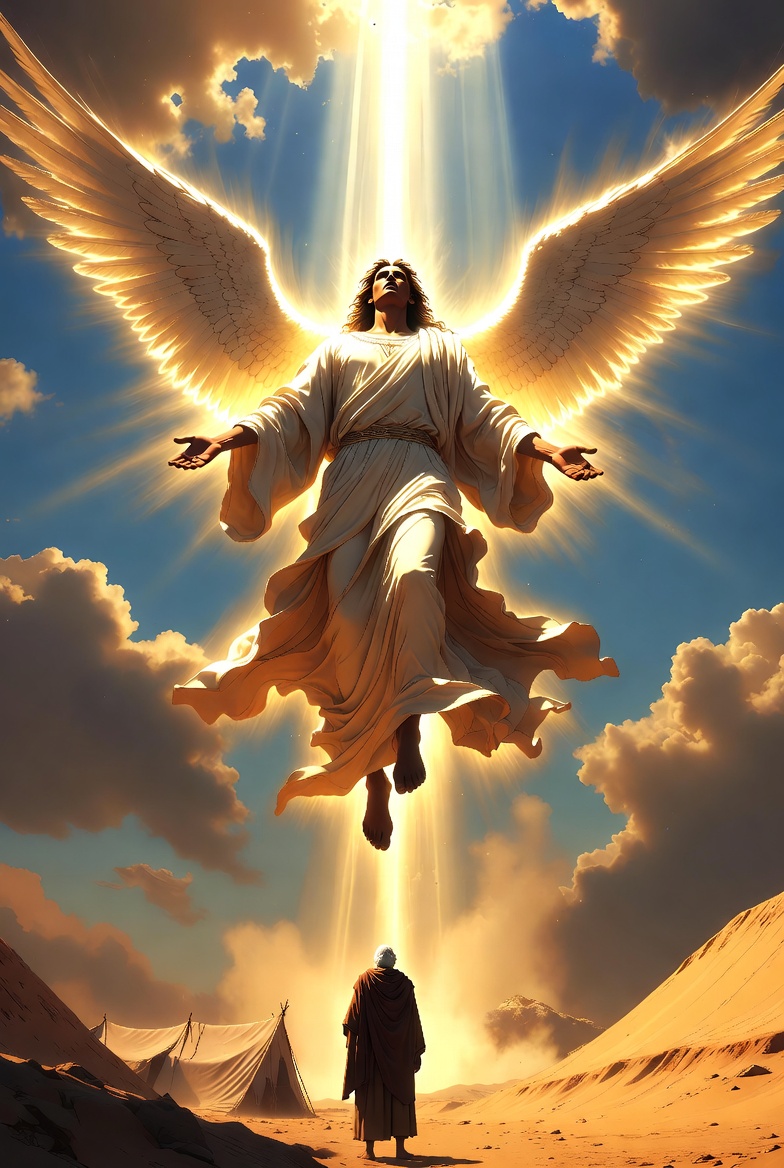
As I’ve mentioned previously, no man could withstand seeing the actual Being of HE WHICH IS. This wasn’t QUI EST that Abraham saw Ascending to Heaven: this was one of His Angels… Messengers.
v.23
And when Abraham took Ismael, his son, and all the homebred of his house, and all whom he had bought, all the males of all the men of his house, and he Circumcised the flesh of their prepuce forthwith the very same day, as God had commanded him. Abraham was 99 years old when he Circumcised the flesh of his prepuce. And Ismael, his son, was full 13 years old at the time of his Circumcision.
Circumcision
Next to Moyses no one before CHRIST provided a greater impetus to Heavenly Father’s Religion for man than Abraham. The second Prophet-patriarch took GOD’s Commandment so sincerely that he grabbed every male in his household and personally Circumcised each. If Abraham went through all of this trouble to accomplish QUI EST’s word, does this not say something to you? Does not GOD’s word resonate piercingly through your heart as it does mine? It didn’t matter what age a man was. If you were a man in Abraham’s household, you were to be Circumcised. It must have hurt something fierce but…. that was the kind of man that roamed this world at one time. Hardened men who buckled when it came to the wishes of ELOHIM and His Prophets! What a remarkable journey ELOHIM’s Religion has traveled!
v.26
The self same day was Abraham Circumcised and Ismael his son.
If a 99-year old man succumbed to Circumcision, what does this tell you about GOD’s word, promises and forgiving heart?
v.27
And all the men of his house, as well the homebred as the bought servants and strangers, were circumcised together.
all the men
Does this not provide a snapshot of GOD’s Church & Religion? A Church in which all of man is unified: Jew, Gentile, and non-believer (or others). Perhaps Moyses writes this because it could be another reference to the Holy Trinity.
—end 17th Chapter—
© 2022-2026, Brother Sebastian & Shepherd Corps Sanctuary, all rights reserved. Work may be borrowed or used but Shepherd Corps source credit must be identified.
Borrowed works are cited elsewhere on this Liturgy tab.
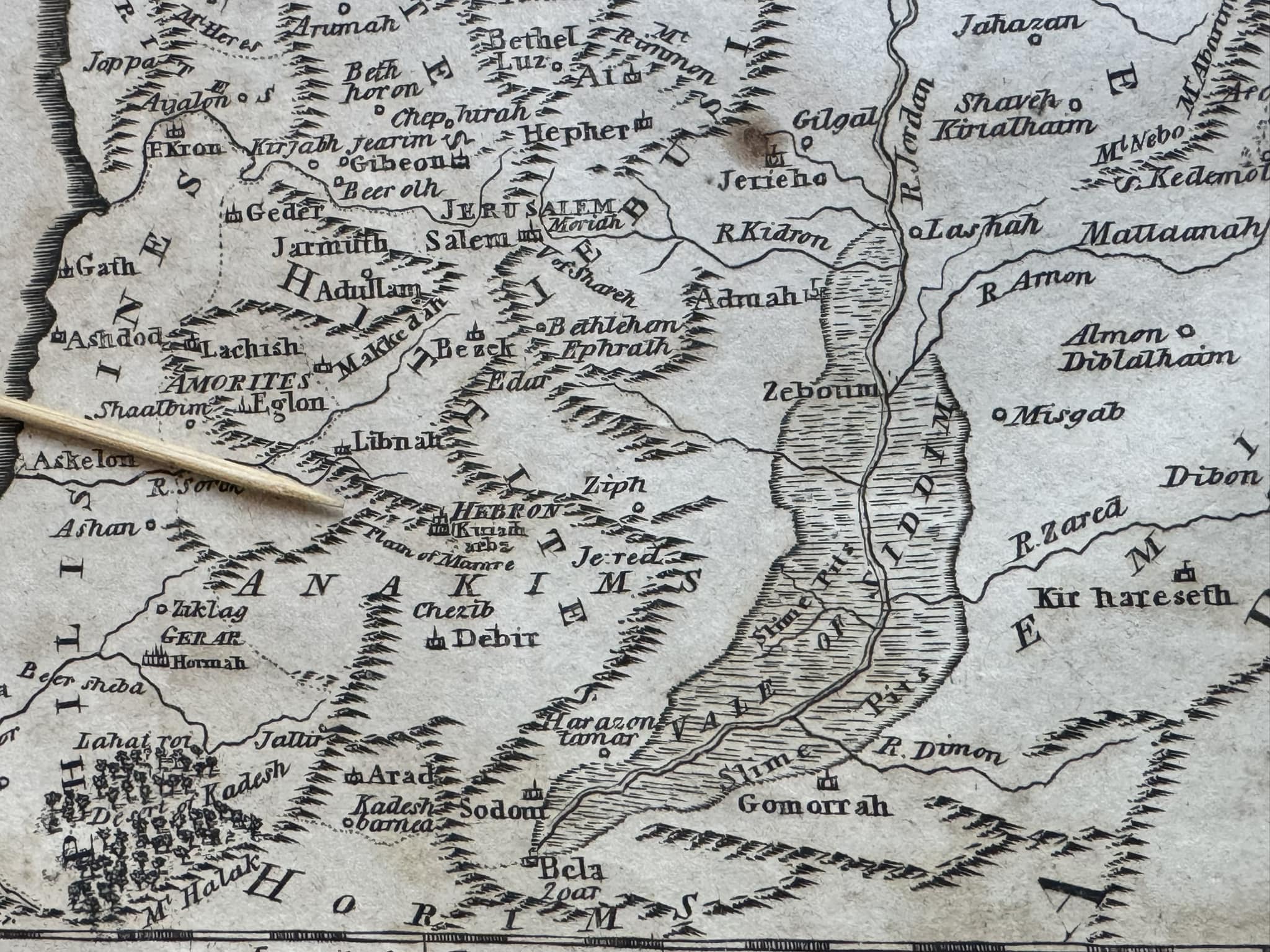
Map 1: Valley of Mambre
And God appeared to him in the vale of Mambre as he sat in the door of his tent, in the very heat of the day. And when he lifted his eyes, there appeared to him three men standing near unto him whom after he had seen, he ran to meet them from the door of his tent, and adored to the ground.
Even during intense trapped valley heat, ELOHIM is easily recognizable: overheated and fatigued, Abraham wastes little time recognizing Who approaches. i know when i actually thought i was about to meet Heavenly Father at His Church in S George, I could not rush down the mountain fast enough! And during the entire drive down, the palpitations from my myocardium never ceased–neither did the laughter, for that manner. This episode occurred because of change of pain medication which compelled my mind to hallucinate, unfortunately. Be it as it may, if it was an exercise in faith and belief, I do hope QUI EST Gave me a passing grade.
v.3
And he said:
Lord, if I have found grace in thy sight, go not past thy servant; but I will fetch a little water, and wash ye your feet, and rest ye under the tree.
Lord, if I
Abraham did indeed see three Entities but adored one. This becomes the first Passage of QUI EST Revealing to mankind three Divine Persons in one GOD.
v.5
And I will set a morsel of bread, and strengthen your heart, afterwards you shall pass. For, therefore are you come aside to your servant.
Who said:
Do as thou hast spoken.
Abraham made haste into the tent to Sara, and said to her:
Make haste, temper together three measures of flour and make hearth cakes.
This is such a heart-warming passage that draws splendiferous parallels to Heavenly Father’s Spouse:
v.7
But himself ran to the herd and took from thence a calf very tender and very good, and gave it to a young man, who made haste and boiled it.
Saint Ambrose of Milan deciphered that the prepared calf as a type of CHRIST and the meal as a shadow of the Eucharist, of which i concur. He elucidated the contrast in timing and manner with the Passover lamb of 12Exo: the lamb is killed at sunset in the midst of the whole assembly. In this scene Abraham’s meal takes place at midday; and the calf is served with milk, that is, not with blood but with the purity of the faith. Thusly, the calf itself is good as it washes away sins. The calf is also tender as it accepts the yoke of the Law and the Cross without a stiff neck–meaning, its bones aren’t broken and it’s eaten in its entirety. As per the learned Father’s assessment, the Law was revealed only in shadow; tis the Gospel the portrays the Law in reality.
If one agrees with Ambrose’s stellar deduction, the earlier Eucharist reflects the Old Testament thanksgiving sacrifice. Thusly, an animal is slaughtered, blood is shed, and, the rite remains carnal & repeated. You can also see that Abraham’s meal begins to spiritualize that type—the victim is still slain yet it’s consumed with milk (purity of faith) rather than blood. This certainly points forwards to the Eucharist of JESUS in which the same Victim is offered, but now in an unbloody manner under the appearances of bread and wine. The one bloody sacrifice of the Cross is made present sacramentally; the faithful receive it by faith, not by a new shedding of blood. The fatted calf of the parable of the prodigal son (Luke 15) is the same figure: the Father slays the Son for the returning sinner, yet the banquet itself is the beautiful non-bloody memorial.
In conclusion, this scene does not deny that blood was involved in the type; it shows the type already moving towards its fulfillment, where the bloody reality of Calvary is given under the form of a pure faith-received meal.
Pay special attention to the above video. As you view it you shall see an incredible miraculous event unfolding during the recording of this video (hint: watch the rodent).
v.8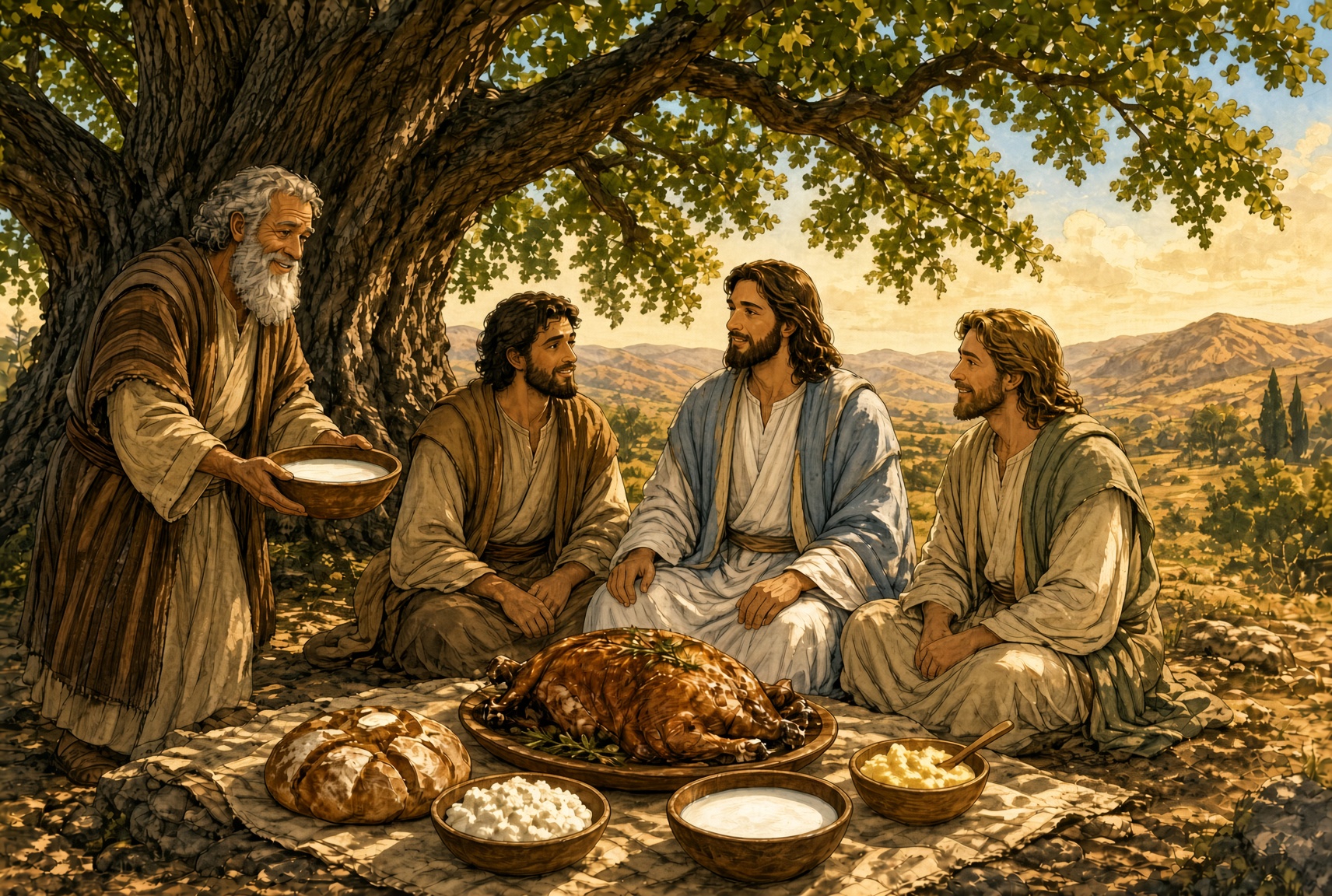
He took also butter and milk, and the calf which he had boiled, and set before them; but himself did stand beside them under the tree.
Obviously, Abraham standing reveals a gesture of hospitality. A custom of the ancient Near-Eastern is that a host of high standing doesn’t sit & dine with honored guests; he remains on his feet to wait upon them. So respectfully, he stands by them under a tree as their attendant, ready to serve. The Fathers repeatedly note the same humility: Ephrem remarks that Abraham did not dare recline with them but like a servant stood apart.
Deeper reflection reveals the same posture is given a spiritual reading that continues the Eucharistic typology we’ve already seen in the calf. S Bede explains that Abraham stands in the Lord’s presence while the meal is consumed, just as the sons of the promise must always stand before God when they offer Him the spiritual feasts of faith and good works. The tree itself has an identity: the Tree of Mambre, whose name means vision or clear-sightedness, as per Origen. Spiritually, it represents the Tree of the Lord’s Passion, which is the Cross under whose shadow the Church now stands and glories–6Gal14. In other words Abraham, the father of faith & nations, already ministers the banquet of the Incarnate Calf to his most divine guests. He does this while standing beneath the Cross—an image of the Priest, or the assembled Church, at the unbloody sacrifice. GOD’s second Prophet serves in lieu of reclining as an equal diner.
In short, Abraham does not join the supper as a fellow guest because he is the minister of the meal. He’s also the worshipper who remains standing in the presence of the Lord under the tree that foreshadows the Cross.
Where is Sara, thy wife?
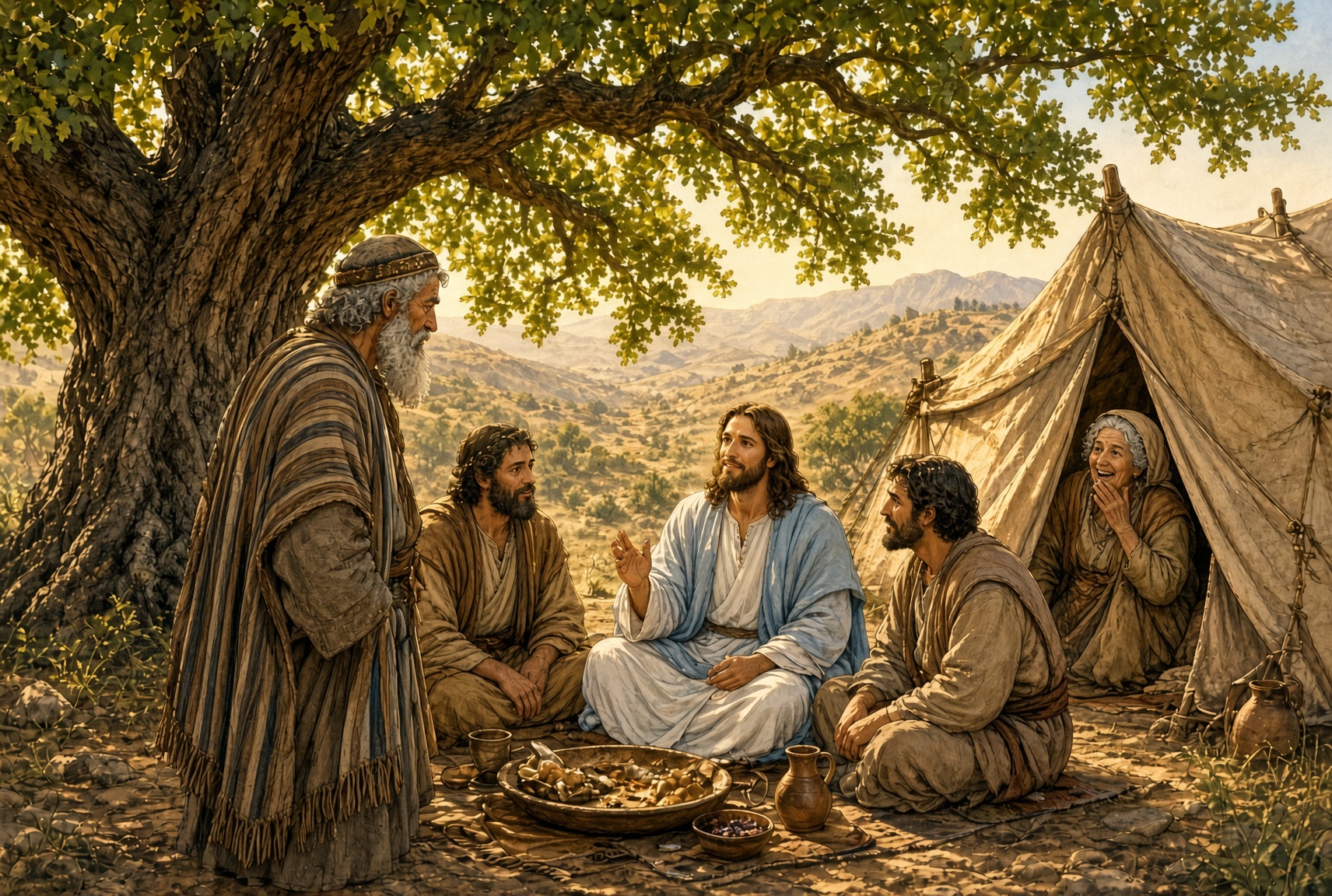 To whom he said:
 Returning I will come to thee at this time, life accompanying, and Sara, thy wife, shall have a son.
Why did Sara laugh, saying: shall I an old woman bear a child indeed? Is there anything hard to God?
In summation, Moyses tells us Sara no longer has monthly fertility blood flows because the time for birthing womanhood has long passed her–or so she thought. Her quiet laughter may have not been heard by the ears of man, but, for ELOHIM Sara’s dubious words came to Him loudly and clearly. To Sara, even love making is something of the past for her and Abraham. But let’s assume Sara’s stance. For her entire life this stunning woman wanted nothing more than to form and develop a beloved family–especially for her lord, husband, and patriarch. Maybe she did not recognize the Men as Messengers of HE WHICH IS, or maybe she did. Moyses doesn’t clarify. But as a refined woman of logic and love, obviously she would doubt even herself because of her advanced age. To become a mother at this age is/was unheard of! But to QUI EST… positively nothing be impossible.
v.14
According to appointment, I will return to thee this very self same time, life accompanying, and Sara shall have a son.
v.15
Sara denied, saying:
I laughed not, being much afraid.
But our Lord:
It is not so, saith He, but thou didst laugh.
The laughter of a husband, then of a wife
Abraham’s laugh was with admiration for joy and wasn’t reprehended for it. Sara’s laughter was one of diffidence and was reprimanded for it, proving nothing escapes HE WHICH IS: even the secrets of the heart. Additionally, Moyses includes these Verses of Sara to inform us of something spectacular about Heavenly Father. Neither man nor beast can maintain a secret from QUI EST. ELOHIM absolutely Knows the trials, truths and desires of our hearts. Just because one may be successful at cloaking one’s sins from others doesn’t mean the same goes for our Lord. There is not one thing anyone can conceal from HE WHICH IS.
The Angels responding to Sara’s lie also teaches us something else. It has to do with His Church. Heavenly Father Establishes for us a way to communicate our sins to Him! This is done by way of His Priests. JESUS CHRIST is both the father and implementer of the Sacrament of Confession in His Church–not man or Apostle, as many believe. Moyses writing of this most exceptional meeting between man and the Holy Trinity is absolutely something to remember. Only Abraham (and Sara) has been Provided the blessed opportunity for such a glorious opportunity: to meet three heavenly Messengers simultaneously, representing the Father, Son, & HOLY GHOST!
v.16
When the men, therefore, were risen up from thence, they turned their eyes against Sodome. And Abraham did go with them, bringing them on the way.
Ever so proud and elated to be amongst our Creator, of course Abraham is going to remain with His Angels as long as he possibly can! Wouldn’t you? 🙄 Tis a reason Moyses includes this scene: to reveal the exuberance of a human who’s able to recognize HE WHICH IS. Patriarch Abraham was so in love and obedient to our Lord, every move he makes is a fantastically pure reflection of that! Dearest Reader, there was nothing super human about Abraham. He was no different than you or me but probably one thing–his most devoted and unending love for QUI EST. For males seeking a bona fide role model, you absolutely cannot do better than GOD’s second Prophet, Abraham.
v.17
And our Lord said:
Can I conceal from Abraham the things which I will do? Whereas, he shall be into a Nation great and very strong, and in him are to be blessed all the nations of the Earth? For, I know that he will command his children and his house after him that they keep the way of the Lord, and do judgment and justice. That for Abraham’s sake the Lord may bring to effect all the things that he hath spoken unto him.
Here again Moyses reveals the extraordinary confidence QUI EST has in Abraham as well as his lineage to remain loyal to Him.
Also, did you happen to notice the multiple times HE WHICH IS switches tenses about Himself? The passage itself is what’s referred to as a divine soliloquy, meaning, GOD Deliberates internally or audibly to/for Abraham. When He alters from the first person to identifying Himself in the third person, this is actually a recognized Hebrew stylistic feature and not a change of speaker. Such a Hebrew narrative often allows a speaker to refer to himself by his own proper name or title for solemnity. Here the title is the covenant Hebrew Name, YHWH. By saying the way of the Lord and that the Lord may bring, QUI EST underscores the promises rest on His unchanging covenant character, not simply on the personal “I” of the moment. There are many biblical experts who argue that the third-person title makes the assurance more formal and binding.
There’s something else you should realize. The apparent tense shifts follow are aligned with the Hebrew verbal aspect versus the English tense:
Put altogether you come up with: GOD therefore speaks as the One who has already chosen Abraham, Who is even now about to act in judgment, and who will certainly complete what He has spoken. All of this provided the Abraham household keeps the way of the Lord. The mixed persons and aspects allow us to hear both the personal intimacy of the Friend of Abraham and the official covenantal authority of YHWH who cannot fail His own word.
There’s a personal note i wish to add. This scene absolutely makes me smile because these Words provide the most fascinating flattery ever to occur on terra! QUI EST flatters and compliments Abraham on his adamant determination, for himself as well as his family, to follow Him for eternity. QUI EST is so thrilled and confident with Abraham that He even tells him, with full confidence, that his future family will also follow along the same line of faith established by Abraham and his beloved, Sara.
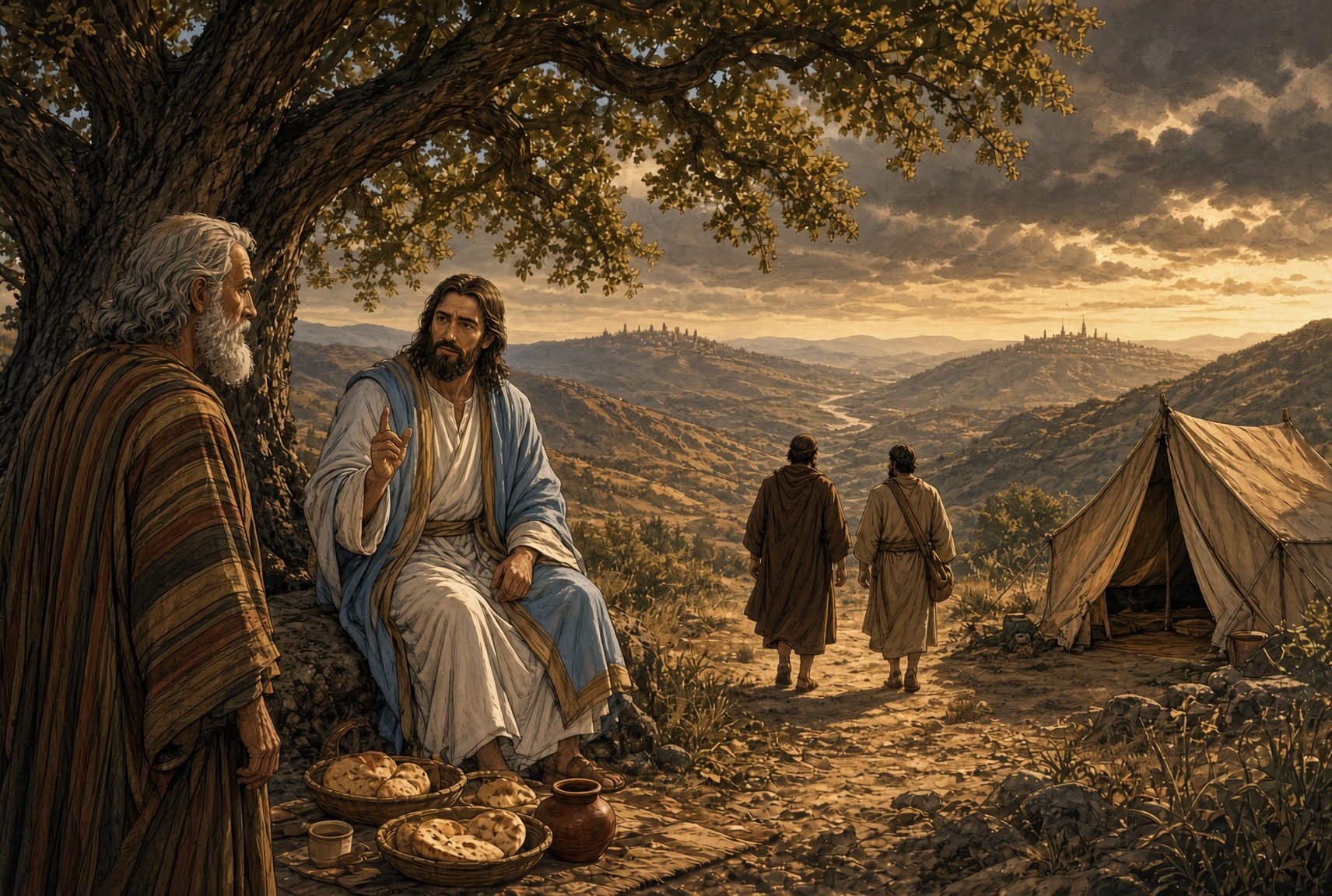 v.19
v.19
Therefore, said our Lord:
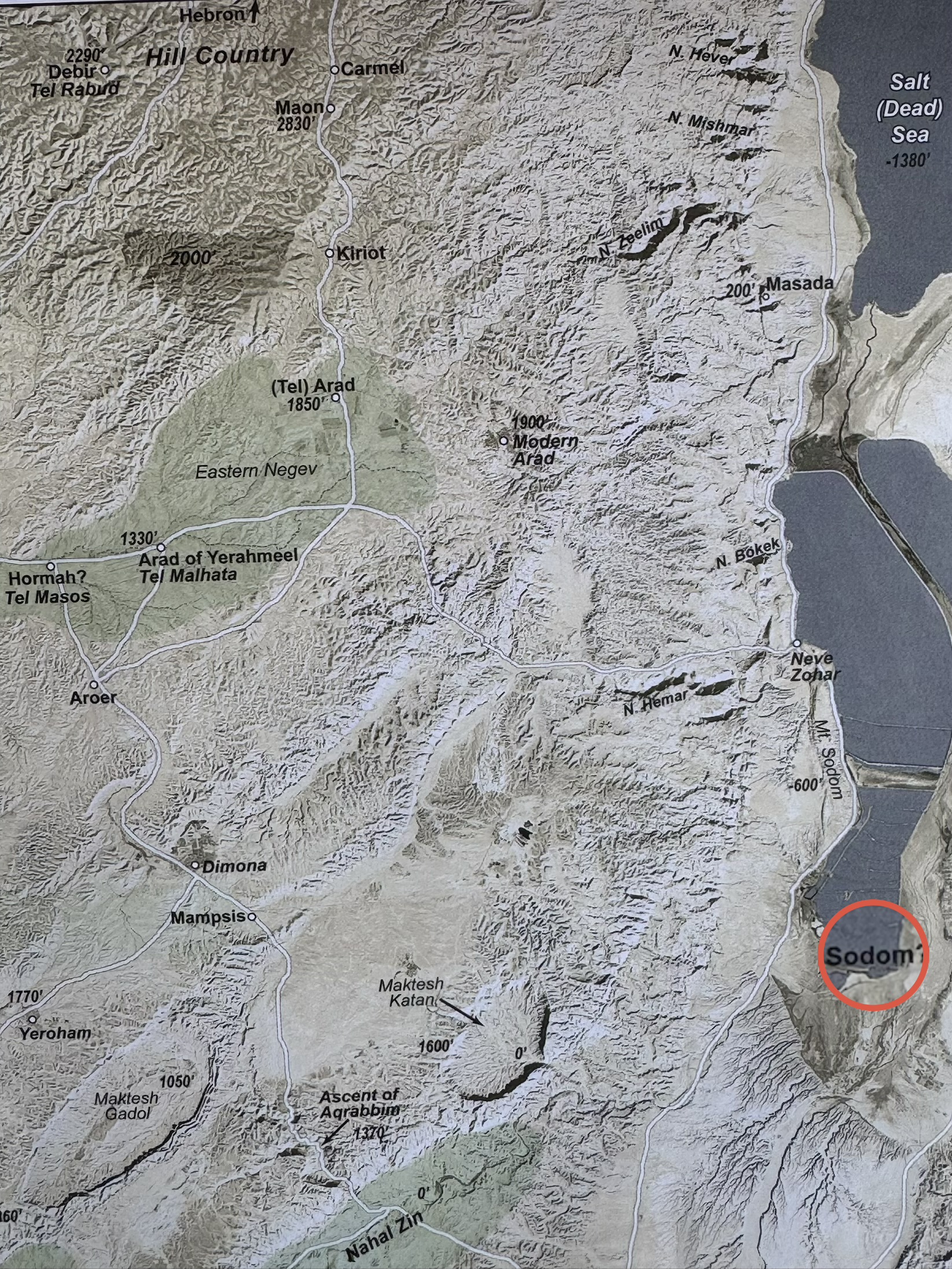
map #2: presumed locale of Sodom=red loupe
The cry of Sodome and Gomorre is multiplied, and their sin is aggravated exceedingly. I will descend and see whether they have in act accomplished the cry that is come to me: or whether it be not so, that I may know.
And they turned themselves from thence, and went their way to Sodome. But Abraham as yet stood before our Lord.
O, how marvelous that Abraham refused to let QUI EST out of his sight! Such an admirable tenacity. Moyses writes this because he’s attempting to portray the relationship between ELOHIM and man is one in which both sides must contribute in order to achieve balance. Heavenly Father is not a tyrant, as evidenced here. QUI EST exceedingly contributes to this hallowed relationship and He expects the same integral effort from us. This follows perfectly with the ultimate gift given to man that is the envy of every other species in the universe: freewill. But there’s even a more highly respectable reason why Abraham adamantly pursues the Messengers. He’s trying to save his fellow man! Abraham’s much forgiving heart is so laced with love of his race that HE WHICH IS obviously Sees this. This is a definitive reason why else Heavenly Father so loved and enjoyed Abraham.
v.23
And approaching he said:
What! Wilt Thou destroy the just with the wicked? If there shall be 50 just persons in the city, shall they parish withal?
If there shall be 50
This is a microcosm of GOD’s Church to come by way of His Son. As patriarch Abraham boldly requests for 50 just persons to be found, the Son Of Man will later allow Himself to be hanged onto a Cross in which all mankind will have the opportunity of being saved. All man has the freedom to choose to live one’s life for vitam aeternam in harmony with the Divinity. All mankind now has the choice for his/her future. Further, just men are a formidable wall in/for their own nations. It’s their faith that saves us and it’s their justice that defends us from destruction.
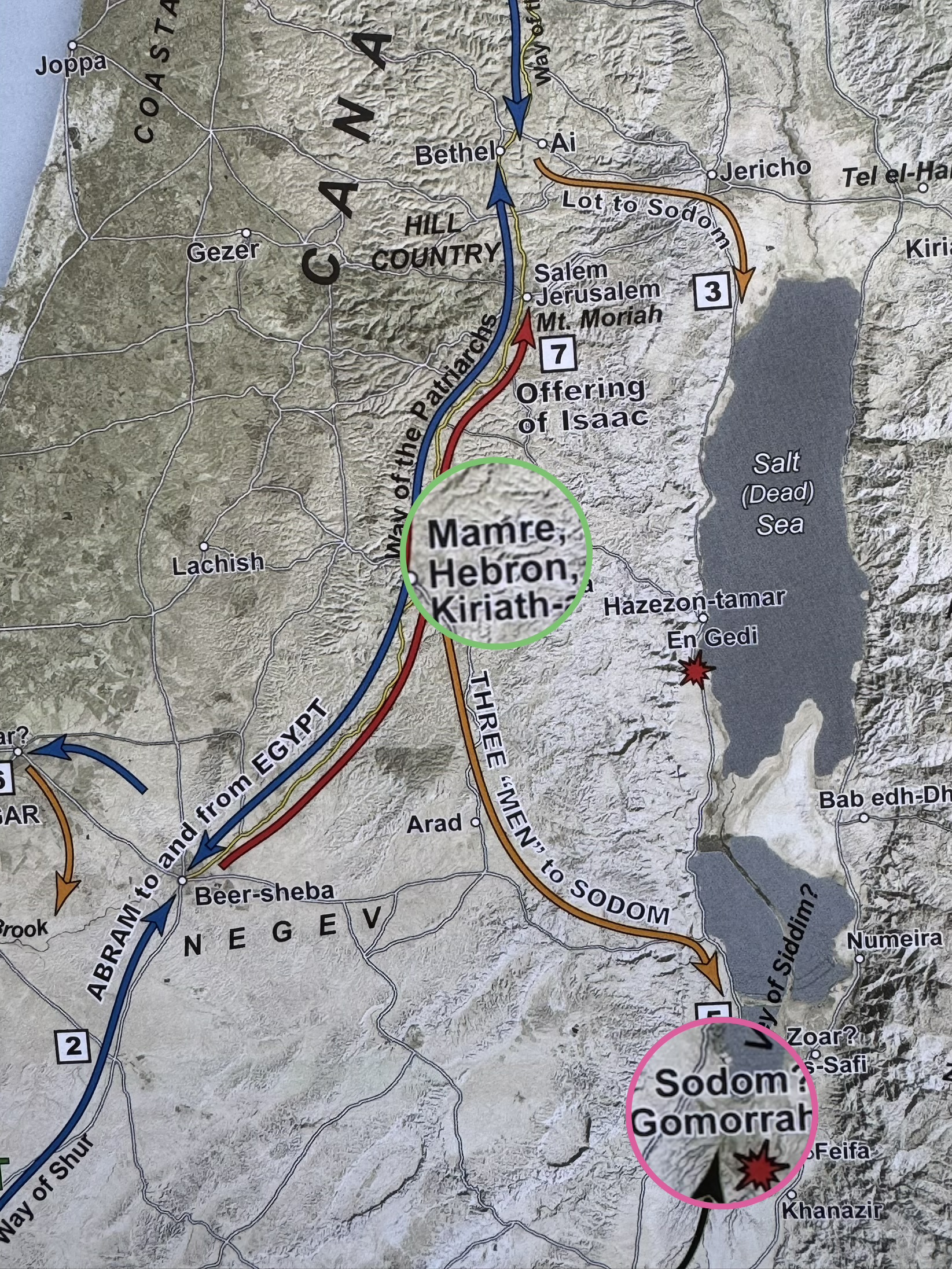
map #3: Mambre=green loupe, Sodom=pink loupe
v.24
And wilt Thou spare that place for 50 just, if they be therein? Be it far from Thee, that Thou do this thing, and that Thou kill the just with the wicked, and that the just be in like case as the wicked, this is not beseeming Thee, Which judgest all the earth; no Thou will not do this judgment.
And our Lord said to him:
If I shall find in Sodome 50 just persons within the city, I will spare the whole place for their sake.
Both Abraham and Moyses were two staunch Prophets who had the nerve and courage to engage in debate with QUI EST. There is no arguing this. i next present you with a couple of spiritual interpretations of this explosive dialogue between Heavenly Father and a man’s representative, Prophet Abraham.
This scene is certainly one of the Bible’s clearest presentations of moral reasoning directed at QUI EST.
To summarize: the moral interpretation here is that GOD is just and merciful, righteousness has preservative power, and, Homo sapiens are invited to stand in the gap and appeal to that character.
Christian and some Jewish traditions read the scene as pointing beyond the historical cities, such as:
These allegorical conclusions don’t cancel the moral evaluation; they actually extend them. The historical negotiation of, about fifty just men, becomes a picture of how divine justice and mercy actually operate in history. Meaning, QUI EST would rather save the many for the sake of the few than destroy the few along with the many. Of course Christian theology ultimately does precisely this via one righteous and divine Man.
v.27
And Abraham answered, and said:
Because I have once begun I will speak to my Lord, whereas I am dust and ashes.
Although well-respected and adorned by his fellow man, in all humility Abraham makes no qualms about diminishing his importance amongst his fellow brothers and sisters to Heavenly Father. Another attribute which so solidified the relationship between Abraham and HE WHICH IS.
dust and ashes
The undeniable modesty of Abraham is on full display with this text. With these Words Abraham humbly names the tension that makes the next Words possible: he has begun to speak; therefore he continue speaking, albeit he is merely dust and ashes. Once the conversation initiated, silence would be a kind of unfaithfulness. So the fabulous patriarch treats intercession as something that, once begun in QUI EST’s presence, must be carried through. Make no mistake, the statement isn’t swagger; tis a confession of two facts spliced together:
Dust and ashes is not poetry for humility. Dust & byproducts are what Adam was Created from and what he will return to. Further still, ashes are what remains after judgment by fire—the very fate hanging over Sodom. Abraham locates himself on the same side of creation and mortality as the city he is pleading for. Comprehend, he doesn’t argue as a peer of HE WHICH IS. He doesn’t even debate as a righteous exception floating above the wicked. He contends as one who knows he is mortal… imperfect… combustible.
The Verse teaches a followable pattern for approaching our Creator:
The quantities that follow—45, 40, 30, 20, 10—are the working-out of this sentence. Each reduction is another act of the same logic: I have begun; I am nothing; I will keep asking.
What’s the spiritual message being presented to us here? Firstly, be convinced that there’s more to this scene than just a negotiation tactic. You should know Abraham becomes the first recorded intercessor who knows QUI EST’s justice as compared to his own nothingness. As per my earlier statement, a type of CHRIST can be recognized here because Abraham speaks for the world from a pedestal of assumed flesh {dust} who shall pass through the fire. This also becomes a prayer of the Christian Church in the same double motion, as in: we have begun to speak because we have been brought near, and we speak as those who are still dust. The Jewish take stresses the daring of chutzpah shel kedushah—holy boldness. This is so because Abraham is teaching Israel how to present one’s self before Heavenly Father by not inflating the self, nor refusing to use the access that has been given. Finally, there’s something else this blessed phrase does. It answers the earlier query, although quietly, Shall not the Judge of all the earth do right? The Judge may be addressed by dust. Thusly, that is part of what it means for GOD to be Judge of all the earth, which includes the ashes.
If the sentence is allowed to keep speaking, it says something like this:
Once God has let a human being stand in His presence and speak about the fate of others, that human being is no longer free to retreat into mere self-preservation. The knowledge of being dust does not end the conversation; it is the only honest way to continue it. Mercy is asked for by someone who knows he himself could be ash. Justice is invoked by someone who cannot claim exemption. The prayer that saves a city, if it saves anything, is prayed from the ground, not from above it.
Abraham does not become less dust by speaking. He becomes the dust that speaks. That is the whole drama of the verse.
v.28
What if there shall be five less than fifty just persons? Wilt Thou for 45 destroy the whole city?
And He said:
I will not destroy it, if I shall find five and forty.
And again he said to Him:
But if 40 shall be found there, what wilt Thou do?
He said:
I will not strike it for 40’s sake.
Lord Bless the tenacity of Abraham and later the zeal of Moyses. Abraham’s love for his neighbor nearly equals his love for GOD, thusly, only for this is why he finds the courage to press our Creator more than a couple of times. Testing our Lord’s patience is what Abraham may have thought during his persistence. Apparently, however, HE WHICH IS Admires such perseverance for one’s fellow man.
v.30
Lord, saith he, be not angry, I beseech Thee, if I speak. What if 30 shall be found there?
He answered:
I will not do it, if I shall find 30 there.
Because, saith he, I have once begun, I will speak to my Lord. What if 20 shall be found there?
He said:
I will not destroy it for twenty’s sake.
I beseech thee, saith he, be not angry, Lord, if I speak yet once more. What if ten shall be found there?
And He said: I will not destroy it for ten’s sake.
And our Lord departed after that He ceased to speak unto Abraham. And Abraham returned into his place.
© 2020 – 2026, Brother Sebastian with Shepherd Corps Sanctuary. All rights reserved. Any works here may be borrowed but credit must be revealed in 12 or larger font.
Works borrowed to this point include:
The Holy Bible & Apocrypha by the English College of Douuay, M DC XXXV, 1609.
The Holy Bible with the Apocrypha 1814 Printed & Published by M. Carey, #121 Chestnut St; Philadelphia.
Illuminated Bible 1846 Harper & Bros Publishing, 82 Cliff St., New York.
The Holy Bible 2013, Loreto Publications, Fitzwilliam, New Hampshire.
Satellite Bible Atlas 2016, 2nd Edition. By William Schlegel, Israel.
https://biblehub.com/atlas.htm 2004-2026 by Bible Hub.
map #1: Sodom=loupe
And the two Angels came to Sodome at evening; and Lot sitting at the gates of the city.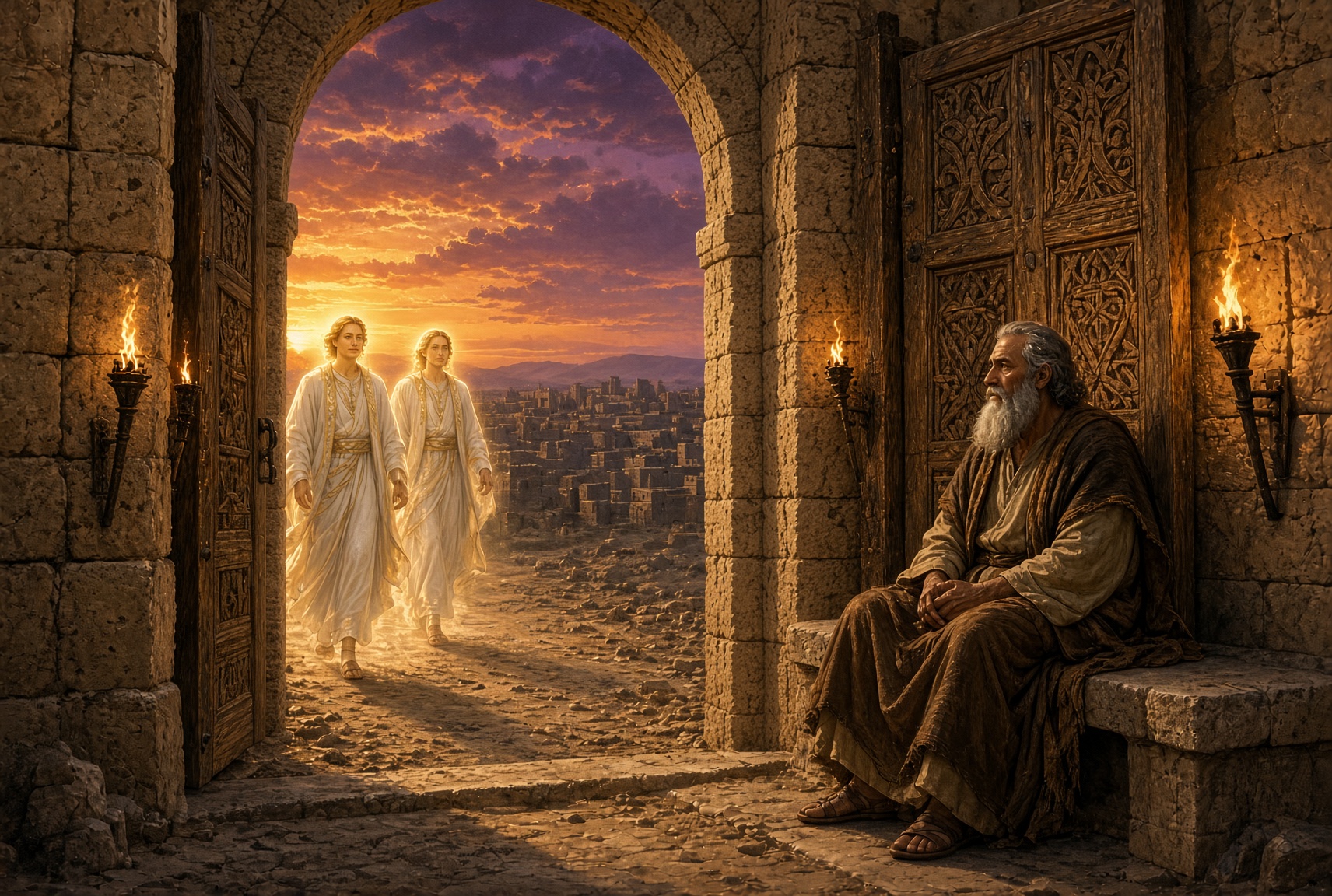
How blessed the family of Abraham as it is Visited by HE WHICH IS twice! Nonetheless, Moyses writes a distinct difference between both visits. The Holy Trinity in divine force tallied with Abraham. When they reach Sodome to the southeast, his nephew, Lot, is visited by two of the Messengers–as in, GOD the Father and His Son. As They Informed the second Prophet of their intent to get a feel of the populace in Sodome, GOD treads specifically to see how His Church will be accepted there. Additionally, the hospitable patriarch & his nephew merited to receive angelic Messengers instead of men! Nowadays, such a heavenly Visit would probably go unnoticed unless It’s announced by a bleep or a ring from cellphones.
Lot is not described as “waiting” in the sense of a planned appointment. Genesis 19:1 says he was sitting in the gate of Sodom when the two angels arrived at evening. In that world the gate explains both his presence and what he does next.
In an ancient walled city the gate was town hall, courthouse, and checkpoint. Elders sat there to judge cases, hear news, watch who entered, and conduct business (Ruth 4; Deuteronomy 21–25; Proverbs 31:23). To sit in the gate was to occupy civic space. That is why the men of Sodom later snarl, “This fellow came to sojourn, and he has become the judge” (Genesis 19:9). His seat already looked like authority.
So one reason he is there is status. Lot has moved from pitching tents toward Sodom (Genesis 13) to living inside it and taking a place among those who run it.
Evening is when travelers need a roof. The square is where they would otherwise sleep—and in Sodom that was dangerous. Lot rises at once, bows, and presses the visitors to come home. Commentators from Clarke onward take this as deliberate: he sits where newcomers appear so he can intercept them before the city does. Abraham sat at his tent door in the heat of the day and ran to guests. Lot sits at the city’s threshold at dusk and does the same work in a worse place. Hospitality learned in Abraham’s household is now practiced as rescue.
The angels first refuse and say they will stay in the square. That tests the city. Lot knows the square is not safe; his insistence is knowledge of Sodom, not mere courtesy.
The verse also sets a contrast. Abraham receives the Lord at the tent in open country. Lot receives the two messengers at the gate of a condemned city. One man is still a sojourner under oaks; the other has a house, a seat, and a compromised life. Sitting in the gate means he has influence—and that he has settled where influence is bought at the price of living among the violent.
Spiritually he is at a threshold in both senses: the physical gate of Sodom, and the line between the household of Abraham and the city that will burn. He is there because that is where elders sit, because that is where strangers arrive, and because the story needs the one righteous man in Sodom to be found exactly where the city meets the road.
v.1
Who, when he had seen them, rose up and went to meet them, and adored prostrate on the ground, and said:
I beseech you, my Lords, turn into the house of your servant and lodge there; wash your feet, and in the morning you shall go forth on your way.
v.2
Who said:
No, but We will abide in the street.
ELOHIM is already cognizant of the purity of Lot’s soul and heart. GOD is not in Sodome to spend much time with Abraham’s nephew. Instead, His singular purpose is to see if Sodomites are worthy and prepared for QUI EST’s Church. Therefore, the answers He Seeks are not within Lot’s home but upon the city streets.
v.3
He compelled them earnestly to turn in unto him. And when they were entered into his house, he made them a banquet and baked unleavened bread; and they did eat.
Recall when Abraham also prepped and served a meal to the 3 Angels. Moyses is brilliant to write Lot’s meal so a comparison can be made to the family Patriarch’s. Being Abraham was the Priest of the family, his superior, Melchisedec, also responsibly prepared and served the Holy Sacrifice to pre-serve and bless the subsequent banquet.
v.4
And before they went to bed, the men of the city beset the house, from young to old, all the people together.
This is a repeated theme we shall illuminate throughout the Liturgy: evil knows its weak being solo. This is why it takes a mob to confront ELOHIM here and various other places throughout the Liturgy. It certainly took a gang of CHRIST’s enemies to scorn, prosecute and execute Him! Always, when mankind is uncertain of his/her actions he/she will involve himself/herself with a group in order to strengthen his/her position. Those who walk firmly in truth, constantly seeking knowledge, you will discover such persons confidently & fearlessly delivering a message without the aid of others. JESUS parlays the quintessential example of a liberated and independent Man who needed only Himself and His Father’s message while traipsing terra. Ask yourself who is you would follow. The loud mouth who is constantly engulfed by supporters and speaks in generalities? Or the lone quiet one who delivers an acute liturgical message then moves on to the next town?
v.5
And they called Lot, and said to him:
Where are the men that came in to thee at night? Bring them forth hither that we may know them.
Lot not only knows man but he certainly knows the residents of his city. And he knows that with a puffed mob, both trust and honor promptly go out the door. Alas, as a faithful follower of Abraham and the Lord, Lot thinks of the only thing he can do to thwart the swelling mob rage. He’s willing to sacrifice his body to greet and potentially calm the aggrandizing hostility. Lot does this as a defender of ELOHIM’s Church.
v.6
Lot, going forth to them and shutting the door after him, said:
Do not so, I beseech you, my brethren. Do not commit this evil. I have two daughters which as yet have not known man. I will bring them forth to you, and abuse you them as it shall please you, so that you do no evil to these men because they are entered under the shadow of my roof.
To the family of Abraham, nothing surpasses QUI EST. More specifically, Lot understands Heavenly Father Brought His Spouse to Sodome… and to Lot’s house. Such exceptional purity can’t be tainted by man and Lot does his best to thwart these hyped men. Further, like his uncle, Lot knows fully well why the Lord has come. And if these angered men aren’t stopped, they will prove to QUI EST that Sodome has no just men! As Abraham desperately defended man and Sodome, so too does his seed.
v.9
But they said:
Get thee back thither!
v.9
And again:
Thou camest in,
–said they,
…as a stranger, what to be a Judge?
O, how the flames of deceit grow when man grows weary of his own self-preservation. The American nation today exemplifies this. How good we all pretend to be, especially when collected as a mob. Will not one in the mob point the finger at himself to see if he truly is good? Or is she good and just because the mob says so? And once again we see the mob rule coming to play. When one lives an honorable life completely respecting ELOHIM and His Laws & Commandments, such a person has no need at all from man’s mob.
v.9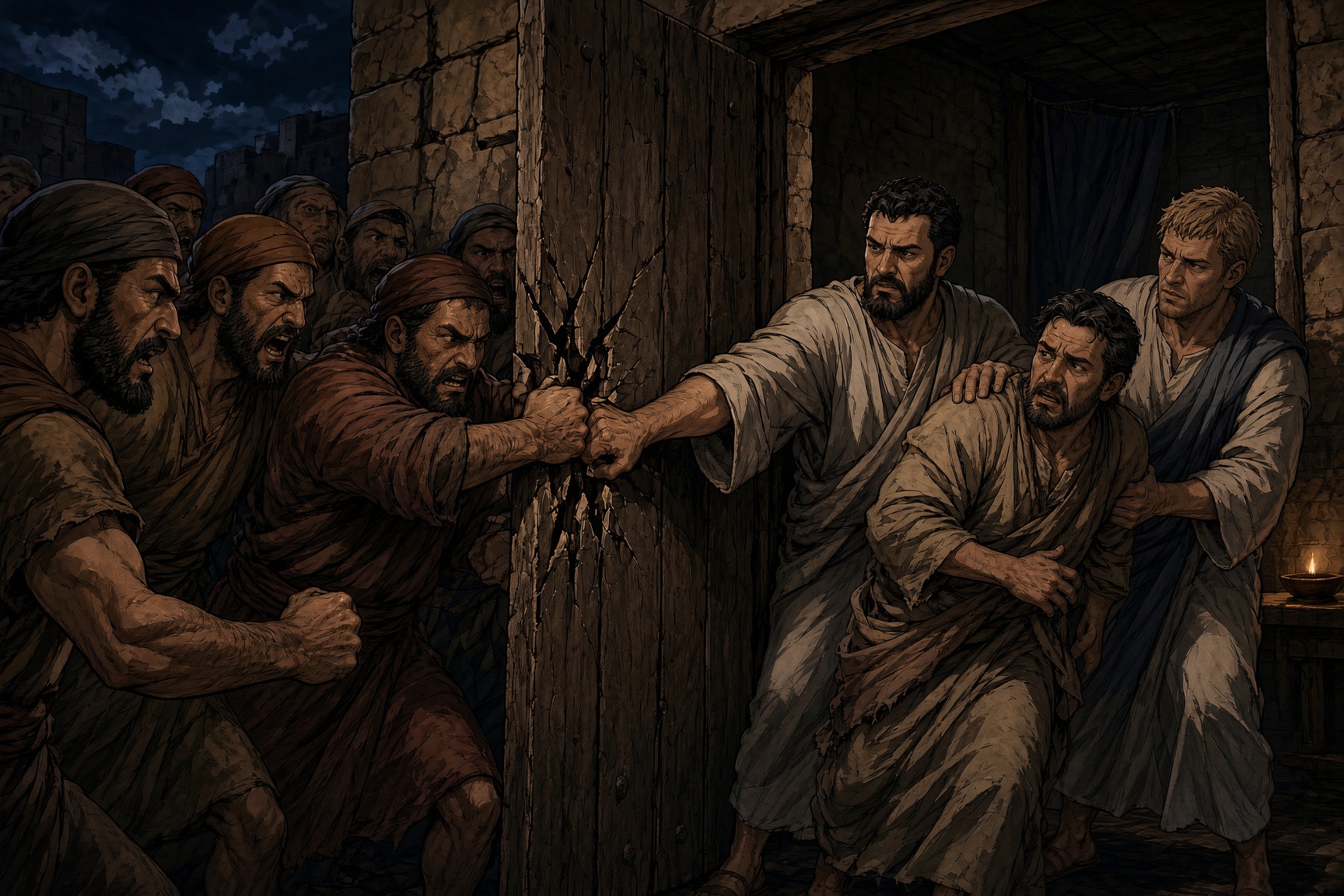
And they did violence to Lot exceedingly. And it was even now at the point that they would break the doors! And behold the Men put forth their hand and drew Lot unto them and shut the door!
As JESUS Told us, blessed be the one who fights for the name and company of our most blessed Lord, alleluia! If and when the time arrives when ELOHIM comes to you… shall ye be ready? Shall ye be prepared like Lot? If you’re having difficulties seeking a male role model, Abraham & Lot are two sensational examples. How blessed fortunate terra would be if more men could mime GOD’s second Prophet and his nephew. Sensational Lot, who knows full well GOD needs no protection from man, volunteers his body anyway in order to thwart the fury and jealousy of man enveloped by darkness!
QUI EST very well knows all of our weaknesses and strengths. And man… enraged as a group to perform violence on others… simply becomes a cowardly minion of the devil. But when alone and without public attention, such a person becomes deflated to his or her own emptiness.
v.11
And them that were without they struck with blindness from the least to the greatest so that they could not find the door.
And They said to Lot:
Who still is here to you? Son in law, or sons, or daughters, all that are thine bring them out of this city. For, We will destroy this place, for that their cry is waxen loud before our Lord, Who hath sent Us to destroy them.
This sin cries to Heaven for vengeance. Lot, alone, did his humanly best to protect our ELOHIM, even using his own family as a potential defense. In the end not only does QUI EST Save Lot but He also offers to Save Lot’s family and extended family! This is truly symbolic of how Heavenly Father Rewards and Helps His children. Unlike man, GOD isn’t about quid pro quo; His involvement surpasses any man’s thought of proportions.
v.14
Therefore, Lot went forth and spake to his sons in law that were to take his daughters, and said:
Arise, get you forth out of this place because our Lord will destroy this city.
And he seemed unto them to speak as it were a jest.
And when it was morning, the Angels urged him, saying:
Arise, take thy wife, and the two daughters, which thou hast; least thou also parish withal in the wickedness of the city.
He lingering, They took his hand, and the hand of his wife, and of his two daughters, because our Lord spared him.
The Church Militant
Who represents what?
Lot represents the just man or of the Church Herself while She still dwells in the gate of the temporal city. He’s cognizant judgment ensues; therefore he goes out to warn those who are joined to him by affinity–sons-in-law who were to take his daughters. The daughters symbolize members of His Church, or Her affections of faith and charity. The sons-in-law personify those who have some outward attachment to the Church but have never truly left the city. When Lot speaks of imminent destruction they treat it as a jest. What we’re presented with here is the perennial experience of the Church militant: She preaches conversion & flight from the world, yet many who are nominally Hers regard the warning as exaggeration or pious talk. Nonetheless, their incredulity does not cancel Her duty; for, She must still speak.
What of Lot lingering? Even the just man, even the Church on terra, remains attached to the goods, habits, and relationships of the doomed city. He doesn’t rise at once. This is why the Angels seize his hand, his wife’s hand, and the hands of their two daughters because the Lord spared him.
The moral lesson is the Church militant doesn’t save Herself by Her own promptness. Grace must take Her by the hand and drag Her out. This is because hesitation is real, whereas, divine mercy is stronger. The same hand that pulls Lot also limits who may be pulled: the mocking sons-in-law remain behind. GOD’s Spouse cannot, by Her own effort, add one soul to the number of the elect; She can only warn and then Herself be extracted by HE WHICH IS.
Conclusively, this scene describes the Church’s double-condition while She is still militant. She must announce judgment to a world that laughs; and She must, Herself, be forcibly delivered from the very world She inhabits. She also happens to reflect the dutiful purpose of a Spouse to Whom She is wed.
An Anagogical Perspective
This scene provides us with a window of our & the Church’s present struggles up to the final separation by way of the following:
Tis JESUS Who supplies the anagogical key: As it was in the days of Lot\ldots they did eat, they drank, they bought, they sold, they planted, they builded; but the same day that Lot went out of Sodom it rained fire and brimstone from heaven and destroyed them all. Even thus shall it be in the day when the Son of man is revealed (17Luk28–30). The sons-in-law who treat the warning as a jest are those who will be eating and drinking when the sudden destruction comes. Lot and the two daughters who are led out by the hand are the remnant who, though they hesitated, are nevertheless extracted because the Lord spared them. In summation this rescue scene portrays a figure of the final judgment: the world consumed, the elect snatched away not by their own speed but by mercy, and the Church passing from her militant state into glory.
To conclude, the decisive actor isn’t Lot’s resolve but the hands of the Angels—meaning, divine initiative. The Church militant must speak and must be ready to leave; the Church triumphant will be the one that was taken by the hand.
v.17
And they led him forth and set him without the city.
And there they spake to him, saying:
Save thy life. Look not back, neither stay thou in all the country; but save thyself in the mountain, lest thou also perish withal.
In the ways of Heavenly Father, there are countless things He gives us the free will to choose for. There are other things, especially with His Spouse, in which He is meticulously specific, just as He is very specific with the instructions Provided here to Lot, like:
These are three very special and distinct set of instructions that entail obedience.
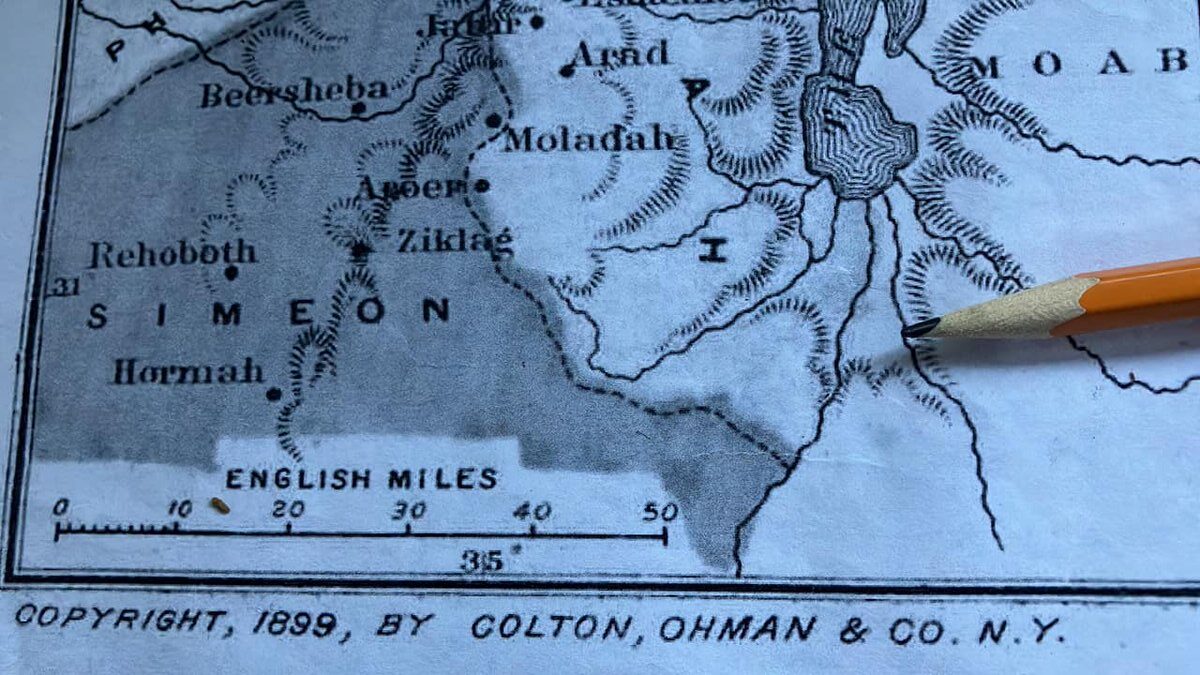
map #2: approximate location of Segor
v.18
And Lot said to them:
I beseech Thee, my Lord, because Thy servant hath found grace before Thee and Thou hast magnified Thy mercy, which Thou hast wrought with me, in that Thou wouldest save my life. And safe I cannot be in the mountain, lest perhaps the evil catch me and I die. There is this city hereby at hand whereunto I may fly, a little one, and I shall be safe in it. Is it not a little one, and my life shall be saved?

map #3: Segor/Zoar=marker shows ~locale
And He said to him:
Behold, also, in this point I have heard thy prayers not to overthrow the city for which thou hast spoken. Make haste and be saved there because I cannot do anything til thou enter in thither.
Therefore, the name of that city was called, Segor.
Segor
Segor means little one. Alas, because of Lot’s audacious tenacity to QUI EST’s Messengers, the tiny community of Segor and her citizens certainly owe their lives to Lot.
Lot’s “bargaining” with QUI EST provides insight into the soul of mankind. Firstly, we see Sodome as the world given over to vice. The mountain to which the Angels command Lot to flee is the height of evangelical perfection. This pertains to contemplation, virginity, & the total relinquishment of earthly goods. Next is the little city. Lot pleads for Zoar by telling GOD he won’t be able to reach the mountain. This is the lesser but still legitimate state of Christian life: marriage rightly lived, ordinary observance, a beginning of good works that has left the fire of the vices but has not yet climbed the mountain of the counsels. Therefore, Lot’s request is the figure of those members of the Church who, having been drawn out of the world, still lack the strength for the higher/spiritual way. Such members of His Church confess the mercy already shown them (Thy servant hath found grace) and ask to be allowed a closer & smaller refuge. And HE WHICH IS Grants it. The little city is spared not because it is holy & respectful of QUI EST, but because a righteous man will dwell in it. This tells us the Church has both the perfect, who ascend the mountain, and the imperfect, who are saved in Zoar–provided they have truly left Sodom and do not look back.
The Angel’s word—I cannot do any thing till thou go in thither—figures the divine order of judgment: the destruction of the worldly city is retarded until even the weaker elect have reached the place prepared for them. Zoar is, therefore, a type of the Church as ark and refuge: small, granted for the sake of the remnant, standing just outside the fire yet already separated from the contagion of the doomed cities.
Lastly, there’s also a Christological variant identified in this scene. Qui EST Hears Lot and Stays the judgment until the fugitive is safe. Similarly, in the fullness of time, HE WHICH IS will not Let the world be consumed until the last of His validated followers will have entered the place of safety He has Appointed.
v.23
The sun was risen upon the earth and Lot entered into Segor. Therefore, our Lord rained upon Sodome and Gomorre brimstone and fire from our Lord out of Heaven! And He subverted these cities, and all the country about, all the inhabitants of the cities, and all things that spring of the earth.
v.26
And his wife, looking behind her, was turned into a statue of salt.
Since the time of Eve women will consistently have the temptation to disobey those more powerful than her. The Curse befalling Lot’s wife continues such blatant disobedience. Later, the offspring of Jacob will horrendously avenge the rape of their sister, who thought she was strong enough to take care of herself in a foreign village. ELOHIM was more than kind enough to allow Lot to flee to the Little City, but all HE asked was for no one to look back at His obliteration of the few cities. Lot’s wife turning into a column of carbon and salt admonishes the servants of Heavenly Father to proceed in virtue, and not to look back towards vice. Later, this becomes the basis for Paul’s philosoph on approaching and living life on earth.
v.27
And Abraham, getting up early in the morning, there where before he had stood with our Lord, behold Sodome and Gomorre, and the whole land of the country. And he saw the cinders rise up from the earth as it were the smoke of a furnace.
An archaeological dig called TeH places Sodome north of the Dead Sea–unsubstantiated at best. i see no liturgical logic to this at all. Further, HE WHICH IS not only demolished the several cities around the Sea, but He flooded them as well. TeH doesn’t fit such a narrative.
v.29
For, when God subverted the cities of that country, He, remembering Abraham, delivered Lot out of the subversion of the cities wherein he had dwelt.
remembering Abraham
As S Augustine addressed, Lot was not a perfect man, nor was he a very wicked person. Yet, he was delivered by HE WHICH IS because of His promise to Abraham. A covenant which continues to this day!
v.30
And Lot ascended out of Segor and abode in the mountain, his two daughters also with him (for, he was afraid to abide in Segor), and he abode in a cave himself, and his two daughters with him.
Refer to the earlier maps of Segor. There’s a very great reason Moyses included this scene in this Chapter. Let’s first retrace the footsteps that brought us here:
How often today, after CHRIST has already came and left earth, we do stubbornly choose to ignore His teachings, instructions, and commandments in order to devise our own methodologies and religions. So frequently we dub this, biblical interpretations. Tis funny that we continue to do this until trouble arrives. When that occurs the first Person we pray to is precisely Who we’ve been insulting all along, ELOHIM. Ask yourself now… how forgiving do you think He is going to be with you upon His return?
Lot’s obstinacy leads to even more darkness within his family
Moyses writes about Abraham and his nephew, Lot, so we can draw comparisons between the pair of honorable men. Whereas Abraham unequivocally succumbs to any of Heavenly Father’s Words, whether the Prophet comprehends their genuine meaning or not, Lot, on the other hand, is more dubious when fully trusting HE WHICH IS. This is a reason why Lot suggested Segor in lieu of GOD’s initial suggestion: the mountains. He just could not blindly put his complete and utter faith in GOD as easily and diligently as his uncle. You also need to contemplate your total faith in ELOHIM. When you state your faith is strong in CHRIST, are they merely words springing forth from your lips? Better yet, is there a limit to this faith in which you so boast of?
 v.31
v.31
And the elder said to the younger:
Our father is old and there is no man left on the earth that may company with us after the manner of the whole earth.
Apparently, Lot wasn’t specific with his daughters on what was going to happen after they exited for the hills. By this Verse tis axiomatic the daughters truly believed QUI EST Annihilated all of mankind along with every nation and city–not just Sodome, Gomorre and their neighboring communities.
Come, let us make him drunk with wine and let us lie with him, that we may preserve the seed of our father.
They, therefore, made their father to drink wine that night. And the elder went in and lay with her father. But he perceived not, neither when his daughter lay down, nor when she rose up.
This is how easy it is for any of us to draw uneducated conclusions about something and then act erroneously upon them. Such unsubstantiated actions abound terra today! For so many of us today a fantasy or a new misinterpretation of the Bible is much accepted and preferred than centuries-old truths and validations. But if the daughters genuinely believed to be doing right, why was it necessary for them to inebriate their father? Let’s attack this from an elevated (spiritual) point of view.
We can safely conclude the sisters did not treat their upcoming act as simply righteous. Their words reveal three things:
They claim there’s no man left after the manner of all the earth and that they must preserve seed of their father. This statement then becomes their motive: lineage, not lust as the text may appear to present it as. But again, why must the siblings make their father over indulge on wine? Then the narrative twice underlines that Lot knew not when she lay down, nor when she arose. If they had believed the deed was clean and that he would bless it, they certainly would have asked him. Instead, the daughters hide it from Lot’s waking will. Perhaps this then becomes the moral crack in their own argument. They think the end (a people after the catastrophe) is necessary; they know the act, done with his knowledge, would be refused. Thusly, the spiritual element becomes quite important based on the following five points:
All and all, the daughters needed the drunkenness because they wanted Lot not to be Lot—not the man who could still say, no. That is why the story is told as tragedy and warning, not as a model of zeal.
v.34
The next day also the elder said to the younger:
Behold, I lay yesternight with my father. Let us make him drink wine also this night and thou shalt lie with him, that we may save the seed of our father.
They made their father drink wine that night also. And the younger daughter went in and lay with him. And neither then truly did he perceive when she lay down, or when she rose up.
The two daughters, therefore, of Lot were with child by their father.
Both incestuous actions GOD allows because of His Promise of free will to mankind. Is it morally valid what these girls did to their father, actually thinking and believing they were all that was left of mankind. How much time passes before the daughters realize their error, Moyses does not indicate here.
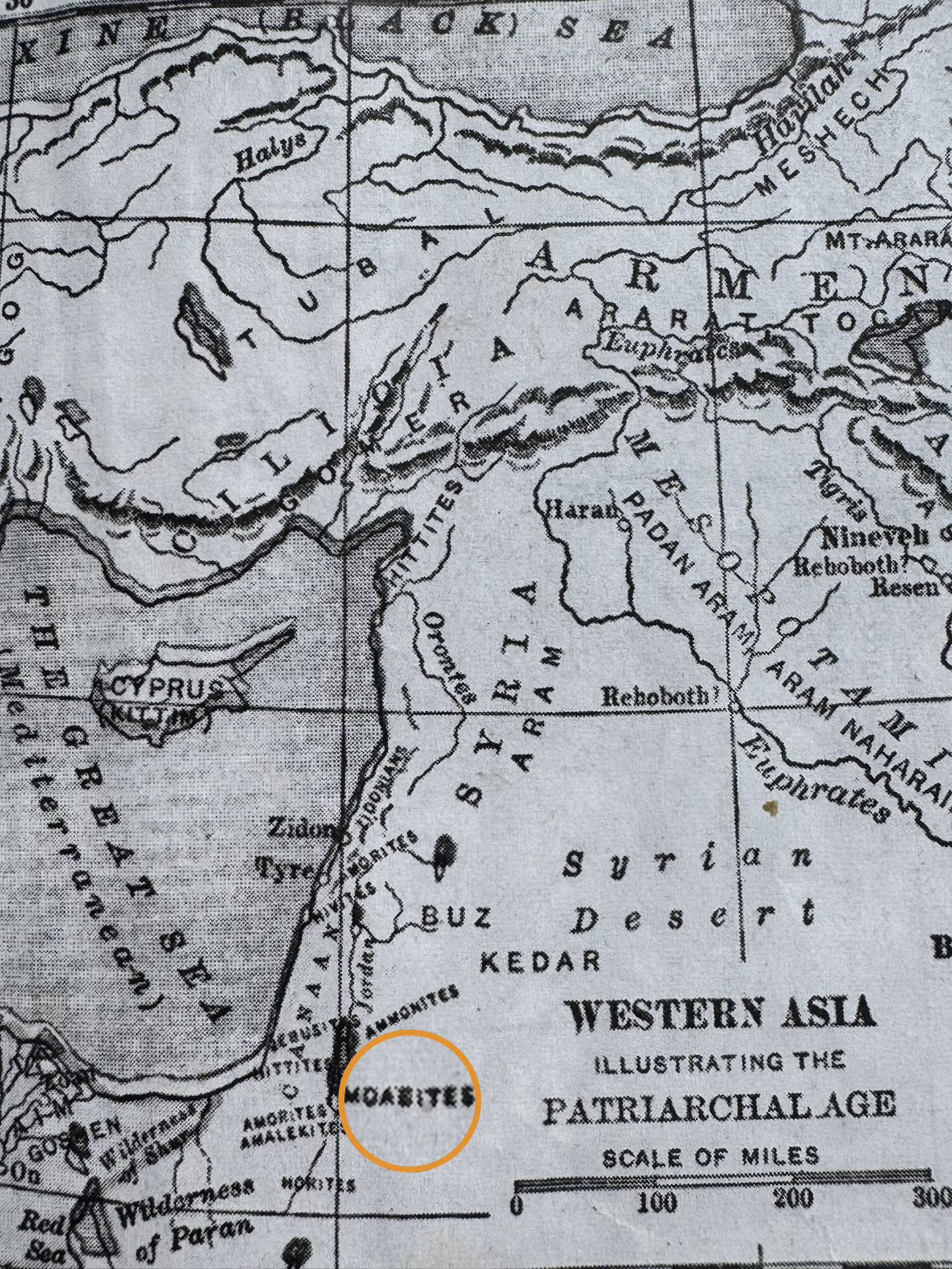
map #4: Moab land=loupe
v.37
And the elder bare a son and she called his name: Moab. He is the father of the Moabites even to this present day.
The younger also bare a son and she called his name: Ammon/Benammi. That is, the son of my people; he is the father of the Ammonites even to this day.
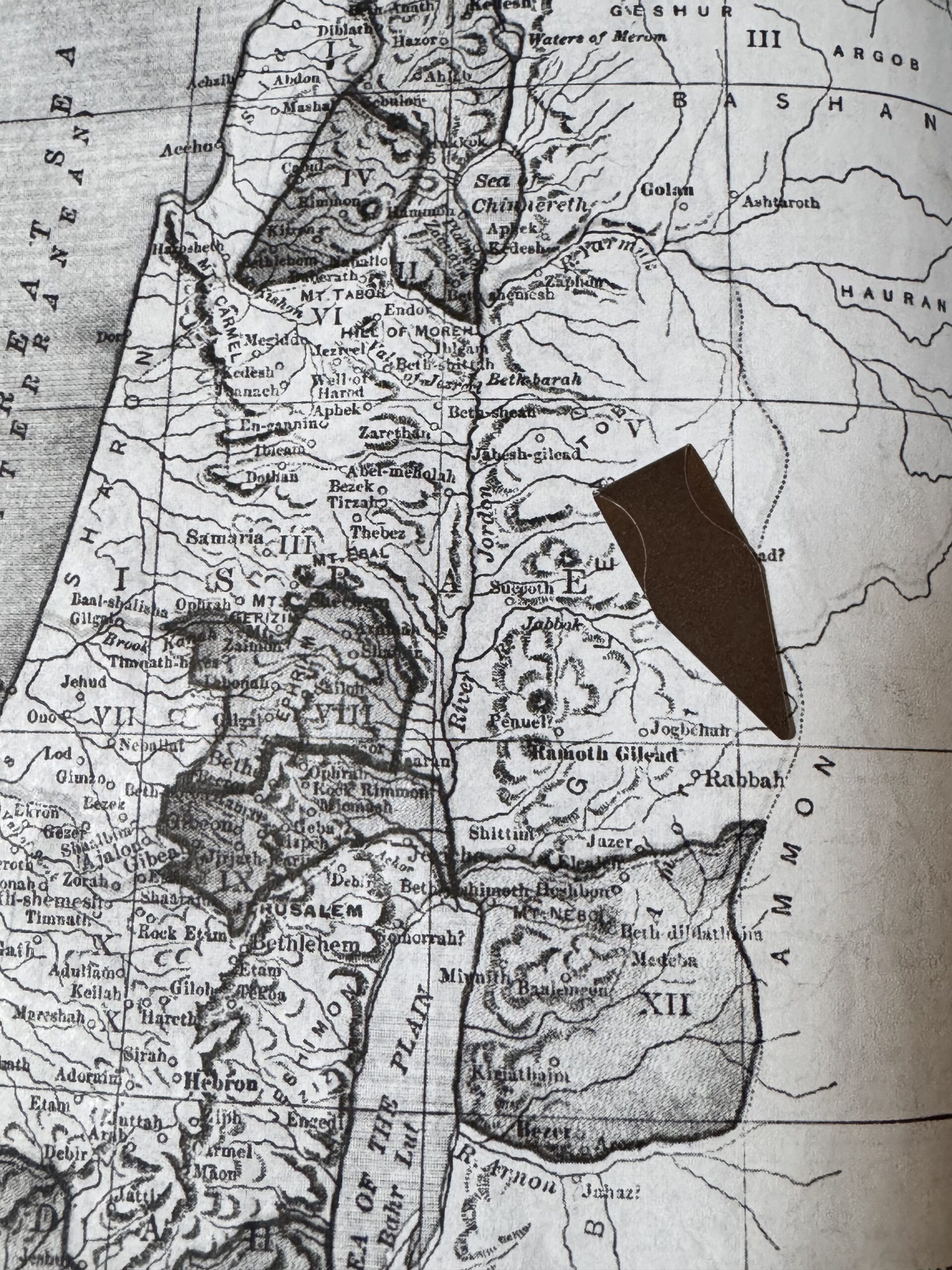
map #5: Ammon nation=marker
Both the Ammonites and the Moabites were two distinct Nations of the 72 Nations. i find it interesting Moyses refuses to identify the daughters of Lot by name. Moyses writes this scene to foreshadow of tribulations and trials the Church of GOD will undergo. Throughout the Old Covenant GOD’s Spouse does face some challenging and even quite difficult times before CHRIST’s birth. Moyses does not identify the daughters by their names because they represent a pair of dynamic schisms the Church will suffer from, or already has, if one considers the Protestants and Lutherans. However, such schisms, for the most part, will eventually fall just as solidly and as transiently as they rose into existence. These churches of man have no place in Heavenly Father’s true singular Church because His Church is already perfect as She was finalized by JESUS Himself. There is no man that can ever improve or enhance ELOHIM’s Religion. To think otherwise is to state that JESUS was imperfect and needs our help in the establishment of His Church. Such a claim also denounces the sacrifices of the Church’s early Apostles, Priests, Brothers, Deacons, Martyrs and Saints.
end 19 Genesis
© 2020 – 2026, Brother Sebastian with Shepherd Corps Sanctuary. All rights reserved. Any works here may be borrowed but credit must be revealed in 12 or larger font.
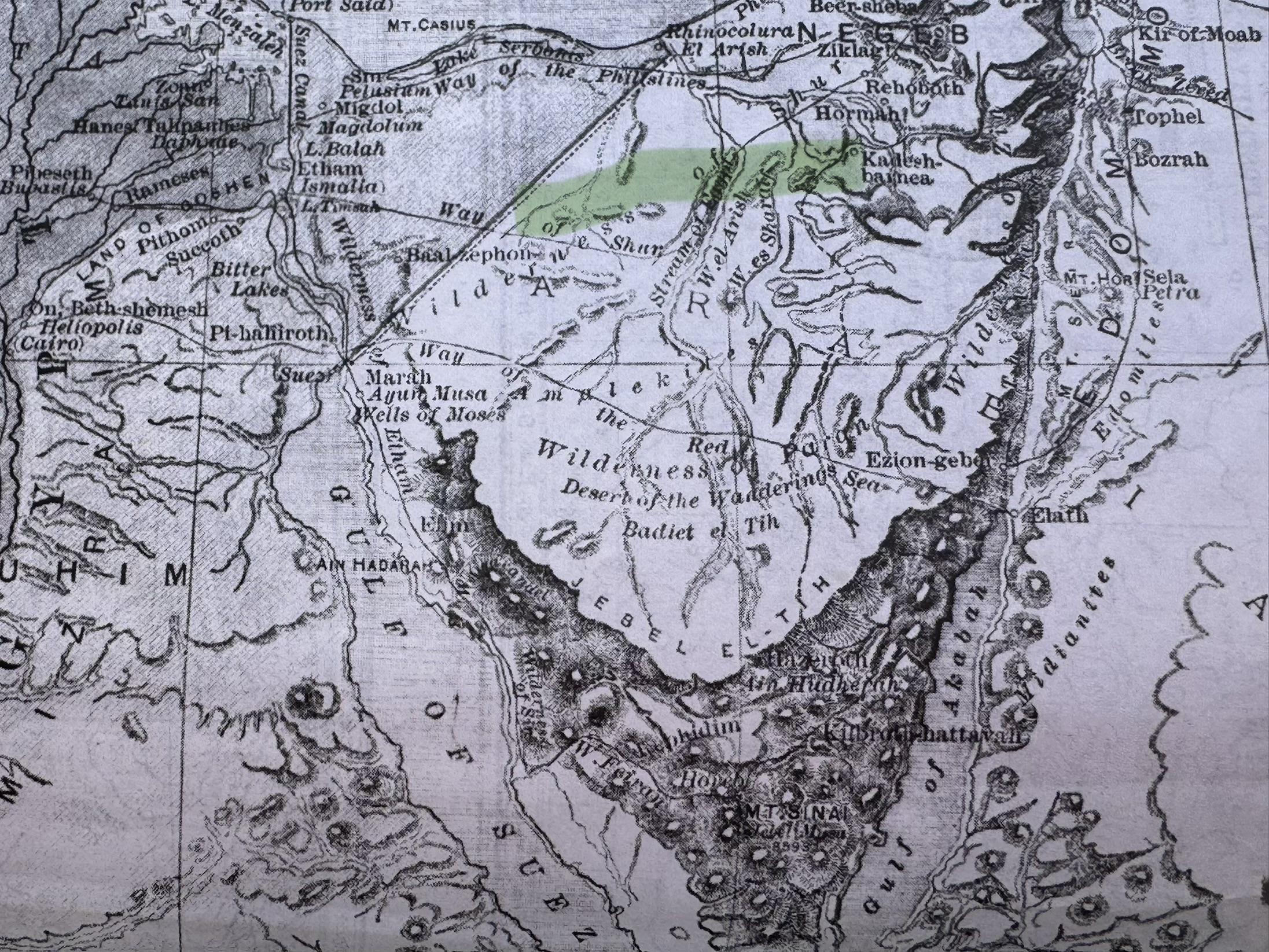
map #1: green highlight shows the area between Sur & Cades
Abraham, removed from thence into the south country and dwelt between Cades and Sur; and he lived as a pilgrim in Gerara.
And Abraham said of Sara his wife:
She is my sister.
This is a precise repeat of what occurred in 12Gen. This brings one to wonder why sister is again used after a promise had already been sealed.
The first thing we learn is that Abraham is a sojourner between Kadesh and Shur, but, he resides as a pilgrim in Gerar. He fears the men of the place will kill him for Sarah. This leads one to speculate that his wife must still possess exceptional beauty even at her advanced age. With all of these points and Abraham’s distrust of mankind, he, nonetheless, identifies Sarah as his sister. A bit later in Verse 12 he admits this is a half-truth: she is his father’s daughter, not his mother’s. Fear for his own life puts the promised wife—and therefore the promised seed—into another man’s house.
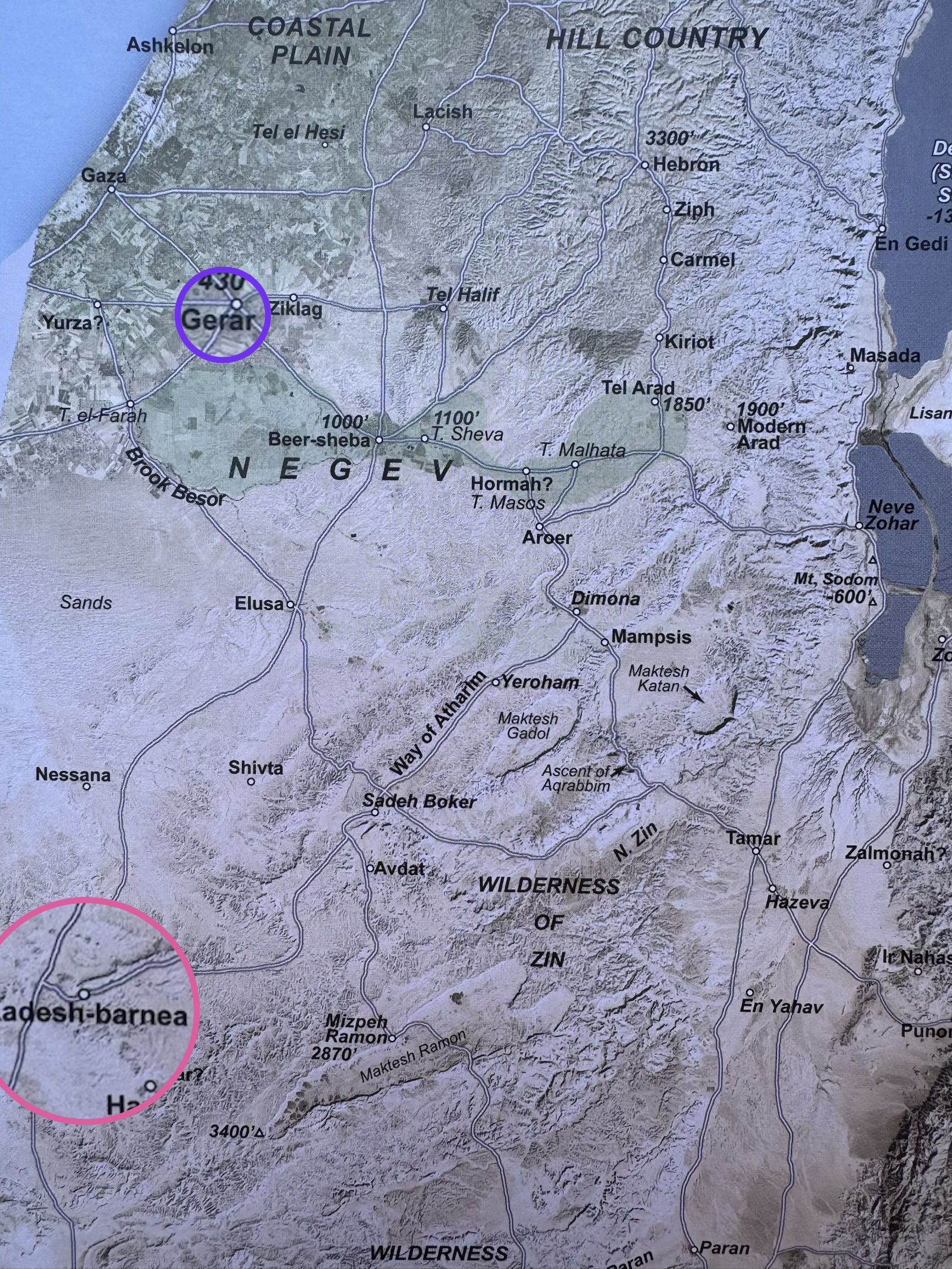
map #2: Gerar=purple loupe, Cades=pink loupe. Negev means the south land, as the text states.
So why, sister? In the patriarchal world a sister can be given, protected, or bargained for. A wife belongs to a covenant. By calling Sarah, sister, Abraham temporarily treats the woman of the promise as transferable kin rather than as the one flesh through whom the nation must come. The hidden tension is that the bearer of the blessing is spoken of in the language of ordinary family arrangement. This even though HE WHICH IS has already Bound Himself to her as the mother of Isaac.
So, are the two events equal or is one more important than the other? The second has more importance and here’s why. In AEgypt the ruse happens before the covenant of 15Gen and before the explicit naming of Sarah’s child. In Gerar it happens after QUI EST has said Isaac will come from Sarah, after the visitors at Mamre, and after Sodom. The pilgrim who has just seen judgment fall on cities still doesn’t trust the land enough to tell the truth about his wife. The sister speech is, therefore, not only fear of Philistine knives; but tis a relapse of the old habit of managing the promise versus receiving it.
Theologically, there’s a hidden meaning: the promised bride is endangered not only by foreign kings but by the believer who will not risk his life for the truth of the covenant. Due to this HE WHICH IS does what Abraham will not do. QUI EST Shuts every womb in Gerar, Warns Abimelech in a dream, and Calls Sarah another man’s wife. Because of QUI EST the sister-language becomes overruled by the wife-language; therefore, the pilgrim’s half-truth cannot cancel the oath. Additionally, there are some Christians who have heard an echo later made explicit in the Song of Songs—my sister, my bride. The woman is both near-kin and covenant partner. Abraham’s use of only the first half of that pair is the failure; Heavenly Father’s restoration of the second half is actual the meaning.
We’ve discussed what this text is so let’s point out what it isn’t. Tis not some sort of secret code that Sarah wasn’t really his wife. Nor is the text a license for the same ruse. Lastly, it is also not a claim that Gerar is perhaps on some different spiritual plane from AEgypt. The text’s actual point is sharper: the man of the promise still speaks like a man protecting himself, does it not? Whereas GOD still Speaks like the husband of the promise, guarding the woman through whom the child must come.
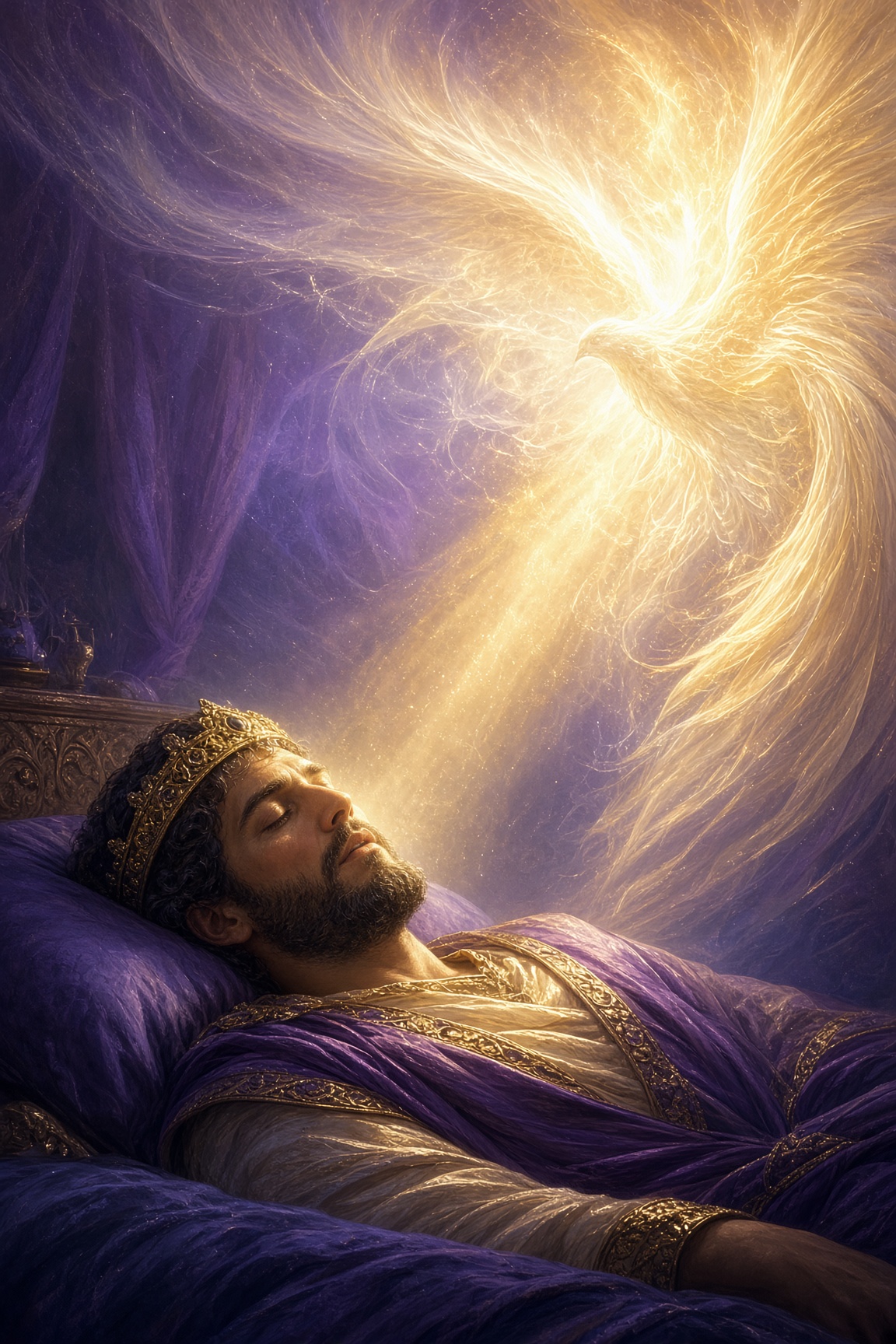 v.2
v.2
Abimelech, therefore, the king of Gerara, sent and took her.
And God came to Abimelech in a dream by night, and said to him:
Loe, thou shalt die for the woman that thou hast taken: for she hath a husband.
But, Abimelech had not touched her, and he said:
Lord, wilt thou kill a nation that is ignorant and just?
The first query we need to address is this: why did Abimelech want Sarah in the first place? As previously stated, Sarah’s beauty is treated as still remarkable. Thusly, a king acquiring a beautiful, apparently unmarried, woman of a wealthy sojourner was a normal royal action—whether for marriage, concubinage, prestige, or a political tie. Abimelech later insists that he did it in the integrity of his heart: he believed she was available. No further motive is annotated in the Scripture. The overall point to this scene is that the taking itself endangers the promised son. This is the reason why HE WHICH IS Intervenes before Abimelech can touch her. Coincidentally, there’s a later parallel with Isaac and Rebecca that shall occur in the same city (26Gen) and will follow an identical logic: a patriarch’s fear, the she is my sister claim, and a local king’s interest in a beautiful woman.
King Abimelech and his southland mountain citizens appear to be simple & just people who don’t seek confrontation with anyone. Knowing who Abraham is, Abimelech treats him so respectfully. He is a pagan king who, in comparison to Abraham, actually acts with more immediate integrity than the second Prophet. He innocently takes Sarah because she was presented as Abraham’s sister; but, he has yet to touch her sexually in any way. His protest to ELOHIM is so sincere & truthful that Heavenly Father indeed Accepts that Abimelech acted in ignorance and with a clean conscience. In fact, the king expresses his concern for his whole people.
Heavenly Father does Confirm Abimelech’s claim but then requires him to restore Sarah. QUI EST also Identifies Abraham as a prophet who must pray for him and Warns that refusal will bring death on Abimelech and all that is his. Abimelech instantly obeys and publicly rebukes Abraham for the deception. The king also compensates the Prophet generously and even offers him freedom to dwell where he wishes. After Abraham prays, QUI EST heals Abimelech’s household, which is reflected by the closed wombs becoming Opened. In fact even his people had been suffering the same temporary barrenness, even though they themselves did not take Sarah. Once the wrong is set right and intercession is made, they are restored with Abimelech. They are therefore a nation that can be called ignorant and just in this specific matter—not covenant people, yet not willfully defiant.
Spiritually the scene does several things concomitantly. GOD Protects the promised seed–as Isaac is about to be conceived–even when the patriarch himself endangers it by fear and a half-truth. He shows that He can speak directly to a Gentile ruler, restrain him from sin, and even hold him accountable. HE WHICH IS distinguishes between ignorant action and knowing transgression. QUI EST also stimulates the reversal of the expected roles: the man of the promise is to be rebuked and must intercede, while the outsider is the one who fears GOD’s word and acts justly once he knows the truth. The closing and opening of wombs underlines that fertility itself is, and has always been, in Heavenly Father’s hand and is tied to the safety of Abraham’s household.
In conclusion, Abimelech is a just pagan whom our Lord Uses both to shield the covenant line and to expose the patriarch’s failure, then restores… once repentance and prayer have occurred.
v.5
Did not he say to me, she is my sister, and she say, he is my brother? In simplicity of my heart and cleaness of my hands have I done this.
And God said to him:
And I do know that thou didst it with a sincere heart; and therefore I kept thee that thou shouldest not sin against Me. And I permitted not that thou shouldest touch her. Now there restore the wife to her husband because he is a Prophet. And he shall pray for thee, and thou shalt live.
There are certainly many things to be learned from these Verses.
From a spiritual perspective, king Abimelech’s words and GOD’s answer turn on the difference between what a man intends and what QUI EST is actually protecting. Abimelech pleads the facts as he knew them: both Abraham and Sarah told him they were siblings. He claims a simple heart and clean hands; HE WHICH IS does not contradict him. Heavenly Father agrees that the king acted in sincerity and, for that reason, restrained him before the act could be completed. In fact, this restraint is the first spiritual point: GOD can keep a person from a sin even when it’s unrecognizable. Ignorance is not treated as innocence in every respect—the household’s wombs were already closed—but it is treated as different from knowing defiance. QUI EST judges the heart’s integrity while still intervening to stop the deed.
There’s also the point that the offense is against our Lord and not only against Abraham. I kept thee that thou shouldest not sin against Me. Sarah is not merely another man’s wife; she’s the woman through whom the promised son is about to come. To take her is to touch the covenant itself. That is why restoration is non-negotiable. Tis also the reason why death is the identified alternative.
Next comes the reversal of roles. The man who created the danger by his half-truth is the man GOD names as His Prophet and requires to pray. Abraham must intercede for the very king he endangered. The Gentile lives because the flawed covenant-bearer prays. Life is granted through restoration plus intercession, not through Abimelech’s good intentions alone.
If we consider these points together, the exchange shows our Lord simultaneously executing the following:
Therefore, tis the sincere pagan who is preserved. The promised seed is kept uncompromised. Lastly, the Prophet, despite his failure, is still the thoroughfare in which life passes.
v.7
But if thou will not restore her, know thou that dying thou shalt die: thou and all things that are thine.
Abimelech is one of just a few men to ever receive such a chillingly haunting caution from GOD Himself. This Verse is quite significant because of an astronomical event the planet recently witnessed. That event, of course, was the destruction of a few cities by brimstone and fire sent directly by ELOHIM! With this freshly on anyone’s mind, even as a Pagan, Abimelech is certainly going to absorb every bit of instruction dictated by Heavenly Father. And because of the recent heavenly destruction of a few cities, only a fool would doubt any word dictated by HE WHICH IS. Abimelech appears to be no fool.
Our Lord’s warning also serves an analogical meaning: what QUI EST has reserved for the promise cannot be held without death. Sarah isn’t merely Abraham’s wife; she is the one through whom the promised son is about to come. To retain her is to retain what Heavenly Father has already claimed. The Sentence therefore falls not only on the individual who holds her but on his whole house because the head’s act implicates all that is under him. This same pattern appears elsewhere: taking what GOD has set apart brings the sentence, dying thou shalt die. Here the reserved thing is the mother of the seed. Life is possible only by restoration.
The overall analogical force is that withholding from the rightful husband (the Prophet, who’s the bearer of the promise) what belongs to him is fatal for the one who keeps it and for all that is his. Restoration plus the Prophet’s prayer is the only given way to live.
v.8
And Abimelech, forthwith rising up in the night, called all his servants; and he spake all these words to their ears. And all the men were sore afraid.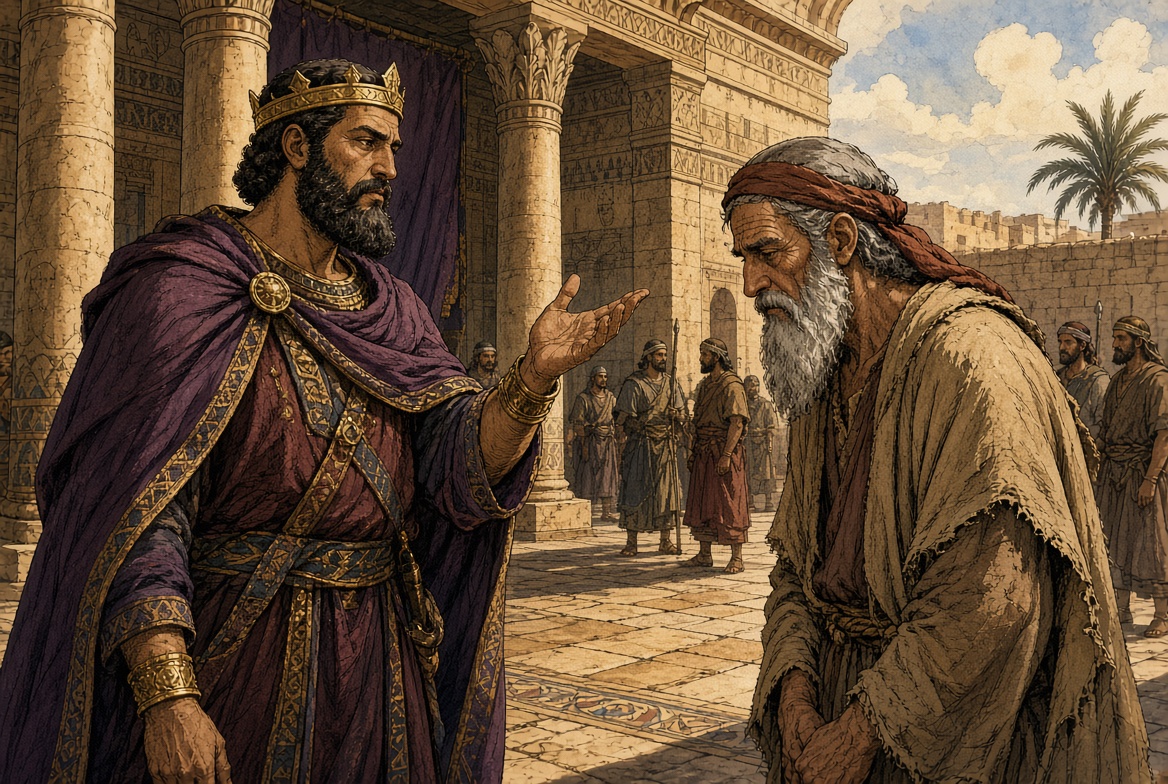
And Abimelech called also for Abraham, and said to him:
What hast thou done to us? What have we offended against thee that thou hast brought upon me and upon my kingdom a great sin? That which thou oughtest not to do, thou hast done to us.
And again expostulating, he said:
What sawest thou, that thou didst this?
Abraham answered:
I thought with myself, saying: Perhaps there is not the fear of God in this place and they will kill me for my wife. Howbeit otherwise also in very deed she is my sister, the daughter of my father and not the daughter of my mother; and I took her to wife.
For clarity we turn to S Augustine who informs us that she is not the daughter of Abraham’s father but of his progenie.
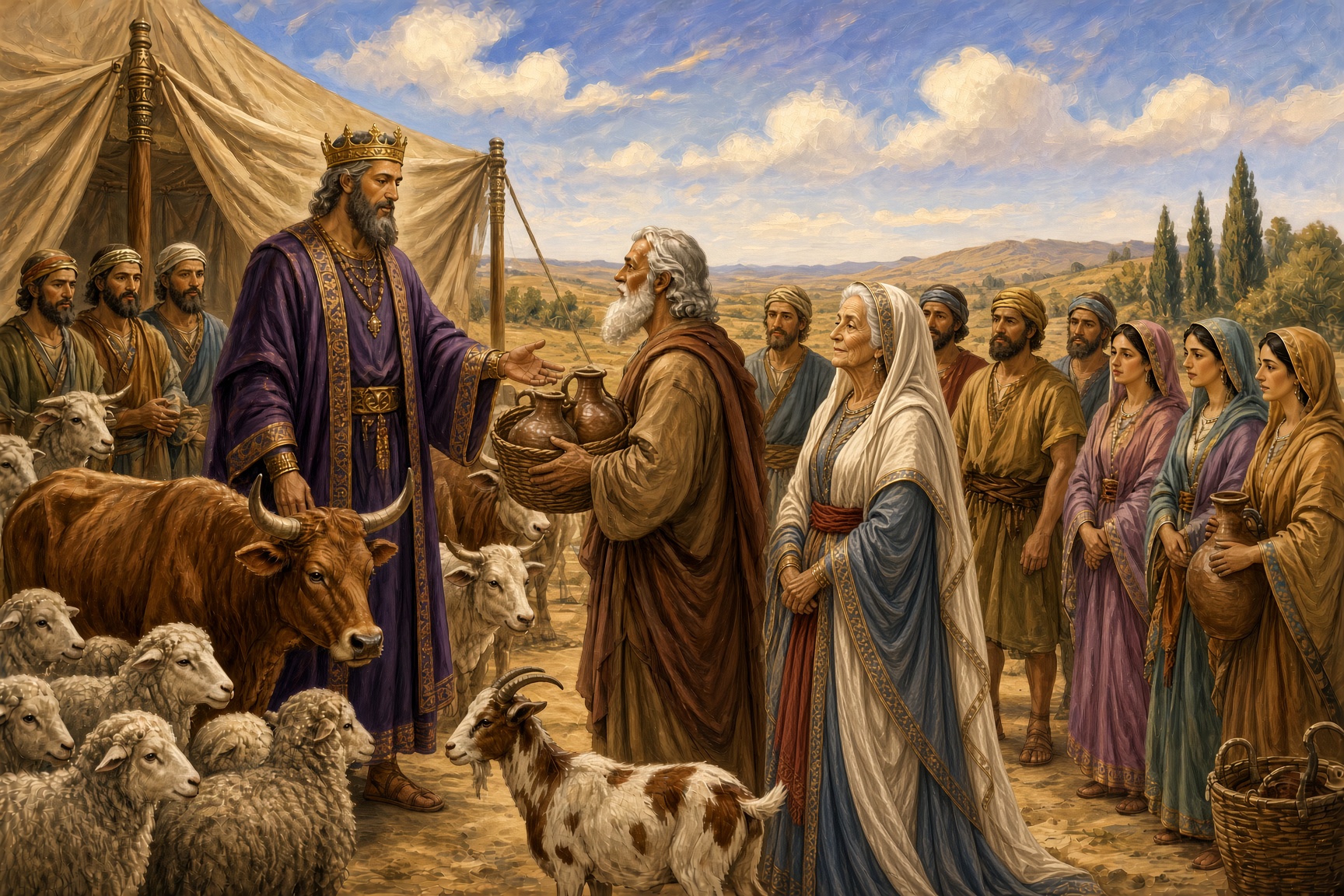 v.13
v.13
And after that God brought me out of my father’s house, I said to her: This mercy thou shalt do with me. In every place which we shall come unto, thou shalt say that I am thy brother.
Therefore, Abimelech took sheep and oxen, and servants, and handmaids, and gave to Abraham: and restored to him Sara, his wife, and said:
The land is before you. Dwell wheresoever it shalt please thee.
Kings of the earth esteeming the Church only for a laudable people of God, seek to subject her to themselves but knowing he to be the inviolable Spouse of CHRIST subject themselves to Her and offer to Her most honorable gifts. These are gifts for the Church and not for personal use of Her Servants, Clergy, &c. Abimelech’s primary objective is returning Sara to Abraham. Everything else is restitution and honor attached to that restoration. Let’s examine each individually:
Sara
She is the gift that saves for, QUI EST had already said life or death hung on returning her. Spiritually, she is the wife of the Prophet as well as the woman of the promise. Giving her back is the Gentile king releasing what he had no right to hold. The other gifts only have meaning because this first thing is made right.
Sheep
Flocks are the ordinary wealth of a sojourner’s house whereas the other animals were bound to sacrifice and covering. The sheep function as living restitution: provision for Abraham’s household and a public sign that the wrong is being paid for, not merely admitted.
Oxen
Oxen stand for strength, labor, and costly substance. They enlarge the working power of Abraham’s camp. Analogically, they are strength transferred from the king’s house to the house that carries the promise—power that had been on the side of the taker is now put in the service of the one who was wronged.
Servants & Handmaids
These gifts specifically increase the household of Abraham. The king who nearly absorbed Sara into his own house now adds people to Abraham’s. The household of the promise grows at the expense of the household that endangered it. It is compensation in persons an, not just in animals: the patriarch’s camp is visibly greater after the offense than before.
All of these gifts together signify more than apology. They are a public transfer of honor and substance so that Sara’s return is not a quiet correction but an open acknowledgment that she belongs to Abraham and only to Abraham. The later thousand pieces of silver in Verse 16, given as a covering of the eyes, completes the same logic: the gifts cover shame, restore standing, and make the matter closed before others. Spiritually, the pattern is consistent with the rest of the Chapter:
v.16
And to Sara he said:
Behold I have given thy brother a thousand pieces of silver, this shall serve thee for a veil of thine eyes to all that are with thee, and withersoever thou shalt go, remember also thou wast taken.
And, Abraham, praying, God healed Abimelech and his wife, and his handmaids; and their bare children: for, our Lord had closed up every matrice of the house of Abimelech for Sara, Abraham’s wife.
thy brother
Abimelech uses this term sardonically. After all, being siblings was the exact claim Abraham & Sara had used. Both of them had said it: she is my sister, he is my brother. Abimelech now knows it was only a half-truth. Using the word after the confrontation is therefore pointed. He isn’t politely adopting their story as if he still believes it. He is throwing their own words back at them. The silver is given to Abraham, yet Abimelech addresses Sara and names him thy brother, which keeps the original fiction in view while making the rebuke public. i believe it also provides the king with a sense of dignity in front of his court/people. The gift is a covering for her eyes—and for everyone who is with her—so that her honor is restored wherever she goes. And when he tells her to remember that she was taken, this then is the second edge: the king who was deceived will not let either of them treat the episode as a small mistake.
Therefore, the title, brother, does two things simultaneously.
As i’ve addressed elsewhere in these discussions, there is no such thing as a good or decent lie. A half-truth is still a lie. No lie can ever trump the realities and goodness of simple truths.
end 20 Genesis
© 2020 – 2026, Brother Sebastian with Shepherd Corps Sanctuary. All rights reserved. Any works here may be borrowed but credit must be revealed in 12 or larger font.
But now Sara swallows whatever pride she had about her laugh and ends up not only admitting to it but also names their son, Isaac. Isaac means laughter.
Who that shall hear of it would believe Abraham, that Sara gave suck to a son, which she bare him now being an old man?
As i explained earlier, medieval and patristic readers treated Scripture as having a fourfold sense, known as the quadriga: literal-what happened, allegorical-what to believe, moral-what to do, and analogical-where we are going. i also added a fifth interpretation, metaphorical-literal, which distinguishes the plain historical event from the figurative language already present in the words themselves. These interpretations rest upon each other; they don’t cancel the historical meaning. Let’s apply the quadriga plus one to this scene:
Sara conceived and birthed at the precise time QUI EST appointed. Her nursing the child is an observable physical proof that the infant is indeed hers. She exclaims that GOD has made laughter for her, so that whoever hears the story will laugh with her–shared astonishment and joy, not mockery. She then marvels that anyone would have believed Abraham if told that Sara would suckle a son born to him in old age. The event is presented as a public covenant-keeping miracle:
Even at the surface level this blessed event is barely touched. Laughter becomes the child’s name and is a figure for the sudden reversal of barrenness into delight. God hath made laughter to me treats joy as a gift created by QUI EST and not simply an emotion felt by Sara. Gave suck is concrete and bodily, yet it also stands for the unexpected fruitfulness of a womb that had ceased after the manner of women. The rhetorical question, Who would believe…?, is a figure of speech that elevates wonder. The literal sense already contains metaphor–tis not stiffly prosaic.
This extraordinary event prefigures JESUS and His Church. Isaac is the child of promise. He was born contrary to nature from a woman who could not; whereas CHRIST is the promised Seed impossibly born of a Virgin. Sara’s earlier incredulous laugh turned into praise prefigures the world’s disbelief at the Incarnation and Resurrection giving way to Gospel joy. In fact S Paul reads the story allegorically in 4Gal22–31. In this Book he writes Sara, the free woman, is:
That promise begets the child, Isaac. We relate an aged Sara nursing Isaac to the Church nourishing Her children with the milk of doctrine. S Augustine notes that Sara’s later words show her laughter has become joyful praise rather than scorn. He also iterates that Sarah & Hagar signify the two covenants and the two cities. Finally, Isaac’s very name, laughter, is taken by the Priests as a type of the supernatural joy our Savior brings into a world of tears.
Sara’s scene provides instruction for the soul. One is not to measure QUI EST’s promises by the apparent deadness of one’s own powers. For example, barrenness—whether of womb, of hope, of virtue, or of fruit in old age—is not final. Further, HE WHICH IS can turn private half-sincere laughter into public shared exuberance. Thusly, we’re provided with the proper response for the receiving of a gift with wonder. We are to nurse what HE WHICH IS has given (as in, to feed and protect the new life), and, we’re to invite others to laugh with us rather than hoard the astonishment. Doubt is not the last word; confession of GOD’s unexpected goodness certainly is. There’s one other moral lesson here. This story warns against despair and against measuring possibility by human age or strength.
The scene points beyond history to the last things and to heavenly glory. The barren made fruitful is a figure of the resurrection of the dead and of the unexpected fullness of the Kingdom. Sara’s laughter shared with all who hear it prefigures the unending joy of the Saints in the heavenly Jerusalem, which is the free mother of us all (4Gal). Then there’s the image of an old woman nursing a son. This is reflective of CHRIST’s Church, or the soul, still bearing fruit at the end of the age. The Church also is the eschatological banquet where the soul’s sorrow is turned to unending laughter. What begins as a household miracle finishes as a sign of the world to come: an end of world in which every promise is fulfilled and every hearer rejoices together.
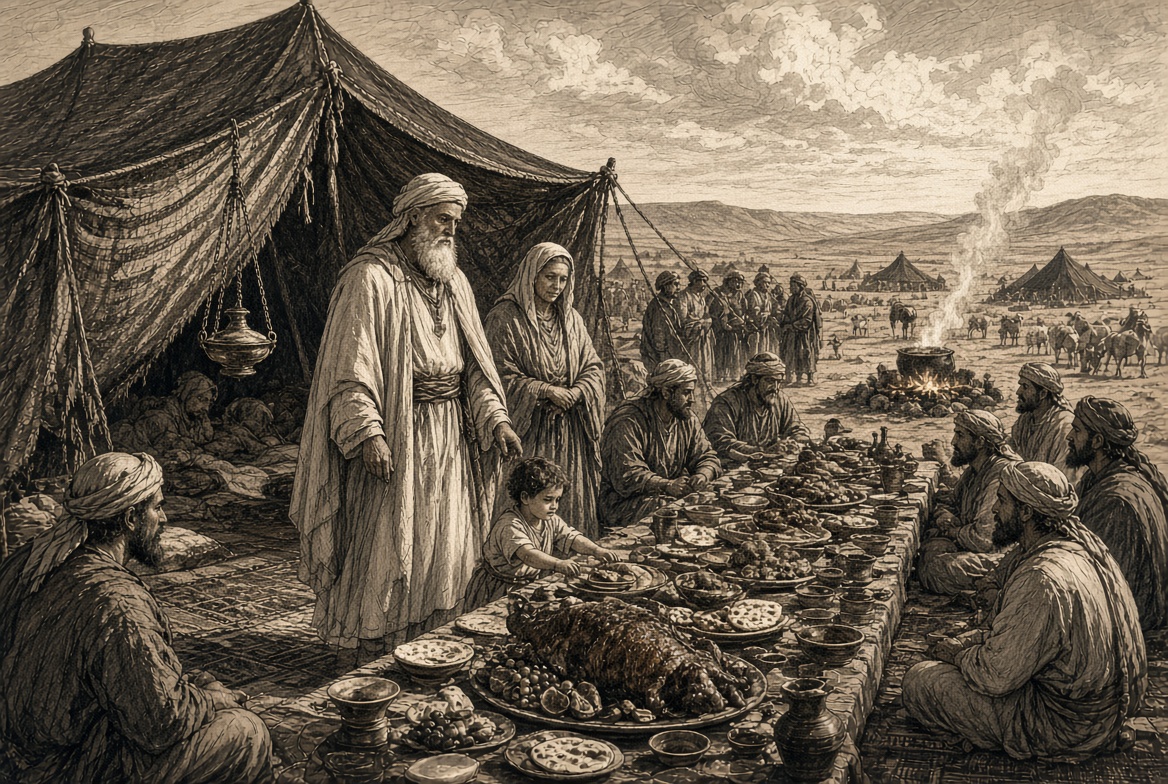
The child, therefore, grew and was weaned; and Abraham made a great feast in the day of his weaning.
This wasn’t just an ordinary milestone feast but a great one! Isaac survives infancy and reaches the age of weaning—an ordinary milestone made extraordinary by the parents’ age and the child’s miraculous origin. Whether tradition has Isaac at two years of age, five, or even older, the point is that he no longer is wholly dependent on the breast. The child has lived long enough to be publicly celebrated. Tis a feast of thanksgiving, social recognition of the heir, and, a covenantal marker that the promised son is established in the house. This great feast is both a meal and a sign—joy made public, the household’s laughter now shared at table. The day itself is treated as a festival of passage: milk gives way to solid food, hidden nurture to open acknowledgment.Magnifying this scene spiritually we realize Isaac, the growing child of promise, prefigures JESUS and the Church. The promised Seed does not remain an infant of the promise only; he comes to the maturity appointed for him. Abraham’s feast is a type of the messianic banquet and of the Church’s festal recognition of the Son. As revealed in the upcoming Text, this feast also happens to precede the expulsion of the son of the slave woman–S Paul’s dual covenants. Henceforth, the weaning-feast belongs to the allegory of the free woman’s son coming into his inheritance while the fleshly claim is set aside. Sara, a type of the Church (or of the Blessed Virgin), has nursed the child; now the child is presented as the heir.
Morally, the soul is to let the gift of QUI EST grow and then to wean it from first consolations. The early sweetness provided in milk is not the end; the promise must be brought to a stage where it can stand, be recognized, and be celebrated without remaining infantile. This is why Abraham boasts his gratitude before GOD versus hiding the mercy. The moral sense also warns against clinging to the first form of a grace; weaning is loss of one comfort and gain of a more durable life. Joy is to be shared at a table and not kept as private astonishment.
There’s one other spiritual reconning in need of identification. The child who grows and is weaned points to the consummation in which the children of the promise are no longer under elementary tutors but enter the mature joy of the Kingdom. Therefore, understand weaning as being the passage from the present age’s milk of faith-under-figures to the solid vision of glory, when laughter is no longer the surprise of an old woman but the unending festivity of the entire heavenly household.
Please don’t misinterpret this as so many films and novels have. The true Church of JESUS our CHRIST does not and never has persecuted anyone, such as heretics, but instead justly punished such offenders. Augustine continues with this:
Ecce libera ancillam afflixit, nec id Apostolus persecutionem non vocat; servum ludens cum domino, et persecutionem vocat. {Behold the freewoman afflicted the handmaid, and the Apostle calleth it not persecution; the servant playing with the master, and he calleth it persecution.}
Try to remember Heretics, whether acting as a Priest or not, and other Infidels do persecute and impugn, whether by word or sword, the truth. This is a reason why mankind has invented over 2,000 Christian and 500 non-Christian religions. Here are a couple of examples of Liturgical truth being disputed:
He taught the spiritual never persecutes the carnal; but spares him as his rustical brother, knowing that he may in time be profitable.
v.11
Abraham took this grievously for his son.
To whom God said:
Let it not seem grievous to thee for the boy, and for the handmaid. All things that Sara shall say to thee, hear her voice because in Isaac shall seed be called to thee.
17Gen21
But my covenant I will establish with Isaac, whom Sara shall bring forth to thee at this time in the next year.
21Gen12
Let it not seem grievous to thee for the boy, and for thy bondwoman: in all that Sara hath said to thee, hearken to her voice: for in Isaac shall thy seed be called.
Both Verses isolate Isaac as the bearer of the called line. In Chapter 17 GOD distinguishes two futures: Ishmael will be blessed and become a great nation, yet, my covenant I will establish with Isaac. In Epistle 21 the same distinction is restated in the language of seed: in Isaac shall thy seed be called. Ishmael remains Abraham’s son and will still become a nation; but he is not the son in whom the covenant-name and the promised offspring are reckoned. Therefore, the two texts say one thing: a blessing can be wide; the covenant-seed is narrow.
With the similarities addressed, tis important to note what has changed between both Verses. Chapter 17 can be pronounced as an announcement; Isaac is not yet conceived. The Sentence is future and calm: Sara shall bring him forth and the covenant will be established. Abraham’s only reply is the plea, O that Ismael may live before thee. QUI EST answers that plea without yielding the covenant. Chapter 21 is identified as enforcement. Isaac is born, named, circumcised, weaned, and feasted. The crisis is no longer possibility but one of inheritance. Sara has said, Cast out this bondwoman and her son. Abraham finds such stinging words to be grievous… for his son. HE WHICH IS does not invent a new law. Instead, He ratifies Sara’s word and tells Abraham to obey it because the earlier sentence still stands: in Isaac shall thy seed be called. The promise of 17Gen21 has become a surgical command. What was I will establish my covenant with Isaac has evolved to become, hear her voice… for in Isaac….
In Isaac shall thy seed be called
This Phrase is actually the legal form of 17Gen21. Covenant… with Isaac names the relation; seed… called in Isaac names how that relation is counted. Paul later treats this exact clause as the principle of the children of promise, as identified in 9Rom7 & 4Gal28–30. The expulsion is not GOD taking back the blessing of 17Gen20; tis QUI EST refusing to let the blessed son of the handmaid share the title reserved for the son of the free woman. The following chart reveals the same word at different times.
| 17 Genesis 21 | 21 Genesis 12 | |
|---|---|---|
| Time | Before birth | After weaning |
| Mood | Promise | Command |
| Abraham’s pain | Hope that Ishmael might suffice | Grief at losing Ishmael |
| Sarah’s place | She will bear the child | Her voice is to be heard |
| Ishmael | Blessed, made a nation | Still made a nation, but sent out |
| Isaac | Future partner of the covenant | Present heir in whom seed is called |
The earlier Verse tells Abraham whom QUI EST has chosen. The later Verse tells him what that choice now costs, and that Sarah’s demand, harsh as it feels, coincides with the covenant Heavenly Father had already sworn.
But the son, also, of the handmaid I will make into a great nation because he is thy seed.
One seed devoted for life under the sun: a worldly king. Another seed devoted to Heavenly Father’s Church. One can look at this, remarkably, from the view of GOD. Those families He blesses with more than one son, such families should reciprocate by guiding one (or more) son(s) to serving QUI EST. There are many families today who do maintain such a fabulous tradition when having multiple sons.
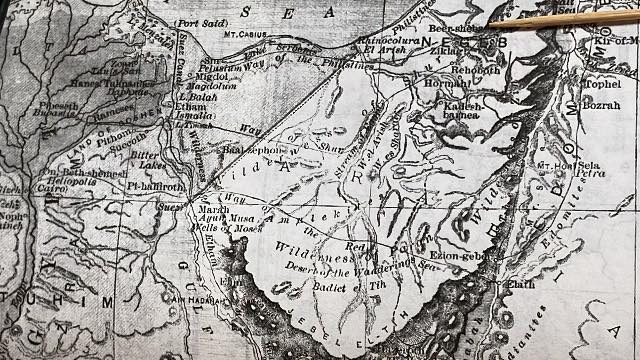
map #1: Bersabee wilderness=marker
v.14
Abraham, therefore, rose up in the morning. And taking bread and a bottle of water, put it upon her shoulder, and delivered the boy, and dismissed her. Who went away and wandered in the wilderness of Bersabee/Beersheba. And when the water in the bottle was spent, she cast the boy under one of the trees that were there.
And she went her way and sat over against a great way off as far as a bow* can cast, for she said:
I will not see the child dying.
a bow*
Here’s a poly sci fact for you that defines how international boundaries were established. For both land and intercostal waters, it probably began with a rock being thrown, perhaps with a sling. After, a tossed stone evolved to an arrow launched from a bow. As man became more advanced at annihilating one another, boundary representation graduated to a projectile launched by black powder–rifle followed by canon. Then, distance became established by measurement, as in, 10 miles.
Why did Hagar give up/throw in the towel? Why was she so convinced they were doomed? Especially after GOD had told Abraham all would be taken care of. A firm reason was the leadership ability Abraham was so blessed with. A reason he was so earthly respected and renowned was due to his respectful treatment to others. I believe it to be axiomatic that Abraham didn’t inform Hagar of his vision from HE WHICH IS. This means Abraham was also extremely respectful of one’s religious beliefs. Hagar was an AEgyptian, not a Hebrew. Hagar had no belief in QUI EST because her patriarch didn’t enforce his religious beliefs on her. Finally, Hagar was a domestic servant her entire life and had very little training or guidance in independent living, let alone survival with a child under her care.
 v.16
v.16
And she sat opposite, she lifted up her voice and wept.
And God heard the voice of the boy.
And an Angel of God called Agar from Heaven, saying:
What doest thou Agar? Fear not. For God hath heard the voice of the boy from the place wherein he is. Arise, take up the boy, and hold his hand; for into a great nation will I make him.
heard the voice of the boy
The scene is written that QUI EST hears the boy but it’s revealed that only Agar is the one weeping. It very well could be that the silence is part of the Scene. Moyses writes GOD heard the voice of Ismael then the Angel repeats it to Agar–the voice of the boy. Therefore, the Text lets us hear the sobbing of Agar while withholding the voice of her son. What QUI EST hears is named only as a voice—cry, groan, gasp, plea, or prayer. Some theologians believe Ismael to be in his mid- to late-teens here and was therefore weeping at the approach of death. That his sighs cried in the ears of mercy. There’s something else about this Scene worth mentioning. His name was already given in 16 Genesis as part of the commentary: Ismael, God heareth. Yet, this Chapter never uses Ismael’s name; the whole rescue is that name coming true.
Perhaps Ismael wasn’t crying because his mother had abandoned him, as if she had thrown him off. She had carried him until the water failed, laid him under a shrub so he would not die in the sun, and sat a bowshot off because she could not watch him die. With her carrying him that would make the theory of Ismael being in his teens illogical. Agar leaving her son is love at the end of its strength, not desertion. What does appear logical is Ismael dying of thirst in the Bersabee after being sent from Abraham’s house. Therefore, his voice would be the voice of a son of Abraham at the point of perishing, where he is—under the bush, in that plight, in that hour. Then there’s the Angel’s Prophecy that Ismael’s line will one day afflict Israel. However, the importance of this is that HE WHICH IS answers that He judges a man as he is now. The canonical Text needs none of that plot; it only insists that the boy was heard where he was.
Let’s now subject ourselves to the spiritual intent of this Scene. Literally, we read of a mother and a youth cast out with bread and a bottle. When the water is spent, the mother can’t bear the sight. QUI EST hears the youth and speaks to the mother from heaven. He commands her to rise, take the child’s hand, and opens her eyes to a well that was already present.
Allegorically, we turn to S Paul in 4Gal22-31: Agar is the covenant from Sinai, the Jerusalem that now it, in bondage with her children–tis Isaac who’s is the child of promise. Being sent out is the fleshly claim yielding the inheritance. Nonetheless, the allegory doesn’t end in spite. As per Origen, the closed eyes and the well are representations of the people, according to the flesh, lie in a hunger not of bread, but of the word of God, until the Angel removes the veil. It is then that living water is seen! The boy under the tree is Israel in exile, thirsting; whereas the well is the Word once the eyes are opened. Lastly is the Angel who calls from heaven and speaks as God is, in the Fathers, the Word Himself—the same Who heard and saw Agar in Epistle 16.
Fear has sat down opposite the dying thing and called that distance wisdom. This is the moral insight. What doest thou, Agar? is the question to every soul that has laid its charge under a bush and walked away to weep. The command is not first see the well but arise, take up the boy, hold his hand. Providence frequently waits on that small obedience. Heavenly Father hears what we have stopped listening to—the voice from the place wherein he is, not from the place we wish He were. The well is usually already present; tis the eyes that are lacking.
Finally, we determine the anagogical perspective with the wilderness being this age and the spent bottle is every created supply. The voice our Lord hears is the cry of the one He has already named. The well is the water that springs to eternal life. Hold his hand, for into a great nation will I make him becomes the promise not heard in vain. Judgment of thorns and mercy to the dying boy stand in one GOD. The covenant-seed is Isaac and his rescue validates that no child of Abraham shall perish unheard where he is.
v.19
And God opened her eyes, who seeing a well of water, went and filled the bottle, and gave the boy to drink.
Although Scripture neither confirms nor denies this claim, I am quite certain she no longer remained a Pagan worshipper of AEgypt’s gods because of her extraordinary two encounters with the Almighty. The Liturgy does provide a couple of facts worth noting, be it as it may:
Whether Agar remained a Pagan or became a convert is pure speculation because her encounter with HE WHICH IS was about something else. Her eyes were opened to a well that was already present. Henceforth, Agar is no longer a woman who can’t see what QUI EST has provided.
God opened her eyes
Agar could already see the desert, the boy, & the empty bottle. What she couldn’t see was the well that was already there. The verb is the same kind of opening that happens when QUI EST makes a person perceive what His word has placed in front of them. Let’s observe this Phrase from a spiritual viewpoint.
Literally, Heavenly Father acts on her sight. Understand that the well wasn’t just suddenly created; instead it is revealed… disclosed. Agar’s distress had narrowed her field to seeing only imminent death but GOD’s mercy widens her vision to see the water. She then does the ordinary things, like filling the bottle and giving the water to Ismael to drink.
Origen provides an enlightened allegorical view: Agar’s closed eyes signified the veil of the letter. Agar, the mother according to the flesh, wanders thirsty—not a thirst of water, but of the word of God—until the Angel takes the veil away and she sees living water. S Paul has already named her the present Jerusalem in bondage. The opening of the eyes is the moment the synagogue, or any soul bound to the first covenant as if it were the last, is shown the well that was in the wilderness all along: JESUS CHRIST, the water from the rock, the Spirit given after the sending-out of the fleshly claim. The same pattern is realized Luke’s Book: their eyes were opened, and they knew Him in the breaking of bread. GOD opens; the well/Light was not absent.
Despair sits a bowshot off and calls that realism. Morally, the soul has laid its charge under a bush and decided there is nothing left to see. This is why What doest thou, Agar? comes first. After this comes the command to rise and take the boy’s hand, followed by the opening of eyes. Eyes are often shut not by ignorance but by grief that will not look again. The well in a dry place is frequently providence already given, which is Scripture already spoken and a means of grace already near. Such a providence so frequently remains unrecognized until HE WHICH IS grants sight. The moral act that ensues is this: fill the bottle, give drink. Opened eyes that don’t serve the dying boy have not yet understood the opening.
Lastly, the anagogical perspective is the last opening of eyes is a vision of ELOHIM, which shows that faith becomes sight and the wilderness is no longer wilderness. Figuratively: water in the waste, life where death was expected. Every lesser opening, such as conversion, consolation, the sudden seeing of a mercy that was previously missed, is a rehearsal of that day when QUI EST opens the eyes of the exile. Wide open eyes is also a revelation that the well is no longer a hidden spring but the river of the City of GOD.
Summarily, I provide you with the following:
Agar doesn’t find water by searching harder. It’s only when QUI EST opens her eyes is she able to see what’s already available.
v.20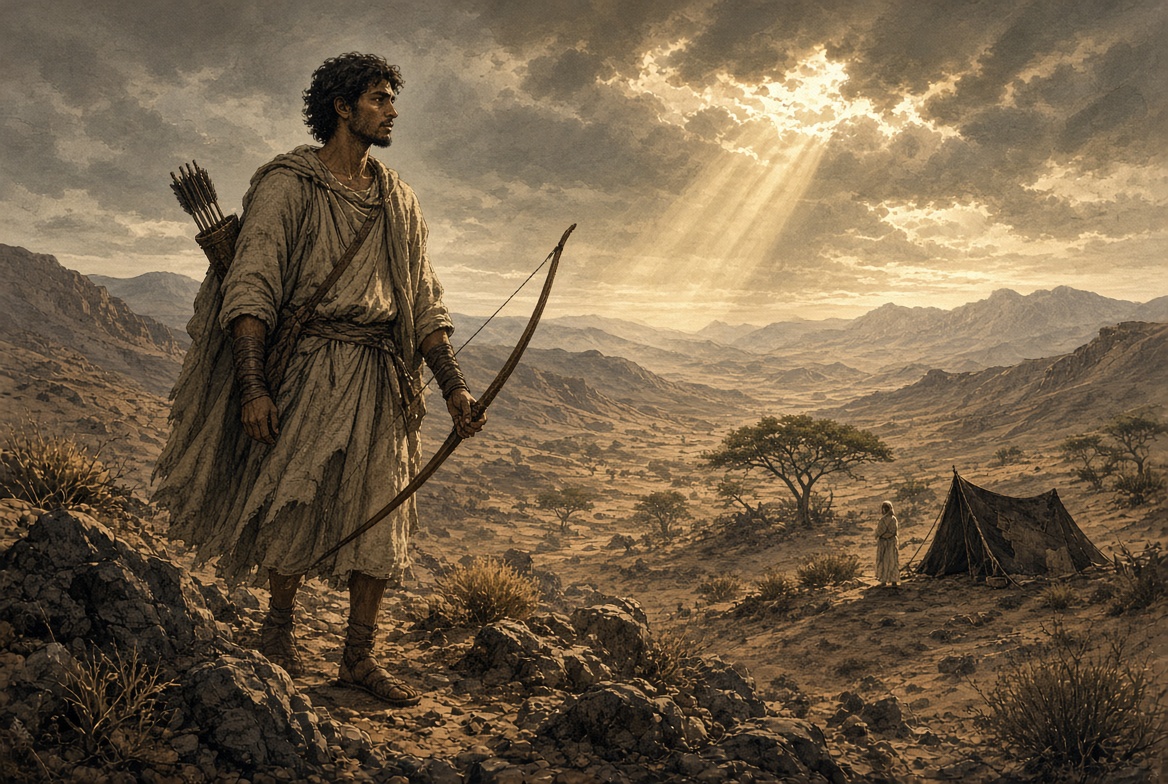
And God was with him: who grew and abode in the wilderness, and became a young man archer.
I used to picture Ismael being instructed and taught by GOD’s Angels and away from the auspices of mankind. I would then ask, why would any man want to leave a life of translation for life under the sun. But, this isn’t the case here. Ismael is reared in the Pharan wilderness with his mum, who later chooses a wife for him from the land of AEgypt. Heavenly Father certainly is with Ismael but in the sense as GOD was with Joseph in AEgypt and with the child Samuel in the temple. In other words, HE WHICH IS accompanies a life that still has ordinary teachers. Ismael also appears again at Abraham’s burial as revealed in 25Gen9. This shows that the break from his father’s house was not the erasure of every tie.
My idealistic thought becomes trumped because of what this Verse does say:
This Verse is can be read as the sequel of the opened eyes: the well was for a moment; God was with him is for years. He grows, he stays, he learns the bow. The mother remains. AEgypt will furnish a wife. HE WHICH IS remains nearer than either—with him in the wilderness, not as his only Instructor, but as the One who does not leave the boy He heard.
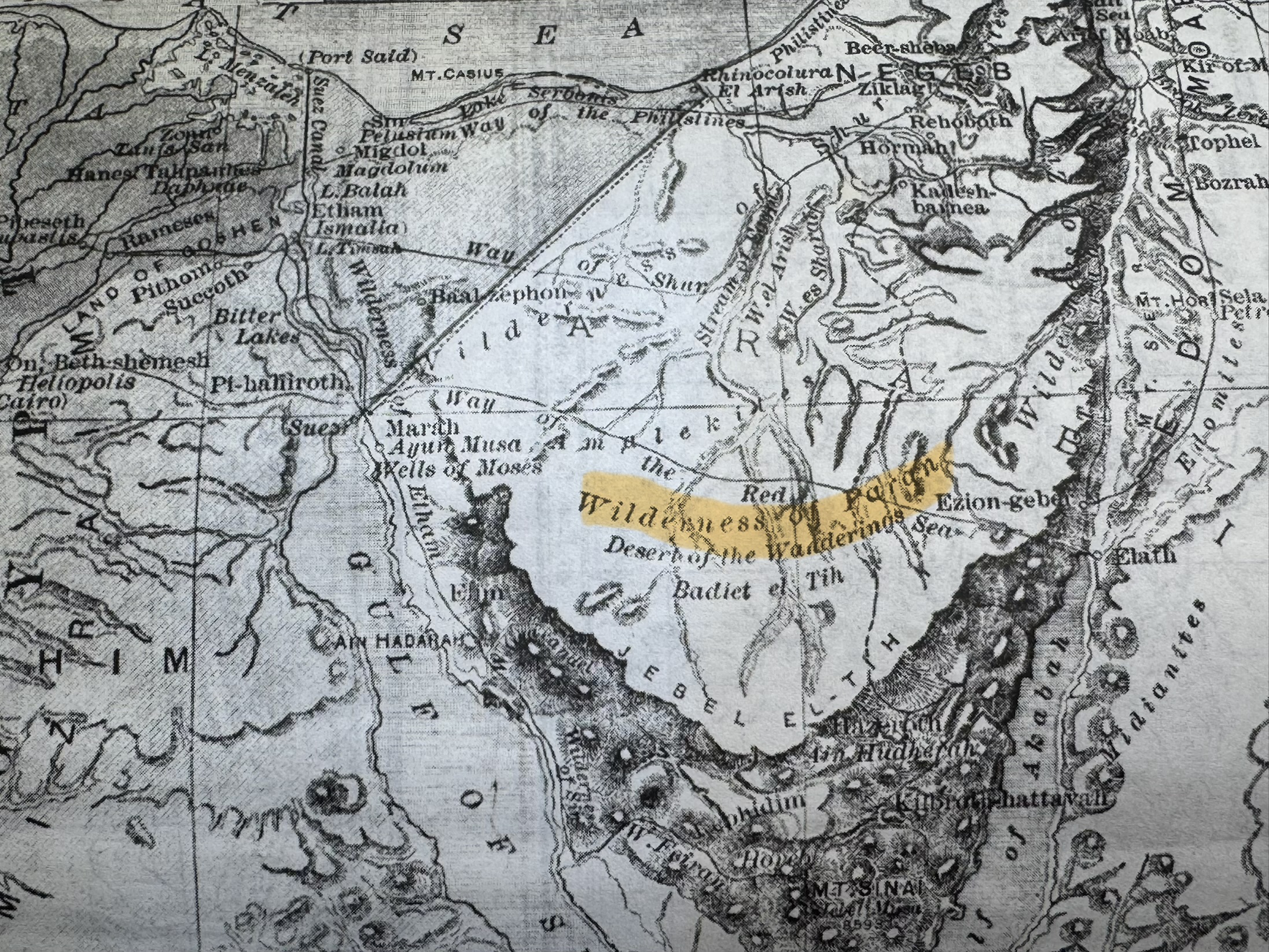
map #2: Pharan Wilderness=orange
v.21
Abraham therefore took sheep and oxen and gave them to Abimelech; and both of them made a league.
map #3: Gerar=purple loupe
Abimelech and Phicol are Philistine officials from Gerar. The Liturgy doesn’t reveal anything specific about their genealogy. Nonetheless, here’s what limited info there is available for Abimelech and his general.
Abimelech
Abimelech functions as a royal title, as in, my father is king, rather than a unique personal name. The same title appears for the Philistine ruler who later engages with Isaac, 26Gen. Further, there is no father, son or sons, or clan line that’s recorded for the Abimelech who met Abraham.
Phicol
Phicol/Phichol is identified only as the general of his army. The name recurs in the later treaty with Isaac, so it may likewise be a title or a repeating family name. No biblical lineage is offered.
Both men belong to the Philistines. 10Gen13–14 traces the Philisthians through Ham’s line: Noe—>Ham—>Mizraim (AEgypt)—>Casluhim (Philistines).
Abraham’s grounded behavior here is also worth taking note. He gallantly takes the high moral road, even when he’s in the right. Keen and wise, the patriarch was the first to realize it’s better to have friends & peace with neighbors than acrimony & war. The Prophet brilliantly thought it better to exchange commerce than bodies.
v.28
And Abraham set seven ewe lambs of the stock apart.
To whom Abimelech said:
What mean these seven ewe lambs, which thou hast made to stand apart?
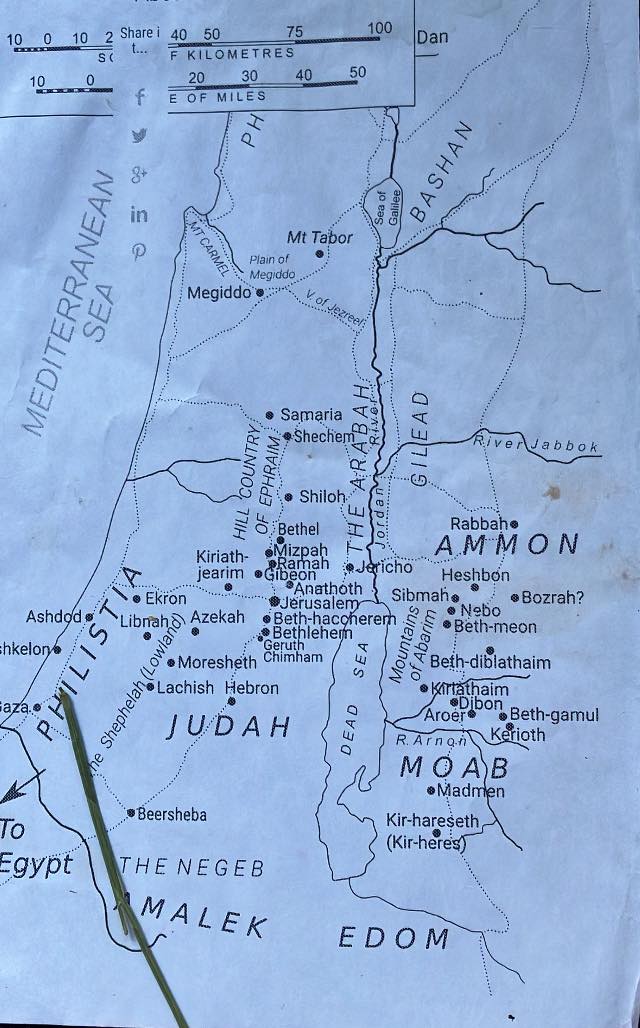
map #4: Bersabee (Well of Oath) to Philisthiim
But he said:
Seven ewe lambs shalt thou take at my hand; that they may be a testimony for me, that I digged this well.
Therefore was that place called, Bersabee [Well of Oath], because there both did swear. And they made a league for the Well of Oath. And Abimelech arose, and Phical, the general of his army, and they returned to the land of the Palestines.
But Abraham planted a grove in Bersabee and called there upon the name of our Lord God eternal. And he was a sojourner in the land of the Palestines many days.
Let’s examine this most pleasant passage from a spiritual analysis. Both the well and the oath mark a limited earthly peace. Water is secured, a treaty is sworn, and the Philisthians recognize QUI EST is with Abraham. Yet, instead of remaining there to share the water, Abimelech and Phicol go home. Their covenant is real but temporal and it certainly doesn’t make Abraham a citizen of Philistia. He stays what’s called a ger—a resident alien who lives beside the land without owning it.

tamarisk–desert evergreen
Then there’s the grove (Hebrew eshel), what usually consisted of a tamarisk. This grove is the counter-sign. A tamarisk grows slowly, lives long, and gives shade in arid country. A passing nomad does not plant one; a man who believes his descendants will sit under it does. Abraham therefore plants what he himself may never fully enjoy. The act is faith in the promise that outlasts both the treaty and his own life.
Under that tree he calls on El Olam, God Eternal (or God of hidden duration). Tis here this title first appears. Earthly kings die, wells can be seized again, oaths can be forgotten. Abraham anchors worship not in the newly won security but in the One who has no beginning or end. The grove is not an idol; it’s a living memorial that the promise is older and longer than the Philistine alliance. Therefore, Bersabee becomes a double place. Tis a well of human oath; and it’s a tree of divine eternity. Abraham possesses a well, enjoys shade, and still confesses that he is only a sojourner. The land is promised, not yet inherited; peace is granted, not yet consummated.
There’s something else I’d like to draw attention to. Being David will also be a sojourner in Philistia before he is crowned King, let’s draw a comparison to the pair.
David’s sojourn is the same pattern under later pressure. Fleeing Saul, he takes refuge with Achis of Gath. King Achis gives Sicelag for David and his family & 600 followers to reside in. He resides in Philisthian land for 16 months and even marches with Achis’ army as far as Aphek. Like Abraham he obtains a measure of safety from a Philistine ruler and dwells many days in their land.
The differences between both journeys sharpen the spiritual point:
Spiritually, both the patriarch and the King face the same tension: GOD may grant peace, water, and even a town inside enemy territory, yet the believer remains a stranger. The true resting-place is not the Well of the Oath or the city of Achis, but the Eternal Almighty Who outlasts every human league. Abraham answers that tension by planting and praying. David’s response to it is surviving until the Lord removes the threat. The later history of Beersheba (Isaac re-digs the wells, Jacob leaves from there, Elijah flees there) keeps returning to the same lesson. That lesson is this: the land of sojourning can become a place of invocation only when the sojourner looks past the treaty to the GOD who remains eternal.
end 21 Genesis
Which things being done, God tempted Abraham, and said to him:
Abraham, Abraham.
But he answered:
Here I am.
God tempted Abraham
i’m a tad befuddled by this word, tempted, because i don’t believe it’s the best translation. The Hebrew text uses the word, test. The Beresith-English translation is, tempt. i am more aligned with, reveal. i believe Moyses wrote this Epistle because QUI EST wanted all man to read and understand a most spectacular patriarch in Abraham. And to prove His point, in which He already knows, as stated earlier, that Abraham will ensure he and his family will indeed follow GOD’s Law. According to S Jerome and others: God tempeth not to evil, but by experience maketh known what virtue is in man. S James teaches: God tempted no one to evil but by trial and experiment made men known to the world. Thusly, in this Liturgical scene Abraham’s faith and most singular obedience were manifested when he refused to doubt. Saint’s Augustine and Theodoret tell us this becomes superiorly exemplified when Heavenly Father offers His only begotten Son in sacrifice, as like the second Prophet, accounting that QUI EST is able to raise up life even from the dead. It also symbolizes that QUI EST, as a Man, shall never ask mankind to do something He Himself would not do–the divine Leader by example. Whereupon He received his Son again parabolically, that is, in figure and mysterie of Christ dead and alive againe.
Isaac, also, in this action certainly exemplifies the remarkable divinity of JESUS, which suffered not, and the ram amongst the briars will figure his humanity–that should be offered in Sacrifice to God.
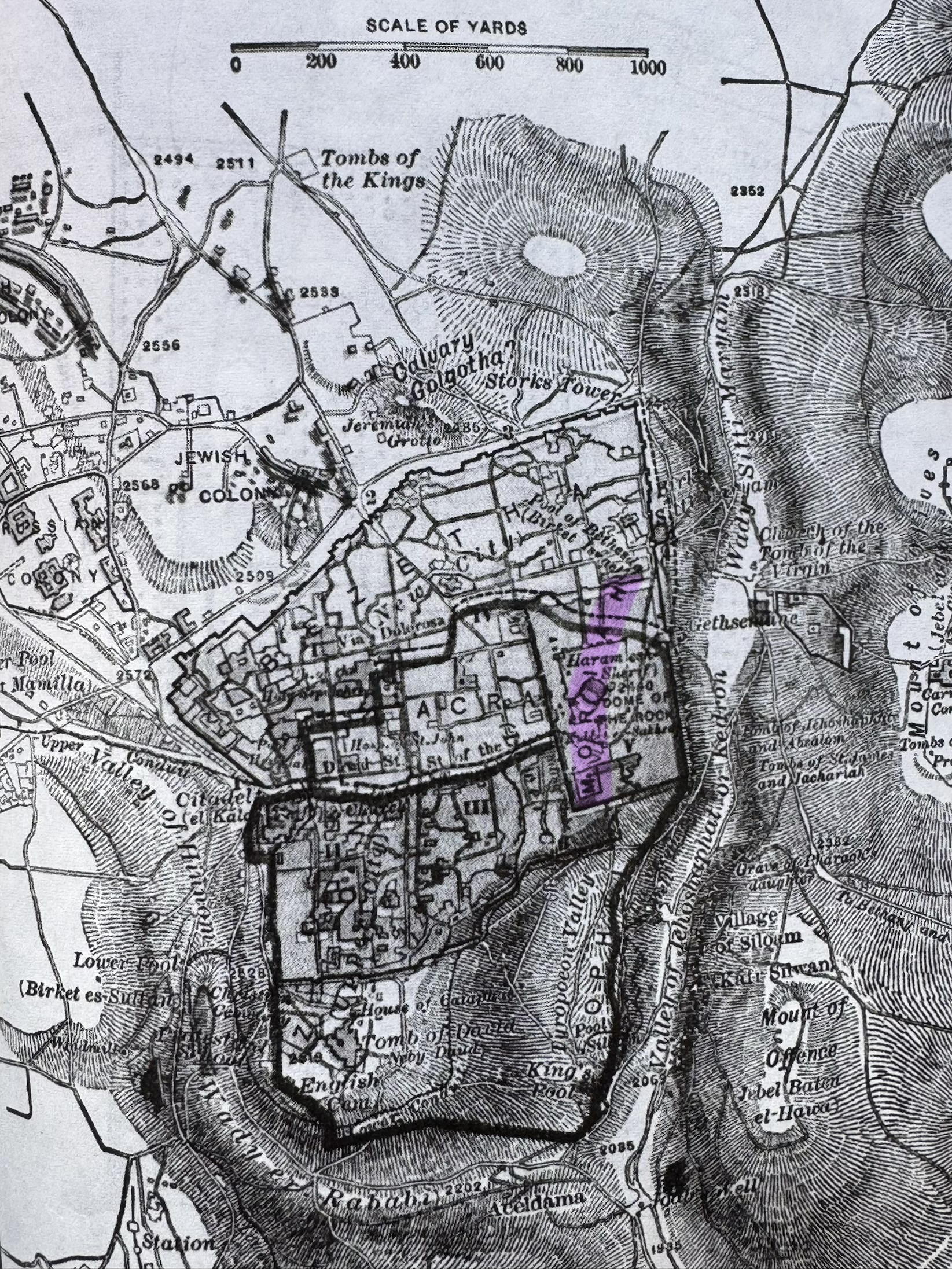
map #1: Land of Vision/Moriah=purple
v.2
He said to him:
Take thy only begotten son, whom thou lovest, Isaac, and go into the Land of Vision; and there thou shalt offer him for a holocaust upon one of the mountains which I will show thee.
Land of Vision
Moriah.
Take thy only begotten son
This history is clear and irrefutable: tis a most supreme example of divine obedience.
Therefore, Abraham, rising up in the night, saddled his ass, taking with him 2 young men, and Isaac, his son. And when he had cut wood for the holocaust, he went his way to the place which God had commanded him.
One can’t help but draw an analogous comparison to JESUS with His Apostles in the garden at Gethsemane. Both Scenes are built on the same shape:
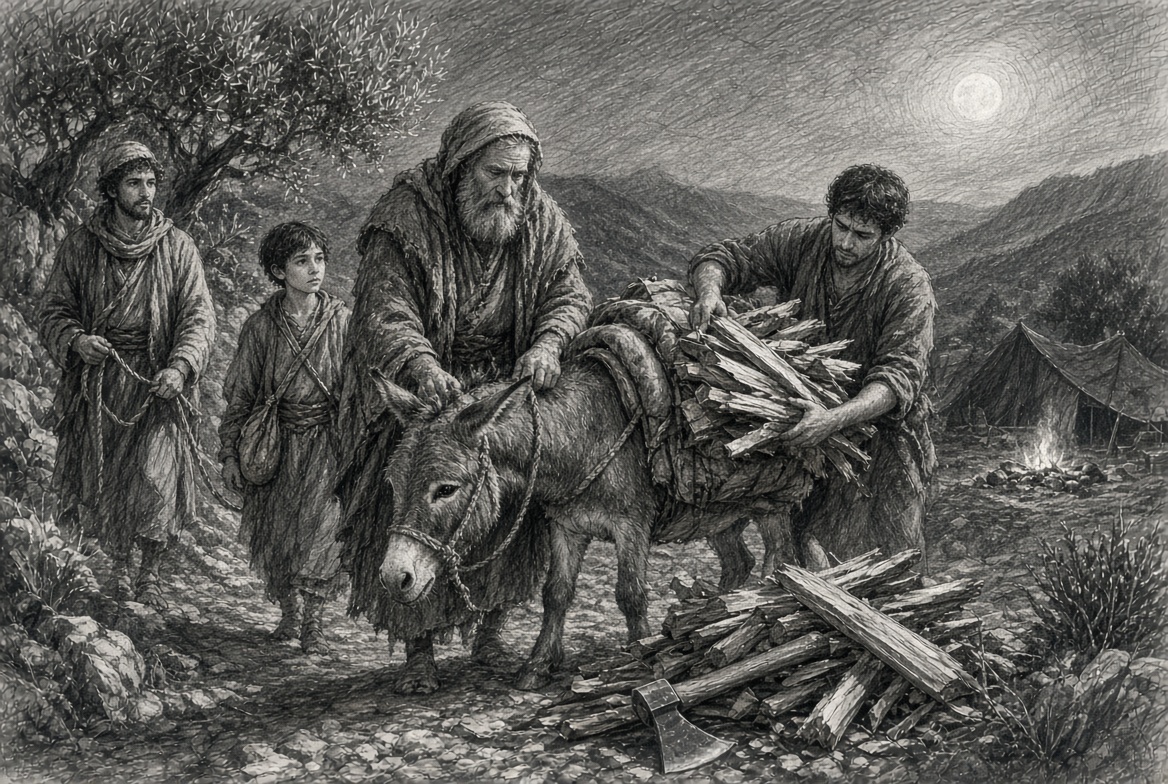 night departure towards a place HE WHICH IS has appointed,
 Abraham rises while it remains night, saddles the donkey, takes two young men and Isaac, cuts the wood, and starts for the mountain QUI EST named. Similarily, JESUS ventures out post-supper at night into Gethsemane with His Disciples. He then takes Apostle’s, Peter, James, and John, a little farther, to face the hour Heavenly Father appointed for Him. Both journeys are obedient before they are explained. Abraham does not bargain in this Verse; he gets up and goes. JESUS does pray that the cup pass; nonetheless He gallantly traipses to the garden already deciding to drink of it if Heavenly Father so wills. In both cases the place isn’t chosen by the traveling men. Moriah is commanded; Gethsemane and Golgotha are the hour the Father has set.
Both Scenes separate the inner circle from the act itself. Abraham will tell the two young men, Stay here with the ass; I and the boy will go yonder. Jesus leaves most of the Eleven behind, takes three farther, then goes a stone’s throw beyond them. The companions are real, but they cannot enter the offering. In Gethsemane they sleep. On the slope of Moriah they simply wait.
Wood is not incidental in either story. Abraham cuts it before he walks. Isaac later carries the wood for the burnt offering on his own back. JESUS goes to the garden already knowing He will be bound to wood. Scripture readings have combined 22Gen6 with the cross-bearing of 19Joh17. The graph below is an example of this.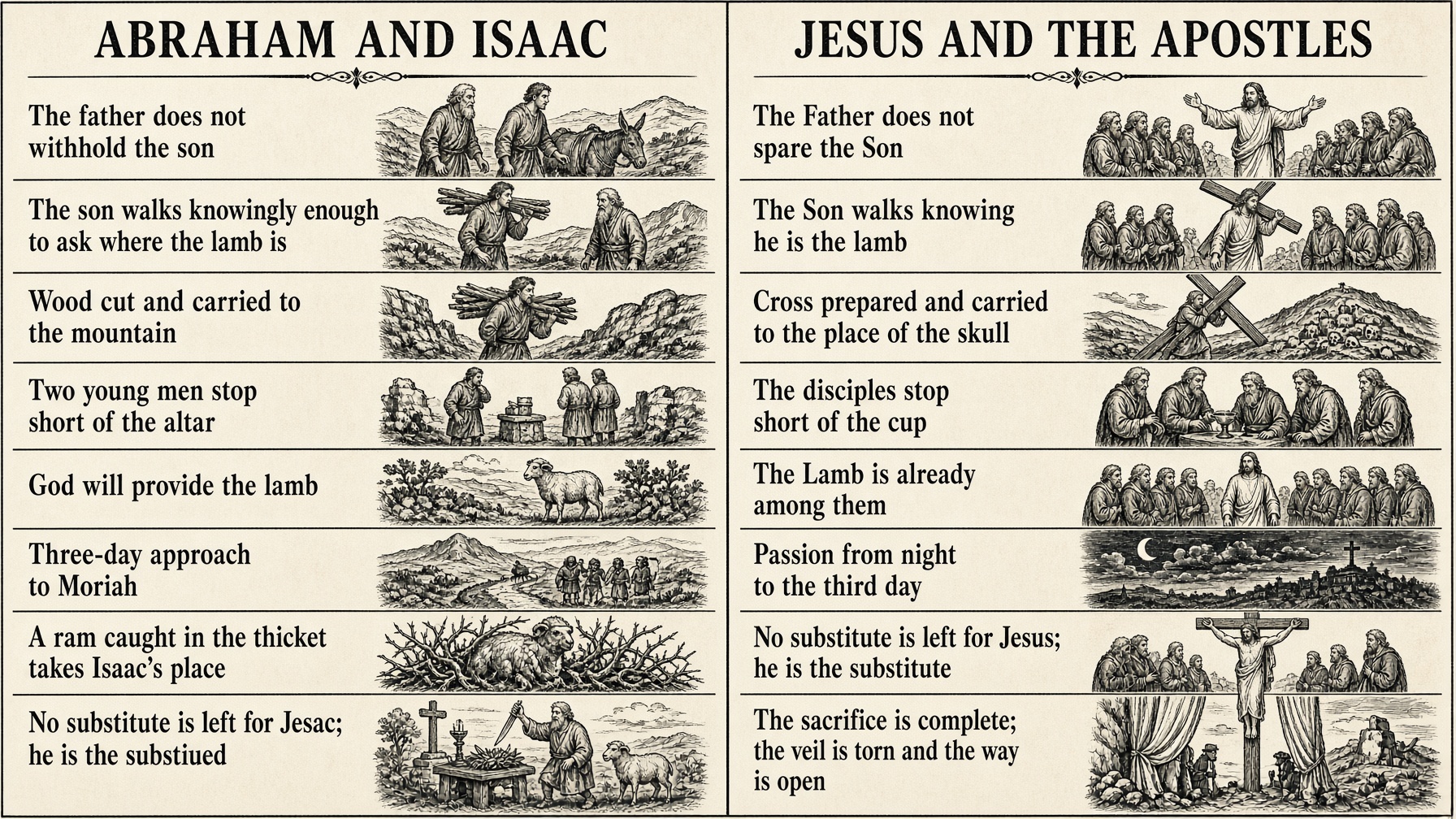
The Abrahamic Scene is tension-inundated because Abraham is already cognizant of what’s been asked of him whereas Isaac isn’t. The tension in the garden is the reverse and the fulfillment of that: the Son knows, and the companions do not grasp it. Abraham’s silence is the silence of a father carrying an unspeakable command. CHRIST’s prayer is the voice of the Son consenting to it.
With the many comparisons pointed out, let’s focus our attention where the two Scenes differ. Isaac certainly isn’t JESUS in the physical sense and Isaac is spared. The knife will be stopped and a ram shall be provided.The whole point of Moriah in the Genesis story itself is that the GOD of Abraham does not, in the end, take the life of His Prophet’s son. Gethsemane leads to a death that is not interrupted. That is why Christian typology calls Isaac a type and not a repeat. This is because the first Scene shows the cost the father was willing to pay and then provides another victim. The New Testament Scene portrays the same willingness with no other victim left. Abraham’s two young men are servants on a journey; the Apostles are friends who fail. Their sleep is not the same as the servants’ waiting. One group is simply not invited up the mountain. The other is invited to watch and cannot. Lastly, Abraham saddles an ass and loads wood; the motion is practical and grim. CHRIST does not pack for sacrifice in the garden. He prays until sweat is like blood. The Abraham scene is obedience in motion; the garden is obedience in agony.
A generalized perspective reveals this. Set next to each other, the Verses project that the passion does not begin at the nails. It begins when the father and the son set out at night toward a place already chosen, with wood already cut, and with companions who will not be able to finish the road. Abraham’s night is the Old Covenant’s sharpest picture of a son given over. CHRIST’s night is that picture taken without remainder: the Son carries the wood, the Father does not stay the hand, and the place GOD commanded is reached.
v.4
And the third day, lifting up his eyes, Abraham saw the place a far off. And he said to his young men:Tarry you here with the ass; I and the boy going with speed as far as yonder. After we have adored will return to you.
He took also the wood of the holocaust, and laid it upon Isaac, his son; and himself carried in his hand fire and a sword.
Re-read this Verse. Tis a very remarkable telling that Moyses writes here. The wood for the Holocaust is being carried by the Sacrificial Lamb himself, Isaac. About 33AD the actual Lamb will also carry His own wood for the ultimate sacrifice devoted to all mankind. Eternal Light is symbolized by the flame that Abraham carries. This very same Light shall be later duplicated via Moyses and the Covenant Ark.
v.6
And as they went on together, Isaac said to his father:
My father?
And he answered:
What wilt thou son?
Behold, sayeth he, fire and wood. Where is the victim of the holocaust?
And Abraham said:
God will provide unto Himself the victim of the holocaust, my son.
They went on therefore together. And they came to the place which God had showed him, wherein he builded an altar and laid the wood in order upon it. And when he had bound Isaac, his son, he laid him on the altar upon the pile of wood.
Where is the victim
This question is the hinge to this Scene. The young lad, in fact, sees the two things that make a holocaust possible—fire and wood—but notices the one thing missing. Abraham’s answer does not deny the wood or the fire; it merely relocates the victim. The instruments are already in place; only the identity of what they shall consume remains concealed.
laid the wood in order
Anyone who has constructed outdoor fires knows it’s designed according to its purpose. Abraham is aware he’s constructing a fire for a holocaust of a human, his son. Thusly, he designs and builds a fire according to its parts: kindling, tender, combustible fuel. The latter needs to burn fast and extremely hot. He chooses the wood accordingly as, after all, tis his son he’s about to sacrifice. It’s the large combustible wood that truly burns the sacrifice, just as JESUS carried large combustible wood in the form of a Cross. Thusly, a holocaustic fire was referred to as an olah–which certainly isn’t a cooking fire. Tis built to devour completely. The wood must be arranged so that the heat rises with the air feeding the flames. This is to ensure nothing of the offering remains. When Moyses writes, laid the wood in order, this informs the reader of a deliberate stacking versus a casual pile (in the field we referred to this as a pig pile). Both the father and the son know what kind of fire they will be creating.
Moyses also writes of the deliberate split in instruments between father and son before they reach the summit. Tis Abraham, over 100 years of age, who carries the fire and the weapon whereas Isaac carries the wood of the burnt offering. It’s not sickening but intriguing that the son bears the fuel that will consume him. This detail is already present in the Hebrew narrative and noticed early: the wood  on Isaac’s shoulder is the same wood that will lie under him on the altar. The later Christian interpretation sees the Cross in that wood as not an invention laid on top of the story: tis an intensification of a pattern the story had already set in motion.
In addition I now provide you with a pair of further notes of embeliishment:
Conclusively, this endearing Scene holds together three things concomitantly:
The large combustible timber Isaac carried up the hill and the large timber later carried outside the city are, in that reading, the same kind of hardwood: chosen because it must burn hot enough to finish what it was built to do.
v.10
And he stretched forth his hand and took the sword to sacrifice his son.
And behold an Angel of our Lord from Heaven cried, saying:
Abraham, Abraham.
Who answered:
Here I am.
And He said to him:
Abraham lifted up his eyes, and saw behind his back a ram amongst the briars sticking fast by the horns, which he took and offered a holocaust instead of his son.Stretch not forth thy hand upon the boy, neither do thou anything to him. Now have I known that thou fearest God and hast not spared thine only begotten son for My sake.
Isaac here signifies the Divinity of CHRIST, Who suffered not. The ram among the briars figures his humanity that should be sacrificially offered to HE WHICH IS. Whereas Isaac prefigures CHRIST’s Divinity, tis the Ram which prefigures CHRIST’s Humanity
v.14
And he called the name of that place, Our Lord Seeth. Whereupon even to this day it is said: In the Mountain Our Lord Will See.
Tis actually a religious & grateful thing when naming a place to preserve a particular memory of QUI EST’s Benefits–that posterity may know thee (S Christoft).
v.15
And the Angel of our Lord called Abraham the second time from Heaven, saying:
By my own self have I sworn,
–saith the Lord,
–because thou hast done this thing, and hast not spared thine only begotten son for my sake. I will bless thee and I will multiply thy seed as the stars of heaven, and as the sand that is by the seashore. Thy seed shall possess the gates of his enemies, and in thy seed shall be blessed all the nations of the earth because thou hast obeyed My voice.
QUI EST’s blessing attributes Abraham as the channel for the existence of all nations today. Hence, HE WHICH IS swears by Himself whereas Abraham’s obedience is the reason the oath is spoken at that moment. In 12Gen3 was the Fatherly promise via Abraham that all families of terra would be blessed. 22Gen then ratifies this promise by an oath after the son is not withheld. By my own self have I sworn is the highest possible guarantee in the narrative. The blessing of the nations is no longer only a spoken promise at the start of the journey. It becomes bound to a completed act: the father did not spare the son. This is the reason why subsequent Scripture treats this Scene as decisive rather than ornamental.
Thy seed… and in thy seed
Collectively, the seed is the people who come from Abraham. Personally, the New Testament reads the promise as aimed at one Seed. Paul is explicit when he iterates the Gospel was preached beforehand to Abraham. The second Prophet is the man through whom QUI EST tied the fate of the nations to a line that would not be cut off. So when I personally stated all nations owe gratitude to Abraham for their existence, I’m not saying such nations owe Abraham as a creditor. The countries of terra owe gratitude for a gift that, on this account, did not have to come through any other house. The logic is instrumental, not sentimental:
hast not spared thine only begotten son for my sake
These Words are later echoed in the language used of the Father and the Son. If Isaac carried the wood, and the ram was caught by the head in the thicket, and the son was not finally consumed, then the oath at the end of the Epistle is not a change of subject. Tis the verdict on the whole scene: because the son was not withheld, the nations will be blessed in the seed. The gratitude is that the Line was kept and that another Son would be given without a substituting ram.
Hitherto fore, if this vow be valid then the blessing of the nations isn’t a generalized religious fog. It’s historically particular because it passes through one man’s obedience on Moriah. Nations that live from that blessing—knowingly or not—stand downstream of Abraham. The proper first thanks is to the One who swore by Himself. The second gratitude is to the man who did not draw back, because the oath names that act as the reason the door to the nations was opened and locked open.
map #2: Bersabee=marker
v.19
Abraham returned to his young men and they went to Bersabee together; and he dwelt there. These things so being done, it was told Abraham that Milcah also had born children to Nachor, his brother.
Why does Moyses write of this here? The reason is because Moyses wants to reveal where Rebecca, wife of Isaac, shall come from. A succinct lineage is as follows:
Thare lives to the age of 205; he dies in Haran.
v.21
These eight did Melcha bear to Nachor, Abraham’s brother.
And his concubine, named Roma/Reuman, bare:
You have now learned who the father of Iran/Aram and Syria is: another nephew of Abraham’s, Camuel.
end 22 Genesis
© 2020 – 2026, Brother Sebastian with Shepherd Corps Sanctuary. All rights reserved. Any works here may be borrowed but credit must be revealed in 12 or larger font.
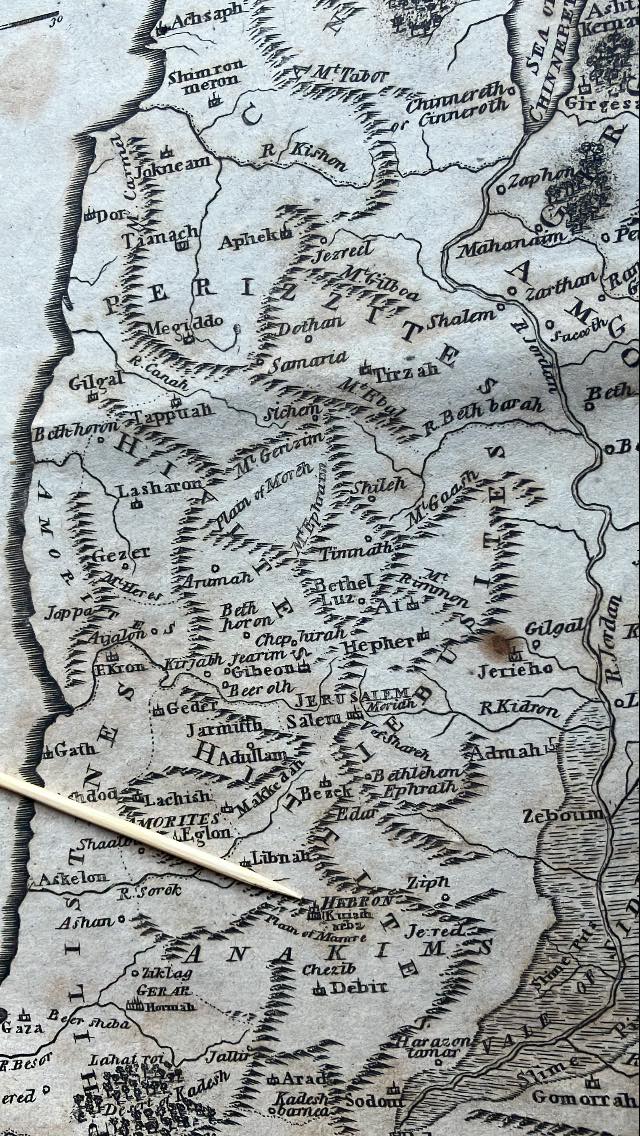
map #1: Arbee (Hebron)
And Sara lived 127 years. And she died in the city of Arbee, which is Hebron, in the land of Chanaan. And Abraham came to mourn and weep for her.
came to mourn
The way Moses writes these Verses leads me to believe Abraham, nearly 140 years old (he’ll live for another 60 years), was not with his wife when she passed. When he does learn of Sara’s demise, I’m certain it crushed him. The verb is wayyavo — he arrived. That is the natural sense of the Hebrew and of older translations such as ours. The previous Chapter ends with Abraham living at Beersheba and Hebron is obviously a different place. Nothing in the Text puts him at her side when she died; the narrative only shows him coming afterward to mourn.
v.3
And after that he was risen up from the funeral obsequies.
the funeral obsequies
Hebron is within the domain of the Hetite people which remains parallel to the Palestine kingdom. Palestine had always been its own territory–something deliberately (seemingly) ignored during the American-led reapportionment of Israel to European Jewish migrants post-WWII. Also, Moyses writes about Sara’s death because it is an early and clear example of the Religious Office of burying the 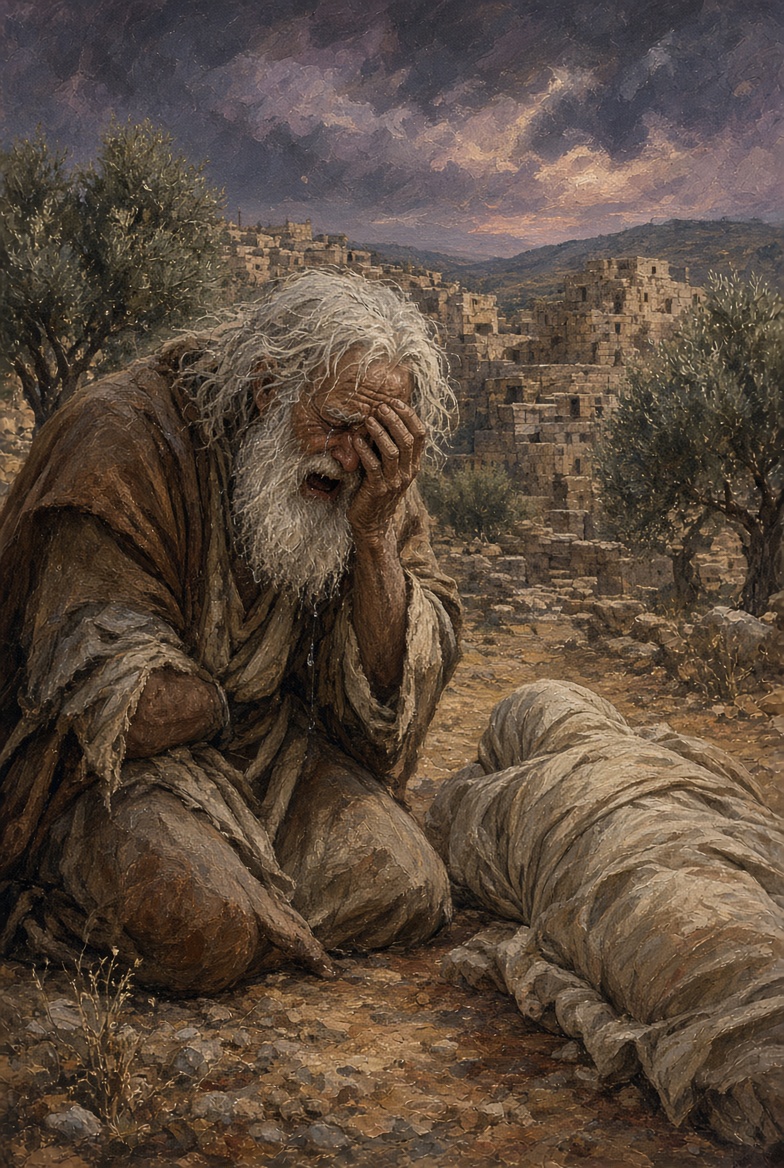 dead.
dead.
Readers/Followers, i should point out many in the world today refer to Hebron, a most special place, as the West Bank. Follow man’s world and continue the mistakes made by unknowledgeable politicians, media, activists, &c, or… enhance your genuine knowledge by what the Liturgy provides.
v.3 cont.
He spake to the children of Heth, saying:
I am a stranger and pilgrim among you; give me the right of a sepulcher with you that I may bury my dead. And no man can let thee but that in his own monument thou mayst bury thy dead.
Abraham didn’t conquer nations and destroy lives. He didn’t brutalize or lie to people to make a name for himself. Yet, he was so widely known and respected. Why? Moyses identifies the interactions of various persons with Abraham to show how well known and respected GOD’s second Prophet and his family are. This is also to inform you that the spiritual life is far superior than the way of the raven.
v.7
And Abraham rose up and adored the people of the land, towit the children of Heth. And he said to them:
If it please your soul that I bury my dead, hear me and be intercessors for me to Ephron, the son of Seor/Zohar, that he give me the double cave, which he hath in the uttermost part of his field, for money to the worth thereof let him deliver it to me before you for possession of a sepulcher.
Abraham’s constant humility is something QUI EST really loves about him. His respect for his fellow man certainly became Abraham’s harbinger and calling card. Also, Moyses writes this to show adoration being used for reverence done to men. S Augustine details such adoration in his discussions of Genesis. Other examples of adoration used for reverence:
v.10
And Ephron dwelt in the midst of the children of Heth.
And Ephron made answer to Abraham in the hearing of all that went in at the gate of the city, saying:
No, it shall not be so, my lord, but thou rather hearken to that which I do say. The field I deliver to thee, and the cave that is therein, in the presence of the children of my people, bury thy dead.
And Ephron dwelt
Ephron’s descendants are unnamed in the Liturgy. His people are the children of Heth—the Hittites living at Hebron/Kiriath-arba/Arbee. The Hittites came to fruition pursuant to the following linear table:
Noe → Ham → Chanaan → Heth → the Hittites of Chanaan → Zohar → Ephron
children of Heth
Heth is identified as a son of Chanaan in 10Gen15. The Children of Heth in this Epistle consists of a local Hittite community at the city gate and not the later Anatolian Hittite empire. Ephron sits among them as a landowner of the field and cave of Machpelah, which is east of Mamre.
Heth is recorded as being a son of Zohar and a Hittite of Heth’s line by way of Canaan & Ham. Nothing further is recorded.
What’s very intriguing about Verses 10-11 are the few setups that are birthed here and paid off later by JESUS Himself. Here are a couple of such:
v.12
Abraham adored before the people of the land.
And he spoke to Ephron, his people standing round about:
I beseech thee to hear me. I will give money for the field. Take it, and so I will bury my dead in it.
map #2: Mambre. The marker reveals the approximate location of the dual cave where Sara is buried. As noted by the co-author, Moyses, the tomb faces the Mambre Valley.
And Ephron answered,
My lord, hear me. The ground which thou desires is worth 400 sicles of silver. This is the price between me and thee. But how much is this? Bury thy dead.
Which when Abraham had heard, he weighed the money that Ephron had asked in the hearing of the children of Heth, 400 sicles of silver of common current money. And the field that before time was Ephron’s, wherein was the double cave, looking towards Mambre, as well it as the cave, and all the trees thereof in all the limits thereof round about, was made sure to Abraham for a possession in the sight of the children of Heth–and of all that went in at the gate of his city.
And so Abraham buried Sara, his wife, in the double cave of the field, that looked towards Mambre: this is Hebron, in the land of Chanaan. And the field was made sure to Abraham, and the cave that was in it, for a possession to bury in, of the children of Heth.
The exchange between Abraham and the youthful Ephron was indeed an exchange between man and GOD by way of Abraham. Ephron displays the innate nature of man when it comes to placing 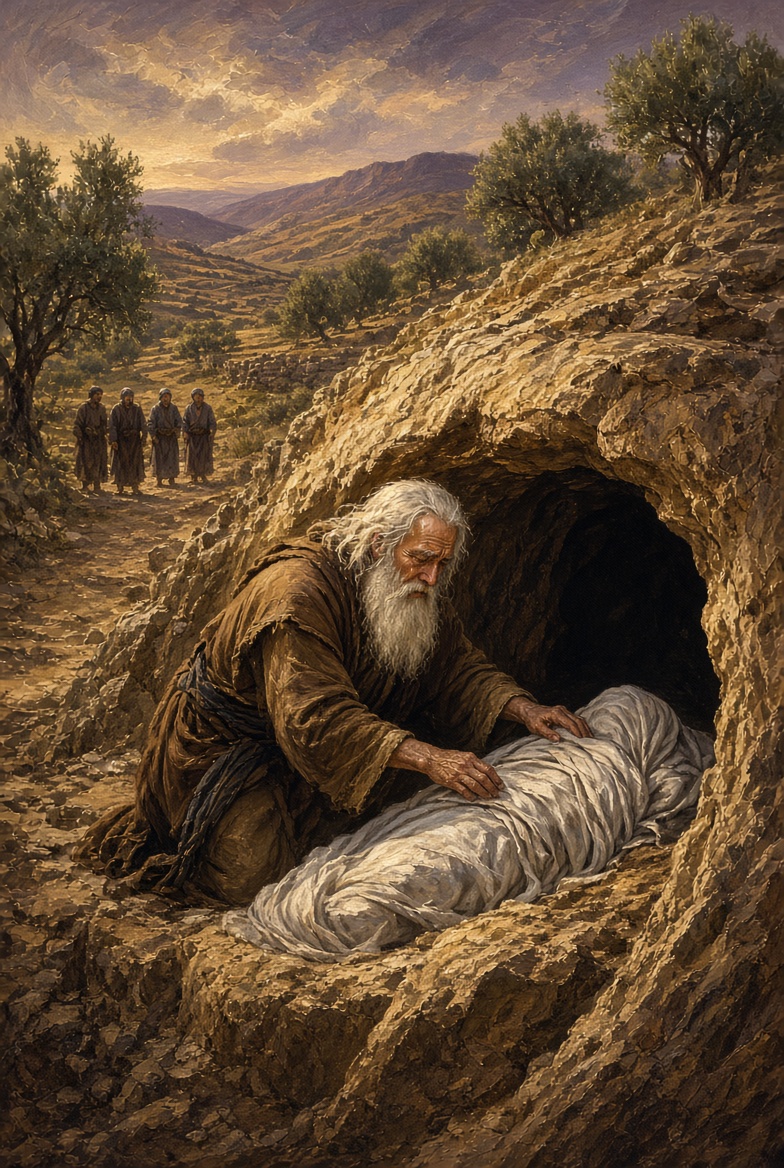 temporal value on something. Thusly, he uses the finite tool of money to represent value. For Abraham, and those who follow the spiritual life, the proper care and blessings for the dead, which JESUS turned into a blessed Sacrament, was much more valuable. The reason for its incalculable value is because of Abraham’s belief in the eternal soul. All and all this Scene involves a burial; but the spiritual weight is a purchase of hope.
Abraham refuses to take the field as a gift. Even though Ephron’s speech sounds generous, nonetheless, Abraham weighs the silver in public, current money, before the gate. Spiritually, this is faith refusing a borrowed grave in the land of promise. You see, a gift from the children of Heth would have left the cave under Hittite courtesy; but payment makes it positively his. What’s quite interesting here is the first piece of Chanaan that Abraham legally owns isn’t a house, lot or a throne, but a tomb. The promise of the land begins where the body is laid down, not where the living first pitch a tent.
Four hundred shekels is the price between me and thee. Between the heir of the promise and the man of the land there must be a settled cost. Nothing of the burial place is smuggled in. This actually becomes the same pattern later at Araunah’s floor: David will not offer what costs him nothing. Death and worship both require a price that is owned; they’re something that can’t be borrowed. Further, the field is made certain in the sight of the children of Heth, and of all that went in at the gate. Such a transaction is not private piety. Witnesses stand so that the possession cannot be denied. Spiritually, faith that buries its dead in GOD’s promise does so in the open. The gate is the place of law. Abraham’s grief resembles a public title-deed.
Machpelah means, double cave. The lot to which the Prophet purchases consists of two chambers, one field, and trees in all its limits. The text insists on the whole: field, cave, trees, boundaries. Nothing of the resting place is left outside the purchase. Spiritually, this is a complete claim. Tis not a slit in the rock for one night, but a bounded inheritance that includes what grows on it. Sara is laid in the inner place; the outer field and the trees remain as the visible token that the dead belong to a land still coming.
Hebron-Mambre is already the place where the Lord appeared and the covenant meal was eaten. To bury Sara there is to plant her body in the same ground where the promise was spoken. The sojourner’s wife is not carried back to Ur, which becomes the confession–this land, not the old country, is home even before the living possess it. Therefore, this passage reads as grief turned into title. Contrition and tears come first—>then silver is weighed—>then the cave is made sure—>then Sara is buried. The children of Heth keep their city. Abraham keeps only a grave—and that grave is the first sure foothold of the promise in Chanaan.
King Salomon, the most intelligent man to ever walk this planet, was also known at The Preacher and Coheleth
And Abraham was old, and of many days, and our Lord had blessed him in all things.
Lovely Reader, a reason these Epistles of Abraham are so extremely important is this: GOD not only blessed him to be the Father of Many Nations, but through Abraham are birthed both Commandments and Sacraments by QUI EST–as you shall witness another Sacrament in the following Verses. Such Sacraments eventually become institutionalized by JESUS through His Church.
v.2
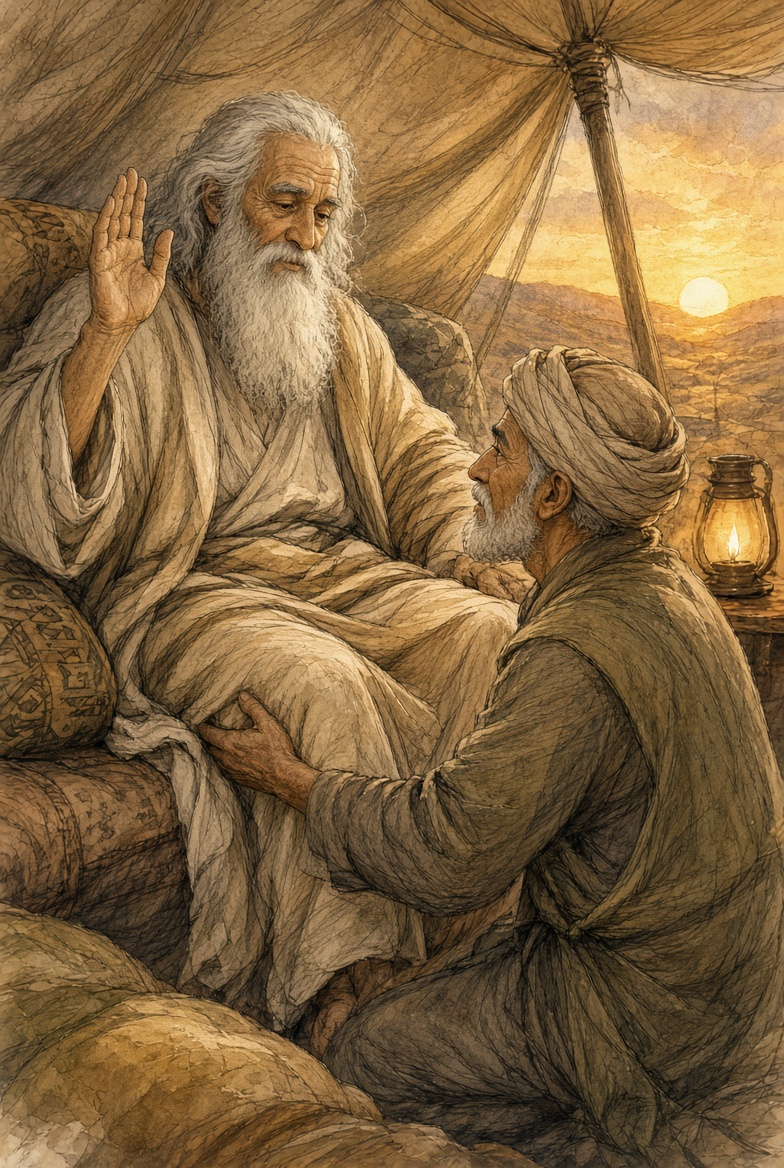 And he said to the elder servant of his house, which was the ruler of all that he had:
Put thy hand under my thigh that I may adjure thee, by our Lord God of Heaven and earth, that thou take not a wife for my son of the daughters of the Canaanites, among whom I dwell. But that thou go unto mine own country and kindred and thence take a wife for my son, Isaac.
take not a wife
The Sacrament i hinted earlier is revealed here: Matrimony. Why was the servant in lieu of Isaac the recipient of Abraham’s goods and possessions? This tradition was quite common amongst the Hebrew people. Until one’s offspring reaches a certain age, a father’s possessions are temporarily passed on to the chief household servant. Such a relationship is personal and consisting of at least a couple dozen years together. Also, in choosing a wife, she must be of virtuous stock and family, especially of true faith and religion: this before all other things to be considered and preferred.
v.5
The servant answered:
If the woman will not come with me into this land, whether must I bring thy son back again to the place from whence thou didst come forth?
And Abraham said:
Beware thou never bring my son back again thither. Our Lord God of Heaven, which took me out of my father’s house, and out of my native country, which spake to me, and swear to me, saying: To thy seed will I give this land; he shall send his Angel before thee and thou shall take from thence a wife for my son. But if the woman will not follow thee, thou shalt not be bound by the oath–only bring not my son thither again.
To show you the specialty of Matrimony as being a blessed Sacrament, Moyses now informs us QUI EST is involved–just as He was with Adam & Eve. Via HOLY GHOST inspired forth-sight, Abraham not only has ready-answers for any problems or questions the veteran house servant may have, but, he also informs the servant of an Angel Who will provide assistance.
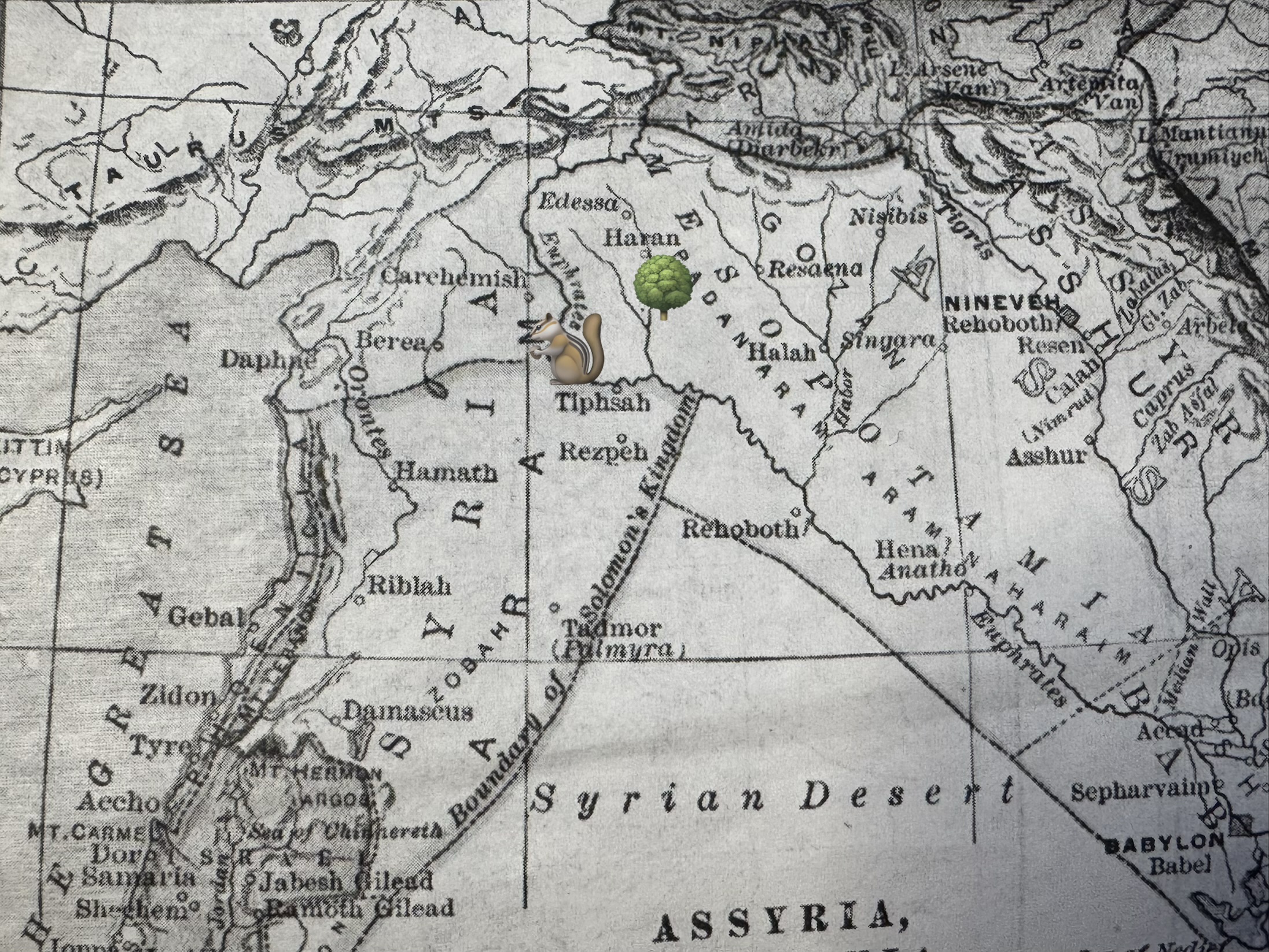
map #1: presumed locales of Nachor. Either at the northern bend of the Euphrates (squirrel) or near Haran (tree)
v.9
The servant, therefore, put his hand under the thigh of Abraham, his lord, and swear to him upon this word.
And he took 10 camels of his lord’s herd and departed, of all his goods carrying something with him, and setting forward went on into Mesopotamia to the city of Nachor.
And when he made the camels lie down outside the city beside a well of water at evening, at the time when women are wont to come forth to draw water, he said:
O, Lord God of my lord Abraham, meet me today, I beseech thee, and do mercifully with my master Abraham. Behold, I stand nigh to the fountain of water and the daughters of the inhabiters of this city will come forth to draw water. Therefore, the maid to whom I shall say, bow down thy tankard that I may drink, and she shall answer, drink, yea, to thy camels also will I give drink, she it is whom Thou hast provided for thy servant, Isaac. And by this I shall understand that Thou hast dealt mercifully with my master.
the maid to whom I shall say
What else can I add to portray to that the servant’s prayer was not a temptation of HE WHICH IS? Not to diminish the wise words of Augustine and the other ancients, but one tantamount thing is that the servant never dares Heavenly Father to perform; nor does he establish a trap for the promise. What he does is simply ask to recognize what GOD had already pledged to Abraham. Additionally, tempting GOD can be seen as an unbelief that forces a proof. Hence, the heart says, If you are God, do this—or I will not trust you. The sign becomes arbitrary and the petitioner stands above the word by making the Lord a defendant. Abraham’s servant stands under a word already given. Abraham has sworn his servant by the God of heaven and earth and has professed that the Lord will send his Angel before him. Thusly, the errand is not show me whether you exist. Tis meet me today in the path you have already opened. He calls Heavenly Father, Lord God of my lord Abraham. The covenant is the ground, not the prize.
What he proposes is actually a fitting test of the very quality the house of Abraham needs: a woman who will stoop, give drink, and then water 10 camels—hard, costly kindness to a stranger. That is not let the first bird land on my staff. Tis asking that providence mark the one whose character matches the blessing. If she only gives him a sip, the sign fails because she’s not the kind of heir the oath requires—not because HE WHICH IS refused a stunt. Also, he doesn’t bind QUI EST to a timetable of his own making as a condition of faith. Meet me today, I beseech thee, and do mercifully. Mercy is requested, not extorted. By this I shall understand that thou hast dealt mercifully with my master. Understanding is the aim because it’s discernment of a provision already implied in the promise to Abraham’s seed–not a new miracle extracted from heaven. The narrative itself refuses the charge. In the subsequent Verses when Rebecca comes forth, tis Heavenly Father answering inside the prayer. Scripture never rebukes the servant. Rebecca’s act is recorded as the Lord’s identification; thusly, the unnamed man worships.
To summarize: tempting HE WHICH IS puts the Lord on trial. This prayer puts the servant on watch. He asks for light on a road he is already walking by command, and the sign is the shape of covenant mercy itself—hospitality that costs—not a demand that GOD jump.
v.15
Neither had he yet ended these words within himself, and behold, Rebecca, came forth, the daughter of Bathuel, the son of Melcha, wife to Nachor, the brother of Abraham, having a tankard on her shoulder: a passing comely maid and most beautiful virgin, and not known to man. And she was gone down to the fountain, and had filled her tankard and came back.
And the servant ran to meet her, and said:
Give me a little water to drink of thy tankard.
v.18
Who answered:
Drink my lord.
And quickly she let down the tankard upon her arm and gave him drink. And when he had drunk, she added:
But for thy camels also I will draw water til all do drink.
And pouring out the tankard into the troughs, she ran back to the well to draw water; and being drawn gave it to all the camels. But he musing, beheld her with silence, desirous to know whether our Lord had made his journey prosperous or not.
As i ponder these Verses pedagogically i can’t help but boldly smile because here Moyses presents to us GOD’s usage of whoever and whatever (His instruments) He chooses in order to advance His spiritual fingerprint amongst mankind: in essence, the coming of JESUS and His Spouse. And the advancement of the Patriarchal seed after Abraham’s passing is apparently GOD has an expressed interest in. For, because of Abraham’s advanced age and declining physical health, QUI EST uses the Patriarch’s most humble and obedient servant to continue with this remarkable story of, The Light: which is what and why the Bible, and Apocrypha, are written. There’s also a growth lesson Moyses is sharing with us. When strangers, and even oftentimes friends, meet it is usually much better to listen to the silence than force dialogue or hasty action.
To provide you with a more detailed analysis, this biblical Scene is actually another one of those hinges I wrote about previously. This particular one is the hinge, or turning point, of the servant’s mission: the moment when Abraham’s oath-bound search for Isaac’s wife becomes a test of divine guidance at a well outside Nachor’s city. The Scene is tightly staged and pedagogically rich because it reveals the following:
Notice the servant arrives at evening, which is normal hour when women draw water. He also compels the camels to intentionally kneel by the well. The Prophet’s servant doesn’t rush into the city or negotiate with Bethuel’s household first. What he does is first stop at the public place where character can be naturally observed. The well itself is both practical and symbolic:
These are things a senior and receptive servant are cognizant of.
Next… the prayer & sign. The servant intentionally addresses the Lord, the God of my master Abraham, tying the request to his master’s covenant-relationship rather than to his own personal status. His petition is specific: kindness (ḥesed) towards Abraham, shown by a young woman who will not only give him a drink but will volunteer to water the camels as well. Watering 10 camels after a journey is heavy, repeated labor. Such an action reveals generosity, strength, and initiative beyond the minimum courtesy owed any stranger. Therefore, this passage teaches that discernment can be concrete without becoming superstition. This servant asks for a sign that coincides with the virtue the marriage requires. Additionally, he frames success as evidence that QUI EST has appointed the woman for Isaac.
Interestingly, Rebecca appears just before the servant finishes his prayer to QUI EST. This certainly reflects timeliness. She’s identified by lineage (daughter of Bethuel, granddaughter of Nachor and Milcah), so the family criterion Abraham set is already met. She is described as very fair and a virgin; the text then specifically shows, rather than merely asserts, her conduct. Rebecca lowers the jar, gives the servant drink, and only afterwards offers to draw for the camels until they have finished drinking. She empties the jar into the trough and runs back to the well. The verbs of haste underline willingness and certainly not one of reluctance. To summarize, here’s the sequence: identity, beauty, and chastity are noted, but the decisive evidence is the acted hospitality that matches the prayer.
With the servant watching in silence sort of provides us with a suspended or delayed judgment. The servant and the read wonder whether the Lord has prospered the journey or not. Abraham’s servant does not seize the first resemblance to the sign. Therefore, the pause itself is instructive: answered prayer is received with attention, not with immediate certainty. The confirmation continues in the Verses that follow–the family inquiry, the repeated hospitality, the ornaments, &c.
Spiritually, this Episode is a classic Old Testament instance of providence working via ordinary (and believable) means. QUI EST is not said to speak audibly. In fact, guidance arrives as the convergence of Abraham’s prior obedience, the servant’s prayer, a public place, and a woman’s freely provided generosity. Ḥesed asked for Abraham is answered by ḥesed embodied in Rebekah. Also, this well Scene belongs to a larger biblical pattern (later Gospel meetings at wells) in which a bride, or a decisive encounter, is associated with water and with an offer that exceeds duty. Many doctors have taught that Rebecca’s voluntary service is a figure of the soul, or of the Church, responding to the one who is sent—this without collapsing the historical narrative into allegory. The servant’s refusal to speak until he has watched is in fact a spiritual discipline: desire for a sign is paired with patience before interpretation.
Pastorally, this Passage holds together two goods that are often split: trust that QUI EST directs the search for a spouse (for any vocation under promise), and the requirement that the person sought show tangible kindness, initiative, and fitness for the household they will enter. The sign works because it asks for the very quality the covenant family needs.
To summarize, this informative Scene teaches a method of seeking: prayer rooted in GOD’s prior promise, a sign joined to moral substance, and immediate (though still provisional) fulfillment. They portray Rebecca’s first act as the kindness in which the servant had asked to see.
v.22
And after that the camels had drunk, the man plucked forth golden earlettes weighing two sicles and as many bracelets of ten sicles weight.
And he said to her:
Whose daughter art thou? Show me, is there any place in thy father’s house to lodge?
The audacity, and even the intelligence, in the servant’s words reveals the HOLY SPIRIT, at this point, has engaged in this man’s soul. An even stronger & sensational Transcendence can be seen in Judith of the Book of Judith.
v.24
Who answered:
I am the daughter of Bathuel, the son of Melcha, whom she bare to Nachor.
And she added, saying:
Of straw also and hay we have good store and a large place to lodge in.
The man bowed himself and adored our Lord, saying:
Blessed be the Lord God of my lord Abraham that hath not taken away His mercy and truth from my lord and hath brought me the straight way into the house of my lord’s brother.
Recall the covenant QUI EST established with Abraham. That Heavenly Father had such exquisite delightful faith in Patriarch Abraham in which He even told His Prophet that his seed to those in his household would/will uphold His laws and continue worshipping Him. Now observe what Abraham’s chief servant had done as soon as he realized the intervention of HOLY GHOST. He right away drops to his knees, maybe makes a small altar as his master had done many times, and offers praise & thanksgiving to HE WHICH IS. And, even if he is incorrect, can anyone ever make a mistake in honoring our Heavenly Father too much?
 v.28
v.28
The maid, therefore, ran and reported into her mother’s house all things that she had heard.
The maid
Rebecca’s name, in fact, signifies maiden.
her mother’s house
Rebecca’s father, perhaps, having many wives, each with their own abode, she went to her mother’s home.
v.29
And Rebecca had a brother named Laban, who, in all haste, went forth to the man where the fountain was! And when he had seen the ear-lets and bracelets in his sister’s hands, and had heard all her words reporting, these words spake the man unto me.
He came to the man which stood beside the camels, and nigh to the fountain of water, and said to him:
Come in, thou blessed of our lord. Why standest thou without? I have prepared the house and a place for the camels.
And he brought him into his lodging. And he unharnessed the camels and he gave straw and hay, and water to wash his feet, and of the men that were with him.
water to wash his feet
Tis with the story of Abraham we are introduced to the ordinary hospitality of feet washing. Firstly, Abraham washes the feet of the three Angels, then Lot offers the same with two of the Angels, and now Laban with Abraham’s senior servant.
Travel made this hospitable practice quite practical. Roads were dust and grit, sandals were open, and a guest did not bring the road into the sitting and eating space. Water at the door, henceforth, marked the shift from outside to inside. In these stories the host supplies it; the guest, or a servant, does the washing. It rests with the other duties Laban performs in the same breath:
Refusing it, as the Messengers first do at Lot’s door, is a way of staying outside the host’s protection.
This custom had occurred in the households of Canaan as well as upper Mesopotamia–as evidenced by Nachor’s family. Comparable welcome of a traveler—water, a seat, a meal—is widespread in ancient Near Eastern hospitality; foot-washing remains a recorded courtesy long after the patriarchs (in Israelite narrative and later in Greco-Roman households). Though Abraham and his family aren’t the inventors of this hospitality, what his stories do initiate is the meaning to this act. Washing the feet is the host’s first proof that the stranger has been received. In fact such is the line 13 John reverses when the host kneels and washes the guests’ feet himself.
With this particular Scene foot-washing is hospitality before it is ritual. Laban brings the servant in, unharnesses the camels, gives them straw and fodder, and sets water for the men’s feet. Such an identical offer already stands in Abraham’s tent (18Gen4) and at Lot’s door (19Gen2). The dust comes off because the road is over and the guest is inside.
A spiritual interpretation reveals the water marks a threshold. Sandals and dust belong to the journey; washed feet belong to the house, the meal, and the conversation that cannot happen in the open. Abraham’s blessed Visitors are received before he even knows who They are. The act is not a purification rite of the later priestly code. Tis the host’s first proof that the stranger has been taken in. Refusal, like when the Messengers hesitated at Sodom, keeps the visitor outside both the roof and the host’s protection. Later Texts keep that meaning and then turn it. Abigail will offer to wash the feet of David’s servants (1Sam25:41). A widow who has washed the feet of the saints is credited with a life of good works (1Tim5:10). In 7 Luke the weeping woman washes the feet of JESUS with her tears in Simon’s house then CHRIST names what Simon withheld: no water for a guest. Hitherto-fore, the neglected basin becomes the measure of whether the host has actually received him.
There’s also the 13th Chapter of John which presses the same custom internally. The host kneels and washes the guests. Peter’s refusal is not modesty about dirt; tis a refusal to be received on those terms. JESUS ties the washing to a share with him then tells His Disciples to repeat it. The dust is still the road’s dust but what changes is who bends. The patriarchs’ water said, You are in my house. The later scene says the same sentence with the roles reversed: the one who ought to be served takes the servant’s place, and belonging is given rather than earned.
Jewish reading stays closer to the hospitality law itself: receiving the wayfarer is a form of righteousness, and Abraham’s tent is the pattern. Christian reading takes that pattern as the line that runs to the upper room. Both turn on one point already present in Laban’s courtyard: ‘you do not hear the errand, or sit at the table, until the journey has been allowed to end.’
v.33
And bread was set before him, who said: I will not eat til I speak my message.
He answered him: Speak.
And he said: I am the servant of Abraham and our Lord hath blessed my lord wonderfully; and he is magnified. And He hath given him:
And Sara, my lord’s wife, hath born my lord a son in her old age; and he hath given him all things that he had. And my lord adjured me, saying: thou shalt not take a wife for my son of the Chanaanites, in whose land I dwell. But thou shalt go to my father’s house and of my own kindred shalt thou take a wife for my son. But I answered my lord: What if the woman will not come with me? Our Lord, saith he, in whose sight I walk, will send His Angel with thee and will direct thy way; and thou shall take a wife for my son of my own kindred, and of my father’s house. Thou shalt be innocent from my curse when thou shalt come to my kin; and they will not give her to thee.
innocent from my curse
Modern translations make the same point more directly. The King James Version writes, then thou shalt be clear from this my oath. The sense is acquittal or discharge: the servant is no longer bound, provided he doesn’t take Isaac himself back to that land. So the Phrase is not a threat aimed at the servant, nor a curse against the relatives. Tis Abraham’s own release clause: success is hoped for, but refusal by the kindred leaves the servant blameless and the oath spent.
v.42
Which when Abraham’s servant heard, falling down he adored our Lord to the ground. And taking forth vessels of silver, and gold, and garments, gave them to Rebecca for a present. To her brothers, also, and to her mother he offered gifts.
v.54
A banquet was made; and eating and drinking together they lodged there.
And in the morning the servant arose, and said:
Dismiss me that I may go to my lord.
And her brother and mother answered:
Let the maid tarry at the least 10 days with us, and after she shall depart. Stay me not, saith he, because our Lord hath directed my way? Dismiss me that I may go on to my lord.
And they said:
Let us call the maid and ask her will.
I share the wise words of S Ambrose when he wrote that children ought not to marry without the consent of their parents good liking; so the parties own consent is most necessarie.
v.58
They dismissed her, therefore, and her nurse, and Abraham’s servant, and his company, wishing prosperity to their sister, and saying:
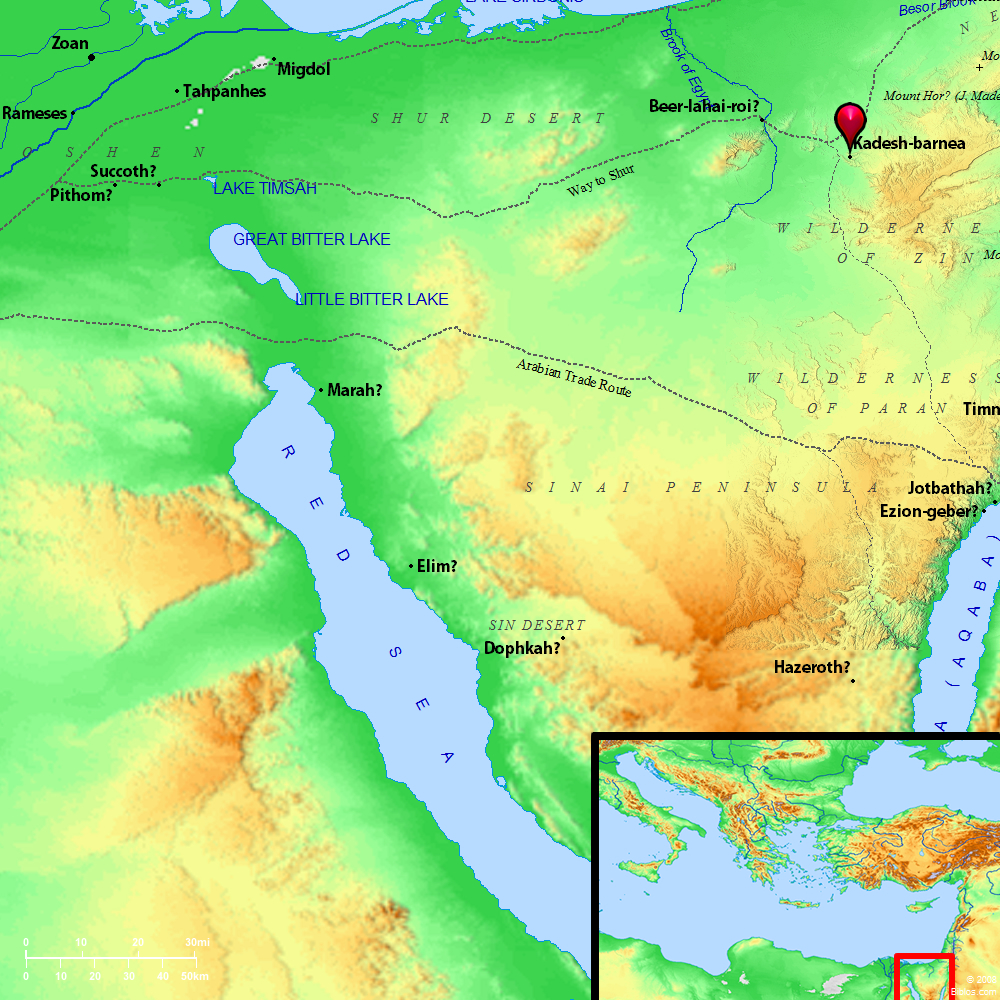
map #1: Beer-lahai-roi, the Well’s exact location is unknown.
And the same time Isaac walked along the way that leadeth to the Well of the Living and the Seeing, so called. For, he dwelt in the south country; and he was gone forth to meditate in the field, the day now being well spent. And when he had cast up his eyes, he saw camels coming a far off.
There are several items worth exploring in this Scene which introduces us to the adult, Isaac.
When Rebecca provides the non-hesitant response that she will go with the visitor, there is no way she came to this conclusion independently. HOLY GHOST absolutely provided her with an incredible feeling of comfort and trust with the message Abraham’s servant brings. Otherwise she would at least be reticent about venturing off with complete strangers and wanting further discussion with her family. Certainly the lavishing gifts provided to her by the servant helped to ease her mind.
thousand thousands, and thy seed possess the gates
Let’s elucidate the meaning of this blessing. Thou art our sister is kinship, not a correction of fact. Laban and the household are sending her away and still claim her. In other words, she goes as one of them and not as a stranger sold off. Increase thou into thousand thousands is, of course, a fertility blessing. They ask that she become the mother of a vast people. The same scale of descendants has already been promised to Abraham—seed like the dust and the stars—so the family is wishing Abraham’s promise onto the woman who will bear the next generation of it. Thy seed possess the gates of their enemies is about dominion and not a wish only for many children. In a walled city the entry/gate was:
Thusly, to possess an enemy’s gate is to take the city and rule it. The wording is almost the oath QUI EST swore to Abraham after the binding of Isaac: thy seed shall possess the gates of their enemies. Rebecca is blessed as the mother through whom that line is to run.
meditate in the field
To me, this section of the Chapter provides the most fantastic illumination. Not only are we introduced to Isaac as an adult but Moyses writes something else quite tantalizing: Isaac was meditating in the field. This becomes the first time meditation is used in the Old Covenant. And i concur somewhat with Saint’s Ambrose and Augustine as they understand meditate to mean mental prayer. The point Moyses makes with these couple of Verses is this: that such a person, when he/she speaks, shall do so considerably with his heart or her mouth. Conclusively, i feel if Moyses intended for prayer to be used in lieu of meditate he would’ve wrote, to silently pray.
When Isaac speaks I believe him to be a man who does so with much deliberation and consideration. Isaac goes to meditate because, like Abel before him, he provides time in his daily life to give thanks and praise to all of ELOHIM’s sensational creations. Terra’s nature is a landscape that can only be sculpted by QUI EST. Isaac has the heart and soul of a kindred spirit–perhaps even a natural romantic. There’s something else this meditation signifies. Tis another one of those quiet hinges I’ve previously written about. You see, GOD’s third Prophet wasn’t at the wedding party, nor was he at Beer-lahai-roi Well. Yet, he’s the hinge because this is where the Story is aiming towards. Speaking of the Well of the Living One, tis interesting Issac resides beside it in Negev land. This is the son of the promise dwelling at the place named by the expelled mother of the other son. I wonder if he opted for this so he could visit with his half-brother, Ismael.
There’s something else in need of mentioning with regard to, gone forth to meditate in the field. As you’ll learn, this in fact is the only written Test entailing his inner life (spiritual self) in this Chapter. The Hebrew verb, suach, is rare; the versions divide between:
Tis the Douay-Rheims Bible that chooses meditation.
Perhaps the time of day can provide further extrapolation. The timeframe is evening. Further, the day is well spent, therefore, the light is failing. This is the same hour at which his father’s servant had prayed at the well in Haran in which Rebecca came out. The two scenes sort of have a rhythmic appeal to them: a man outside the camp at evening, a woman arriving with camels, a recognition that does not need any dialogue. Isaac lifts his eyes and sees the camels. Rebecca lifts her eyes, sees him, and slips down from the camel to ask who he is. In fact, her veil goes on before they meet.
With the mid-30s Isaac established as the hinge; nonetheless, the Story itself is told via Abraham’s most trustworthy servant. Later you’ll learn Isaac brings Rebecca into Sara’s vacant tent and that he loves her. Further, Rebecca will provide comfort to Isaac as he contemplates the missing of his mother–24Gen67. (Recall that Sara has died in the previous Chapter.) But tis the meditation in the field which provides for the last solitary moment before that comfort. The well he walks towards was named by the woman Sara drove out. The bride who will enter Sara’s tent is the answer both to the empty tent and to the promise that seed would possess the gates of enemies: the blessing Rebecca has just received on the road.
Lastly, nothing in the Verse states Isaac is waiting for any woman; but the timing makes the field a meeting place anyway. With the Isaac Scene we see the heir of Abraham, at evening, on the way to the Well of the God Who Sees when the woman, who will continue to carry the line, comes into view.
And the servant told Isaac all things that he had done. Who brought her into the tent of Sara, his mother, and took her to wife. And he loved her so much that it did moderate the sorrow which was chanced of his mother’s death.
A spiritual interpretation of this unfortunately truncated Scene treats the above sequence as a figure of covenant succession as well as a bride brought to the heir. Let’s identify the specific points of such an elucidation.
First up is Rebecca’s cloak. This being the first act of her meeting with Isaac, the bride-to-be has already asked who the man is. As soon as she learns who he is, she immediately covers herself. In the plain sense this is bridal modesty before a husband not yet formally received. Now, if we absorb this spiritually, the veil is the moment she ceases to be a woman of Haran on the road and becomes the one who belongs to the heir (the continual seed to QUI EST’s Church). She refuses to approach the wealthy bachelor uncovered. Thusly, recognition comes before a union–this goes with all permanent unifications involving mankind. The covering, therefore, marks the change of her social state.
The hinge on this Scene is the servant’s report. Isaac does not court her and doesn’t repeat the journey. Incredibly, he receives the bachelorette on the word of the one sent to fetch her–the most trustworthy and loyal servant to Isaac’s father/family. If we magnify this through a Christian lens we can see the servant is often taken for the Spirit of Truth, or for the apostolic witness, who goes out, finds the bride, and presents her to the son. The marriage rests on that completed errand and certainly not on a new negotiation in the field.
Next up is Sara’s tent. It’s interesting that Isaac continues to use his mother’s tent and thusly it’s the sharpest symbol of this Scene. Sara is dead; the tent is empty. This means the Godly promise has no mother in the land. Isaac does not build Rebecca a separate new place first. He intentionally and specifically brings Rebecca into the mother’s tent. This is so the new wife shall inhabit the space of the woman through whom the promise had already passed. Spiritually, I dub this as succession and not replacement–as in erasure. The covenant household continues and the bride is installed in the inheritance rather than beside it. As a matter of iteration, S Paul reads Sara and Agar as two distinct covenants (4Gal). Then later we extend Paul’s point to this tent, the dwelling of the free woman now held by the next generation.
There’s also a comfort that’s provided here, which is the inward side of the same act. Scripture reads Isaac loved Rebecca and that her reciprocal love moderated the sorrow of his mother’s demise. The spiritual sense is that the promise remain in a state of grief. Moyses tells us the continuation of the seed of Heavenly Father’s Church is indeed something to be celebrated and not crushed in despair. Sara’s death had closed one chapter at Hebron whereas Rebecca’s entrance opens the next chapter without denying the loss. Consolation here is not forgetfulness. Instead, tis the heir given a wife, the empty tent filled, and the line carried forward through love rather than through the mourning alone.
Weaving all of this together, this Verse is read as:
And Abraham married another wife named, Cetura, which bare him:
Iecsan also begat:
The children of Dadan were:
But also of Madian was born:
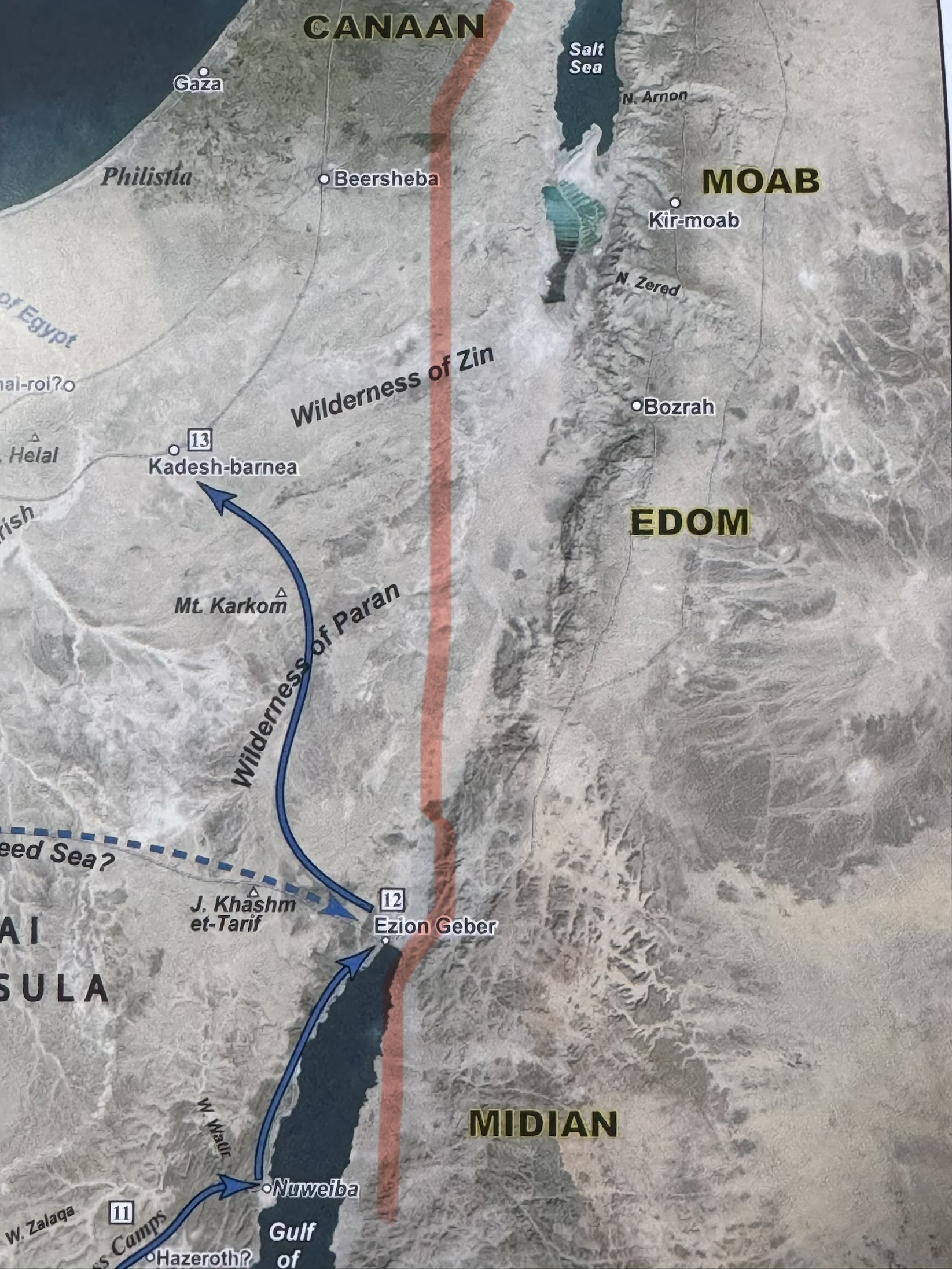
map #1: eastern lands are to the right of the red line
All these were the children of Cetura.
And Abraham gave all his possessions to Isaac. And to the children of his concubines he gave gifts, and separated them from Isaac, his son, whilst himself yet lived, to the east country.
Abraham divides the outrageously wealthy household while he is still alive: all he has goes to Isaac. His offspring by way of the concubines receive gifts and are sent east, away from Isaac. Unfortunately, the blessed Text gives the act and not a speech explaining it. The speculative reasons have to be read from what the division protects.
The inheritance, strictly speaking, is the point to the Reading because of the covenant line: the land promised to Abraham and his seed, the blessing, and the status of heir. Isaac is the son of Sara, the son specifically named in the promise. If the other sons remain beside him then the estate and the claim would be split. Gifts settle them without making them co-heirs. Abraham brilliantly uses separation as a tool to keep the promise from becoming a dispute among brothers after the father’s death.
Exploring separation we see the direction is quite deliberate: not north, west or south but east. So, why east? East is away from Chanaan. East is toward the lands Abraham already knows as kin country and steppe–flat and without woodland. Agar was sent south toward Shur and Egypt. Cetura’s sons (Zimran, Jokshan, Medan, Midian, Ishbak & Shuah) are later associated with Arabia and the eastern deserts. Thusly, the east country is the same horizon as the east to which the nations spread. Agar’s son, Ismael, has already been set in the wilderness of Paran, as per Chapter 21. The concubine sons are pushed onto that outer map so that Isaac remains the one who stays in the land of Israel’s future.
Albeit location is important so too is timing. Abraham specifies his will whilst himself yet lived. He doesn’t leave the severance to executors. A living father can endow, dismiss, and make the boundary hold. After his demise the only lawful heir in Chanaan is already alone in possession, which is what the burial Chapter then assumes. The upcoming burial Chapter reveals Isaac and Ismael meeting in order to bury their father at Machpelah; nonetheless they do not share the estate.
Something else in need of mentioning concerns contrast. Abraham’s order also reflects a contrast with the quarrel that he didn’t want to risk. Recall that Sara had demanded Hagar and Ishmael to be cast out because Ishmael wouldn’t inherit jointly with Isaac and GOD had told Abraham to heed his first wife. With this perspective the later dismissal of the concubine sons is actually the same policy. A policy executed under controlled and calm conditions and one being, of course, prepaid. That way there would be no second expulsion crisis, no rival camp inside the Negev, and one containing gifts instead of empty hands. The east is far enough that their increase does not crowd the well and the tent where Isaac lives.
In conclusion, sending the brothers east is how Abraham keeps one heir in the promised land without pretending the other sons were never born. When the concubine sons leave they do so being very much provided for–with abundant (not limited) possessions. The promised land for QUI EST’s Church remains with the promised seed, Isaac.
And the days of Abraham’s life were 175 years. And decaying he died in a good old age, and having lived a great time, and being full of days, and was gathered to his people.
lived a great time
For the most part and though not specified directly, the Liturgy teaches us that those who live justly lives are certainly rewarded by QUI EST with fullness of days. The days of the wicked are void of fruit. This is true whether such persons have long or short lives.
map #2: Mambre, burial tomb/cave of Abraham & Sara
v.9
And there buried him, Isaac and Ismael, his sons, in the double cave, which was situated in the field of Ephron, the son of Seor the Hethite, over against Mambre, which he had bought of the children of Heth: there was he buried, and Sara, his wife.
This phrase could be confusing to many a reader, however, tis intended to mean a calling, not a vocation. Their calling, more directly, is old English for their names and not a vocation or some sort of divine summons. This conclusion is arrived at due to the entire Latin Phrase, in vocabulis et generationibus suis (by their names and by their generations). Vocabulum is the word by which someone is called. The translator rendered it as, calling. The Hebrew behind both is the ordinary formula, by their names, according to their generations. Modern versions state the same thing without the archaism: the sons of Ismael are listed by name, in birth order. The notice itself is a toledoth, a generations heading. The Hebrew word תּוֹלְדוֹת (toledot) means, begettings, descendants, or the account that issues from someone. The set phrase is elleh toledot, these are the generations of…. In this beautiful Book of Genesis this Phrase indicates a new section. Keep in mind, however, the term doesn’t always introduce a bare name-list. Sometimes it opens a genealogy or even a narrative of what came from such and such person. Additionally, the usual count is ten or eleven, as reflected in the following:
– the heavens and the earth (2Gen4)
– Adam (5Gen1)
– Noah (6Gen9)
– the sons of Noah (10Gen1)
– Shem (11Gen10)
– Terah (11Gen27)
– Ishmael (25Gen12)
– Isaac (25Gen19)
– Esau, twice (36Gen1&9)
– Jacob (37Gen2)
The Ismael Paragraph we’re exploring is actually one of these. These are the generations of Ismael starts his register, names his twelve sons, and closes his line. The next heading, these are the generations of Isaac, then carries the main story forward. The side branch is recorded, then set aside. Thusly, a toledoth is both a family notice and a structural seam. It answers who came from this person, and it tells us which Line the Book will follow next.
Let’s finish this discussion with the identification of the tribes or kingdoms each of Ismael’s sons shall father. Ismael’s sons are princes that are named by villages and encampments from the wilderness toward Assyria. Most are North Arabian tribes and not settled kingdoms. Some are very identifiable whereas others are barely traceable at all.
Taken together they match the 25 Genesis range from Havilah toward Shur, facing Egypt, and on the road toward Assyria. Kedar, Tema, Duma, and Nabaioth are the names that later sources still recognize. The others are genealogical markers of small camps that were absorbed into larger Arab confederations.
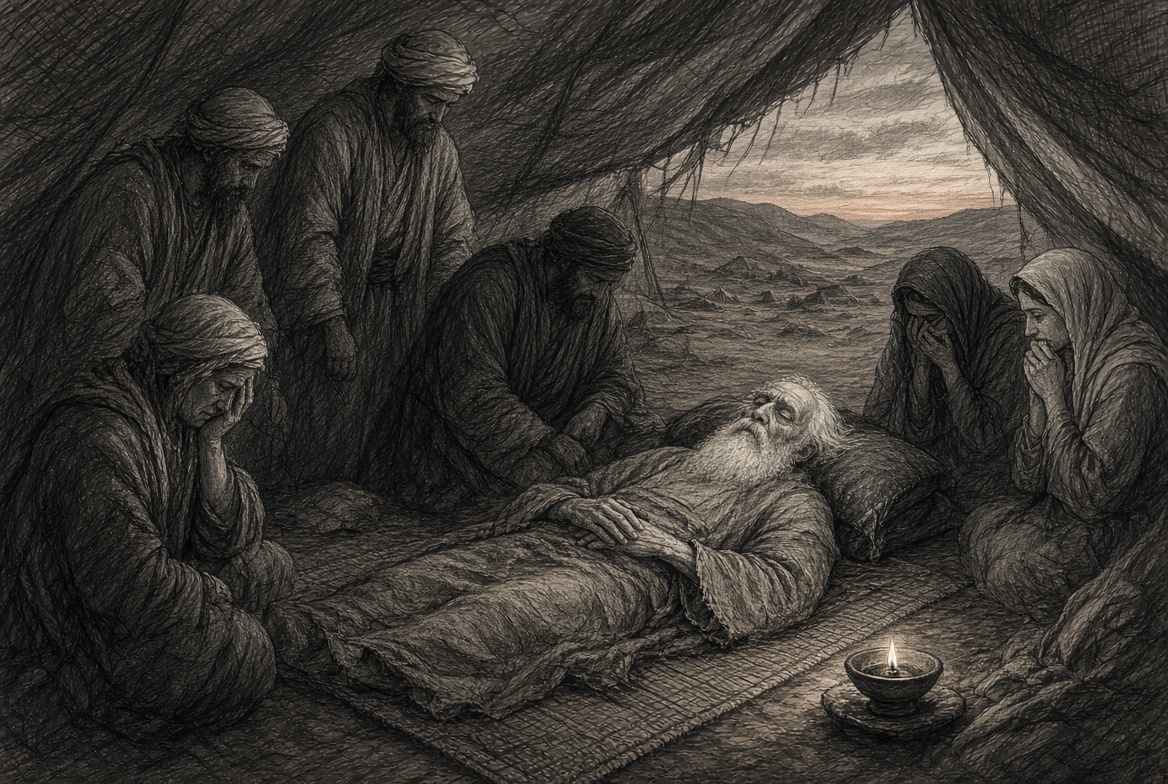 v.16
v.16These are the sons of Ismael; and these are their names by their castles and towns–12 princes of their tribes. And the years of Ismael’s life came to 137, and decaying, died, and was put unto his people. And he dwelt from Hevila even to Sur, which looketh towards Egypt, as they enter to the Assyrians, before the face of all his brethren died before he.
from Hevila even to Sur
One can’t help but conclude, deja vu, when comparing the westward travel of Adam & his family with the travels of Ismael less than 1200 years later. Both share the name Havila and a west-facing desert arc, but, specifically, they’re not the same journey. Ishmael’s range is stated; Adam’s migration from Havilah is an inference. The likeness is real, but it is a likeness of map-edges, not of the same journey.
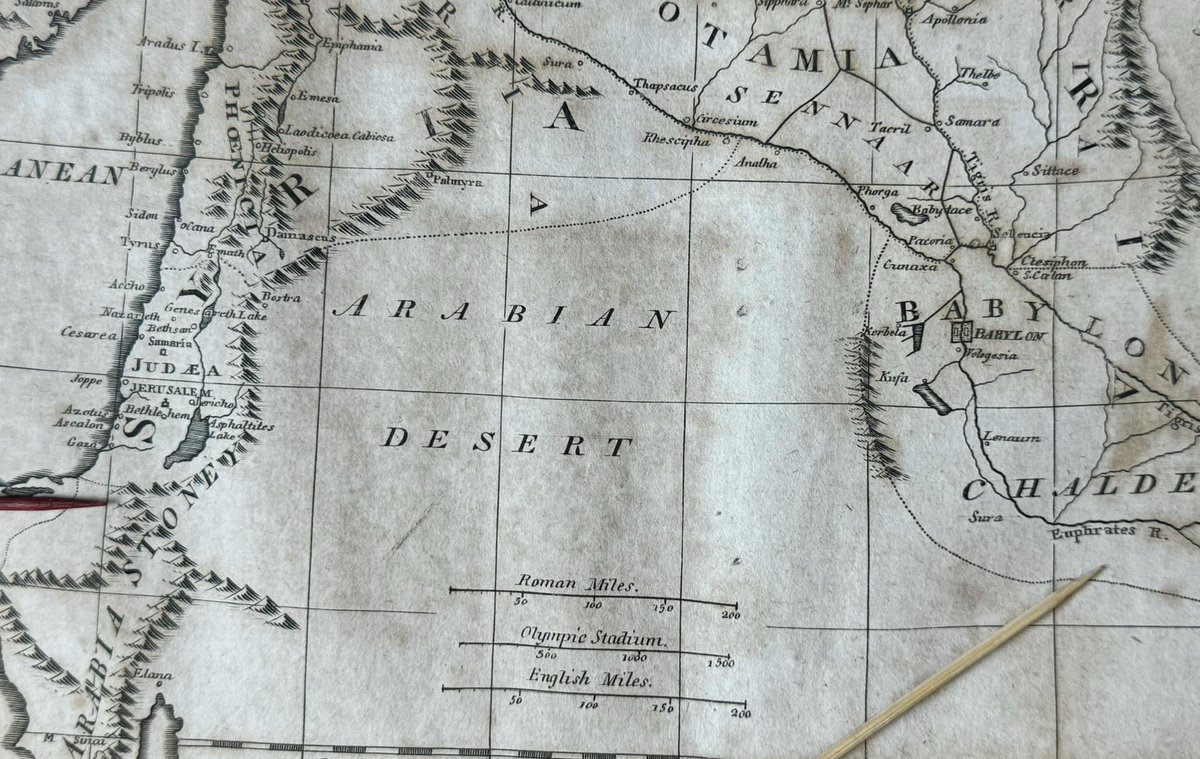
map #3: Hevila=plain marker, Sur=red marker
Ishmael’s notice closes the line of Abraham’s son by the womb of Agar. Twelve princes stand by their towns and encampments. His years reach 137; he fails and dies and is gathered to his people. Then the territory: he dwelt from Hevila to Sur, which faces Egypt, on the way one takes toward the Assyrians, before the face of all his brethren. The Hebrew rendition of this same Scene is fairly identical to what the Latin to English reads: they settled from Havilah to Shur, which is on the face of Egypt as one goes toward Asshur, and he fell (or settled) opposite all his brothers. The verb is plural for the tribes, then singular for Ishmael. It is a completed settlement, not a travel diary. Sur is the western stop: the wilderness wall in front of AEgypt, the same road where the Angel found Agar in 16Gen7. Havila is the other stop, inland or east. As thou goest toward Assyria does not put the Ishmaelites in Nineveh; it orients the strip of north Arabia that lies between the AEgyptian frontier and the Assyrian direction. This same span, you’ll later discover, is reused for Saul’s blow against Amalec in 1 Sam15:7.
Such a travel formula is one that Adam never receives. In the second Epistle of Genesis a river leaves Eden and splits. The first head is Pishon, which winds through the whole land of Havilah, where the gold is good, along with bdellium and onyx. The third is Hiddekel, which goes east of Asshur; the fourth is Euphrates. Eden itself is planted eastward, and the man is put there. After the expulsion the Cherubim stand at the east of the garden. There’s also Cain, who goes out from the presence of the Lord and settles east of Eden in Nod. The only stated human motion is out of the blessed Garden and, for Cain, further east. Havila is a land in which a river encircles; tis not Adam’s departure point nor is it a stage on his road.
The shared names are what make the two passages feel like one migration. Havilah, the face of Egypt, and Asshur appear in both. 2 Genesis frames a watered world whose edges are Havila, Cush, and Asshur. This current Chapter frames a desert people on those same edges: Havilah at one end, Shur on the face of Egypt at the other, the road running in the Assyrian direction. Later many readers have often treated them as one Havilah. The table of nations already has two:
Jewish and modern geographic notes tend to put the Ishmaelite Havilah in northern or western Arabia (gold country in the Hijaz, or the northeastern sand tract toward the Gulf) and Shur on the isthmus side. Some biblical-geographers identify the Pishon with the dry Wadi al-Rummah/Wadi al-Batin, running from the western Arabian gold hills northeast toward Kuwait, so that Eden’s Havilah and Ishmael’s Havilah can be the same Arabian tract. But that’s a coherent hypothesis and not part of any liturgical text. Other placements push Eden’s Havilah toward the Gulf, or even towards the Caucasus gold country, which would separate the two Havilahs.
before the face of all his brethren died before he
Being this Clause could be a tad confusing to digest, let’s dissect its intent. This Phrase contains one verb that’s doing two jobs. The Hebrew Genesis ends עַל־פְּנֵי כָל־אֶחָיו נָפָל (upon the face of all his brothers he fell). נָפָל is the same root as he fell; and here it’s the idiom for a lot that falls–a camp that settles and a man drops into his place. The Vulgate seems to hear the death in it, henceforth, it’s written as, coram cunctis fratribus suis obiit (before all his brothers he died.) Our Text, before the face of all his brethren died before he, retains both readings concomitantly: he died in their sight, and he died ahead of them, already set down over against them. I’d say this double-sense becomes the entire point to the Verse. I validate this with 16Gen12 in which twas already stated the wild-ass man would dwell עַל־פְּנֵי כָל־אֶחָיו–on the face of all his brothers. Yet 25Gen18 cashes the promise in geography and in a grave. From Havilah to Shur, on the face of Egypt as one goes toward Asshur, the twelve princes hold towns and camps. Then tis the father of those princes who falls on that same face. He doesn’t die inside Abraham’s camp nor does he die after his brothers left. He dies first, in front of them and still opposite them.
Before he is the temporal edge of that. Ismael is Abraham’s elder son, born when Abraham was 86, and now he’s dead at 137. Isaac’s lineage, on the other hand, is still alive and opening. The obituary places the death in their presence so that the brothers who remain — Isaac’s house, and the nearer kin — look out on a territory already occupied and a man already gathered to his people. The fall is not a defeat inside their tents. Tis a settlement that outfaces them with the following:
Thusly, the Phrase extrapolates as a completed stance. The face of the brothers is the near-side, so to speak, of the promised line. Ishmael lives on that face, from Havila westward to Sur, and dies on it, still before them. The 12 princes inherit the stance and not a seat at the table of Isaac.
And Isaac besought our Lord for his wife, because she was barren; Who heard him and made Rebecca to conceive.
—exclude not, but indeed include secondary causes, and ordinary means, by which His eternal will and pleasure is fulfilled. After all, if GOD foresaw Rebecca will have children, then did He not know Isaac would pray for it? Not only pray for but obtain it as well! What myself and brilliant others before me claim is this: the one was sure to come as the other. Additionally, S Gregory taught this same sort of consequence being both valid and true for vitam aeternam. I believe this claim of Gregory’s to be brilliant!
 v.22
v.22S Augustine disputed but certainly couldn’t decide whether Rebecca visited a Priest, Prophet, Altar or something or someone else during this most emotional period of her life. Maybe, perhaps, she simply ventured off to engage in private or Isaacian prayer. From a realistic point of view, tis also quite possible she, with the sufferable agony she was experiencing, sought the aid of a healer as well. Isaac’s spouse absolutely did not want to lose the miracle offspring snuggled within her precious womb.
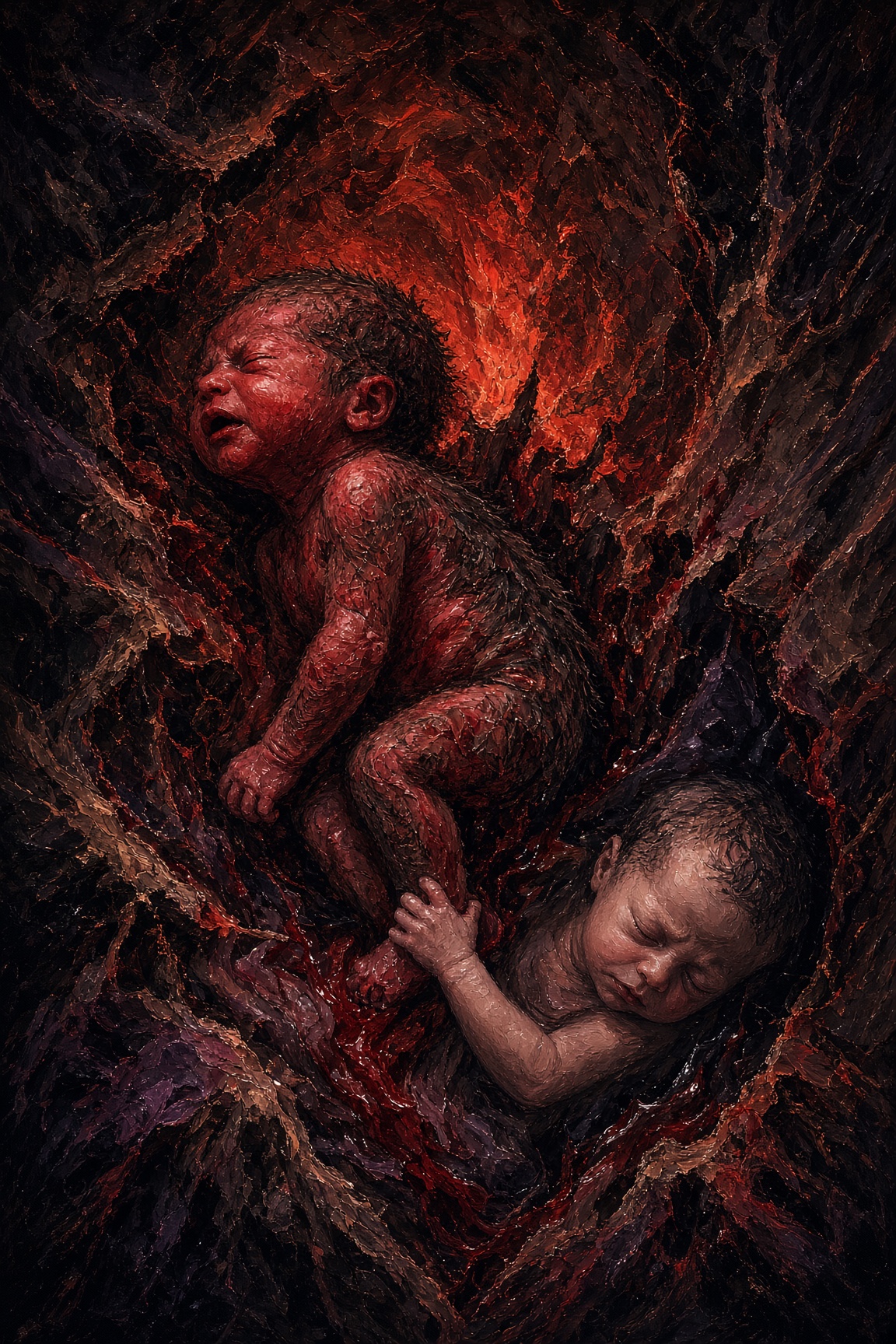 v.24
v.24
Now her time was come to be delivered, and behold twins were found in her womb. He that came forth first was red, and all hairy in manner of skin, and his name was called, Esau. Immediately the other coming forth, and his hand was holding the heel of Esau; and therefore he called him, Jacob.
Threescore (60) years was Isaac when the little ones were born unto him.
Tis interesting Moyses jots descriptive words commemorating Esau’s birth whereas there are none for Isaac. Esau is birthed with a bright red tint to his flesh and having hair coating his entire physique. i believe Moyses & ELOHIM intentionally do this to reveal Esau as formidable for man’s world. And being man is so visually inclined to the point where it controls our fears, loves, and assumptions, Esau is henceforth described. Whereas Jacob’s birth is for the Spiritual realm of mankind, not the physical world. This is why his physical descriptions are unimportant because Jacob was born to represent the Light–the roots to QUI EST’s Church. Tis the bloodline for such Light is what’s imperative, not each individual Patriarch within this very marvelous and specific genealogy. This is the same approach of Shepherd Corps. It’s not important who the persons are that make up our Sanctuary. What is important is the message we each carry and share with the inhabitants of Heavenly Father’s world.
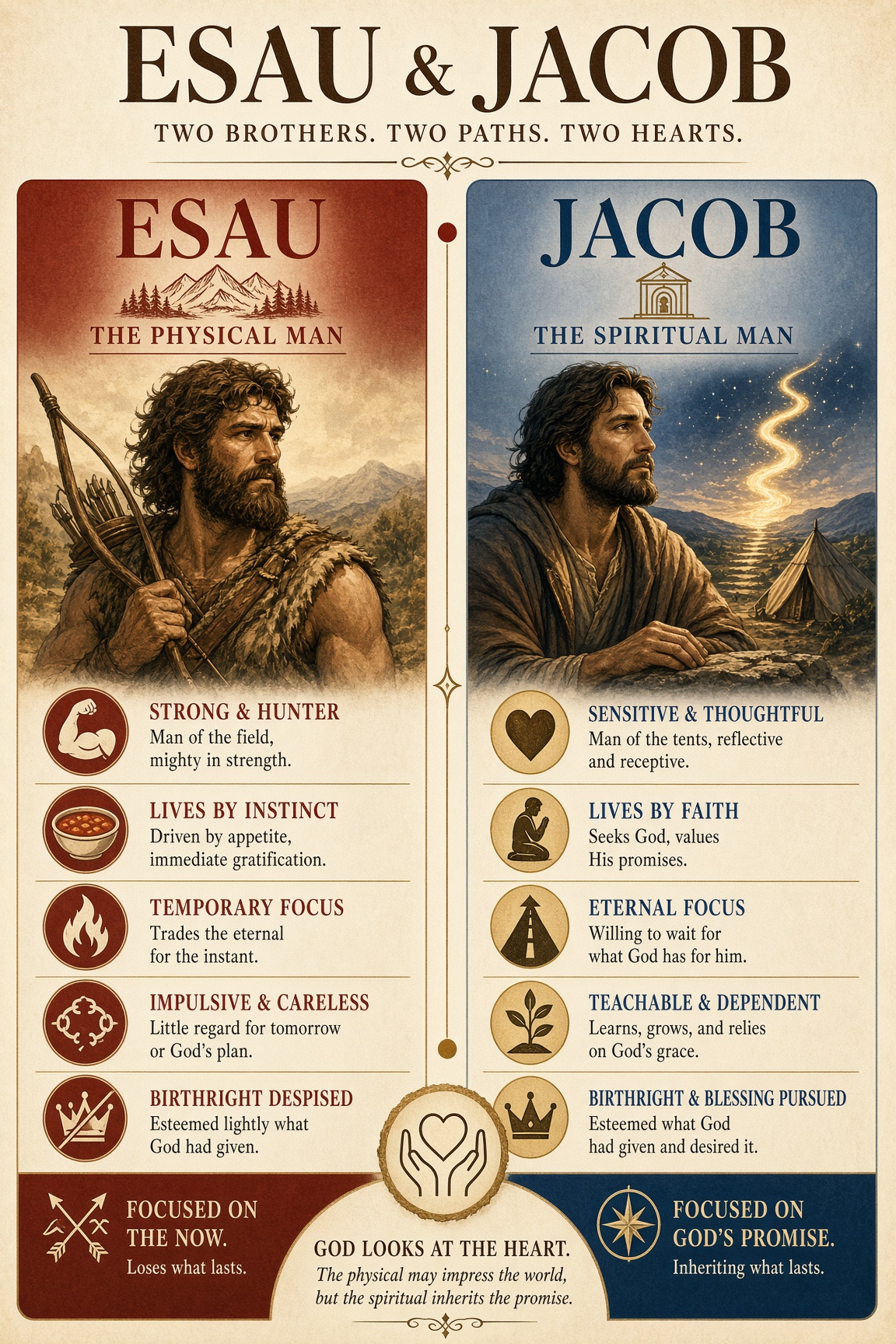
Without a doubt the narrative is selective and purposeful rather than exhaustive biographical. Esau receives the striking physical details because they immediately establish his identity; they foreshadow his character and destiny, and set up later events and wordplays. Jacob’s description is minimal and action-oriented because that single gesture defines his name and role in the story.
Examining the etymology and wordplay one learns Esau is linked to the idea of hairiness, being the word is related to Hebrew terms for hairy or covered–later associated with Seir. Red (admoni) anticipates the name Edom (red), which Esau receives after selling his birthright for red lentil stew, 25Gen30. Jacob (Ya‘aqov) plays on heel (aqev), suggesting supplanter, or one who grasps at the heel.
Next, we explore the apparent narrative foreshadowing. The hairiness is essential for the later deception in which Jacob wears goatskins to mimic Esau and receive Isaac’s blessing. The redness links birth appearance to appetite and the birthright sale. Esau’s robust finished appearance (interestingly, there are some Jewish traditions describing Esau as fully developed, with hair like an adult) contrasts with Jacob’s smoother and more ordinary presentation which points to their divergent paths—Esau as an outdoorsman/hunter, Jacob being a tent-dweller.
Lastly, we note the contrast & character. The vivid, almost animal-like, description of Esau marks him:
Jacob receives no comparable physical portrait because the story’s interest is in his grasping action of his twin’s heel. The narrative is reflective of the reversal of expected primogeniture already announced in the oracle revealed to Rebecca: the older will serve the younger.
To summarize, the Text invests descriptive energy in Esau where it serves immediate identification, irony, and later plot. We clearly see Jacob’s defining moment is the heel-grasp that signals his future role.
Let’s wrap this discussion with a spiritual interpretation of this intriguing event. We can certainly draw several layers of meaning from the contrast of both births. Here are a couple:
The narrative, therefore, uses Esau’s more elaborate physical portrait not as favoritism or mere curiosity, but as a literary and theological signal of character, destiny, and the contrast with the chosen line that runs through Jacob-Israel.
v.27
Who being grown up, Esau became a man cunning in hunting and a husbandman; but Jacob, a plain man, dwelt in tents.
Holy Scripture here premonisheth Jacob’s sincerity, lest in the Mysteries following he might be of false dealing–S Augustine.
v.28
Isaac loved Esau because he did eat of his hunting. And Rebecca loved Jacob.
And Jacob boiled broth, to whom Esau, being come faint out of the field, said:
Give me of this red broth because I am exceeding faint.
For which cause his name was called Edom.
To whom Jacob said:
Sell me thy first-birth-right.
Sell me thy first-birth-right
Jacob lawfully bought it but it was Esau who sinned in selling his first birth right. i find it most intriguing how QUI EST’s Spiritual Bloodline sometimes uses the ways/methods/means of man to obtain the presence of His Church and the delivery of the Son of Man. Also, Jacob was instructed by his mother, you will soon read, that GOD chose him in place of Esau, his older brother, because GOD revealed to her the elder should serve the younger. Jacob did lawfully use this opportunity to get Esau to grant his first birth right to his younger twin. Be it as it may, Esau sinned in selling his birth right; this showed him to be an intemperate profane man–12Heb.
v.32
He answered:
Loe I die, what will the first birth-right avail me?
Jacob said:
Swear therefore to me.
Esau swear to him and sold his first birth right. And so taking bread and the rice broth, did eat and drink, and went his way: little esteeming that he had sold his first-birth-right.
Let’s close this Chapter by detailing one of the starkest biblical portraits for the trading of eternal spiritual privilege for temporary physical satisfaction.
What has unfolded here is that Esau, exhausted from the field, declared he was about to die and the birthright was worthless to him at that point. Thusly, he swears an oath, sells it to Jacob for bread and lentil stew (rice broth in older renderings), eats, drinks, then walks away—despising what he had just surrendered. The writer’s final verdict is quite blunt: Thus Esau despised his birthright.
Speaking of which, what was this birthright exactly? In the patriarchal family the birthright, known as bekorah, included:
What’s stunning about the action of Esau is that he did not merely trade property; he treated the sacred covenant-bearing status as common and disposable. Let’s now extrapolate a spiritual perspective of this Scene by jotting a few points:
1. Profanity — treating the holy as ordinary
12Heb16–17 names Esau as the classic profane (godless) person who for one morsel of meat sold his birthright. The Greek word implies someone who has no sense of the sacred, who lives as if spiritual realities do not matter. Esau’s cry, What good is the birthright to me?, is the voice of a heart that sees only the immediate material world.
2. Appetite over inheritance
Esau lived by the senses. Hunger became the decisive reality; the unseen future inheritance became unreal. The New Testament language (16Rom18; 3Phi19) speaks of those whose god is their belly. The stew was not the problem—the ranking of values was. He chose the visible over the invisible, the momentary over the eternal.
3. Irreversible exchange
When Esau later wept and sought the blessing, he found no place of repentance in the sense that the blessing could not be recovered, as described in 12Heb17. Tears of regret are not the same as a changed heart that truly values QUI EST. He wanted the benefits of the birthright without the GOD Who gave it.
4. Contrast with Jacob
Jacob, for all his later flaws and deception, at least desired the birthright and the blessing. He understood its worth. The story is not primarily a morality tale about clever bargaining. Indeed, tis a revelation of two hearts: one that prizes the covenant promises, and one that doesn’t.
With the aforementioned, a broader spiritual perspective is deduced.
The spiritual heart of this Scene is the tragic ease with which a person can despise what GOD calls out as being precious. Esau walked away belly-full and content, having just bartered away the line of blessing. The Verse leaves us with the sobering question of what we ourselves treat as common when hunger, convenience, or the pressure of the moment presses in.
—end 25 Genesis—
© 2020-2026, Shepherd Corps Sanctuary, all rights reserved. Any borrowed images are identified as sources elsewhere. Our work may be borrowed as long as we are identified as the source.
–AND IN THY SEED SHALL BE BLESSED ALL THE NATIONS OF THE EARTH FOR BECAUSE ABRAHAM OBEYED MY VOICE…
In this 26th Epistle you will learn, once again, the changing of weather patterns and climate has been with terra since her creation. It’s what climate does… changes. As with Abraham, this particular climatic event in the Near Middle East leads to another famine. If you’re a member of the human race who sincerely wishes to aid terra, do the following:
Do at least these and you shall see terra reciprocate positively. Being an active knight is far superior than being a mere protestor belching acerbic language while waving graphic placards.
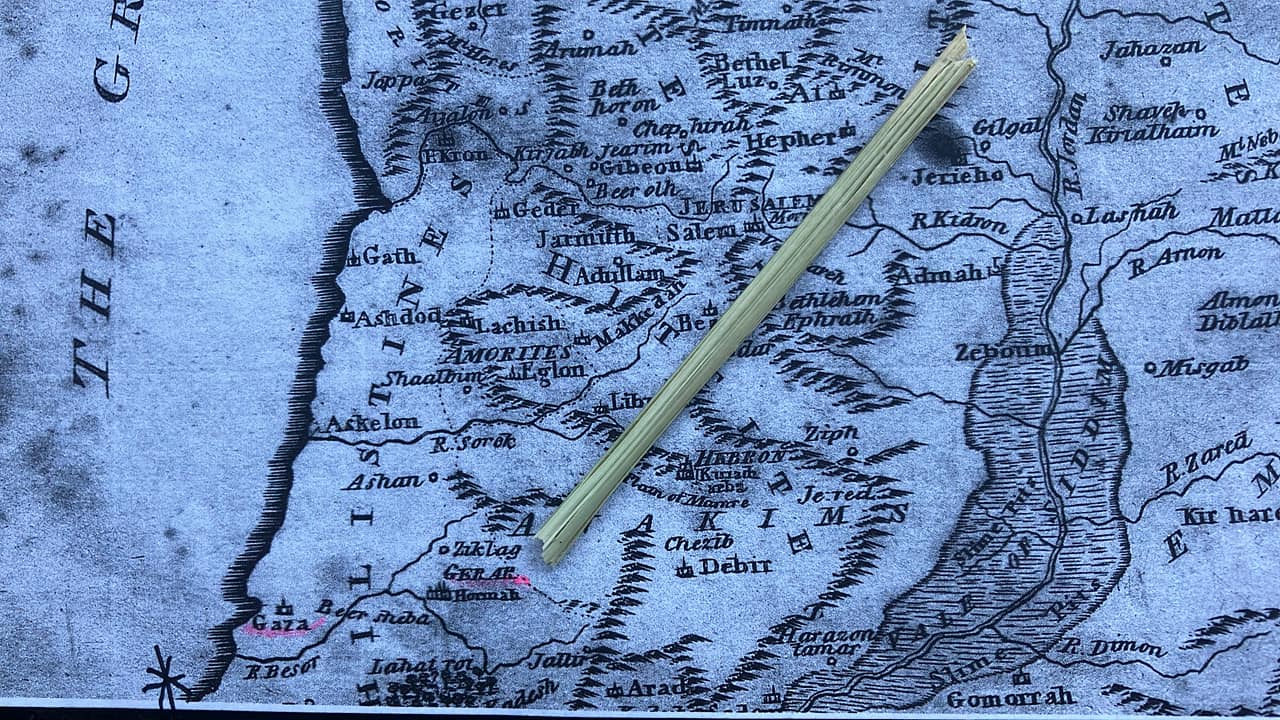
map #1: Gerar=marker
v.1
And when a famine was risen in the land, after that sterility that had chanced in the days of Abraham, Isaac went to Abimelech, king of the Palestines, into Gerara.
And our Lord appeared to him, and said:
Go not down into Egypt but rest in the land which I shall tell thee.
How about our Heavenly Father, huh? Once again He arrives to the rescue of man because He keeps His promises and certainly protects what’s His–His Spouse (via the seed of Isaac). And by Abraham’s most exceptional life, QUI EST did invite the Egyptians to true Religion, in which they rejected, so now He commands Isaac to stay in Gerar until the famine lapses. Just as QUI EST keeps and maintains His vows to us, so too should man be with his/her promises to Him. But so often a person today gives his word in one moment then she breaks it in the next.
v.3
And sojourn in it; and I will be with thee, and will bless thee. For to thee and to thy seed I will give all these countries, accomplishing the oath which I swear to Abraham, thy father. And I will multiply thy seed as the stars of heaven; and I will give to thy posterity all these countries. And in thy seed shall be blessed all the nations of the earth for because Abraham obeyed My voice, and kept My precepts and commandments, and observed My ceremonies and laws.
My ceremonies and laws
This pertains to the external ceremonies in the law of nature. For, these weren’t the same laws and ceremonies which later were prescribed by QUI EST, and of course delivered by Moyses, but other observances by which Abraham, and other holy Patriarchs before him, served GOD with certain external worship. These absolutely differed from the rites of the Gentiles–especially from the time of Enos and forward.
With these two Verses QUI EST appears to Isaac to affirm the covenant He established with Isaac’s father. This isn’t a new promise but more like a living inheritance: the same divine commitments are now spoken directly to the next generation with an explicit reason. When Heavenly Father states, I will multiply thy seed as the stars of heaven, He is taking the earlier promise made to Abraham and placing it on Isaac’s own head.
the stars of heaven
This image is both quantitative and qualitative—a seed that shines, that is fixed in the heavens, that outlasts earthly turmoil.
to thy posterity all these countries
The land promise shall be given to the posterity. In the biblical Narrative this is not abstract geography; tis the concrete territory Isaac is already occupying (Gerar and the adjacent areas). The gift is framed as the fruit of Abraham’s faithfulness yet it’s now secured for Isaac even before he has fully demonstrated the same obedience. Additionally, the material inheritance (countries) and the spiritual vocation (blessing the nations) are not separated. The land is actually the stage on which the wider blessing is meant to be enacted.
in thy seed shall be blessed all the nations of the earth
The singular, seed, is important. While it clearly includes the multitude of descendants, the phrasing leaves room for a particular seed through whom the universal blessing comes. In Jewish tradition this is often read as the destiny of the people of Israel to be a light to the nations. In Christian reading it’s classically understood as pointing to the Messiah–as S Paul argues in 3Gal16. Either way, the promise is not merely ethnic enlargement; it is missional. The nations are not spectators of Israel’s prosperity; they are recipients of the blessing through Abraham’s line. More importantly, this Phrase inclusively represents GOD’s Church, which indeed has multiplied exceedingly throughout the world.
for because Abraham obeyed My voice…
This final Clause is quite striking. The covenant is unconditional in its divine origin, yet here its continuance and transmission are linked to Abraham’s firm obedience. The language is unusually comprehensive—voice, precepts, commandments, ceremonies, laws—covering personal hearing, moral statutes, and ritual observance. This is not presented as merit that earns the promise from scratch, but as the living condition under which the already-given promise is confirmed and passed on. Isaac receives the inheritance not because he has already matched Abraham’s record, but because Abraham’s faithfulness has created a spiritual and historical pathway.
One can’t help but realize a spiritual trajectory with everything presented here as a Covenant made to a singular man goes from one, to many, then finally to all. This movement is identified as from Abraham, to Isaac, to innumerable seed, then to every nation. The covenant begins in a particular family and expands toward universal scope without losing its particularity. This trajectory is rooted in Abraham’s obedience. Because of this GOD’s promise is a pure gift although it travels through human faithfulness. It is because of Abraham’s listening and keeping that GOD’s word is now spoken to Isaac. Later generations are invited into the same pattern:
to thy seed
The seed is representative of both people and person. The Text holds together the corporate destiny of the descendants and the possibility of a singular bearer of blessing. This tension has sustained both Jewish hope for the people and Christian hope in the Messiah.
In conclusion, this most extraordinary Passage presents a GOD Who keeps faith with the faithful, Who multiplies what He has already begun, and Who intends the particular story of Abraham and Isaac to become the means of blessing for every nation. The ground of that intention is named clearly: Abraham’s obedience
.v.6
Therefore, Isaac abode in Gerara.
Who, when he was asked by the men of that place concerning his wife, answered:
She is my sister.
For, he was afraid to confess that she was married to him, thinking lest peradventure they would kill him because of her beauty.
A reader can’t help but be flabbergasted by a deja vu to Isaac’s father doing precisely the same thing. Therefore, let’s explore this some.
Isaac’s lie occurs in Gerar which is a near-exact repetition of his father’s pattern, driven by the same fear of man, even though the circumstances and the fresh divine promise make it especially shocking. With these pair of parallel accounts we recall Abraham used the half-truth two times.
Isaac, sojourning in the same region of Gerar, does precisely the same with his own wife, Rebecca: She is my sister, because he was afraid to confess that she was married to him, thinking lest peradventure they would kill him because of her beauty. The language and motive are nearly identical—fear that local men will murder the husband to take the beautiful wife.
The half-truth itself had a factual basis in both cases. After all, Sara was Abraham’s half-sister and Rebekah was certainly Isaac’s cousin. This made the deception easier to sustain and harder to expose immediately.
But why did Isaac truly fear man that much? Abraham’s fear was grounded in what QUI EST had recently executed against the temporal paradise–Sodom, Zoar, etc. This destruction of the cities of paradise occurred between Abraham’s two incidents and certainly long before Isaac’s. It demonstrated GOD’s willingness to judge extreme wickedness and to protect the righteous, such as Lot’s rescue. One might, therefore, expect Isaac to have drawn the opposite conclusion: that a GOD Who had already shown both judgment and protective power would not leave His chosen heir exposed. Yet, Isaac still defaults to the same calculation his father used. Several factors in the Text may help explain this:
Let’s identify the spiritual trajectory of this Narrative. There’s a generational transmission of both the covenant promise as well as the human weakness of fearing man more than QUI EST. Isaac receives the identical word his father received, yet he also inherits the same momentary unbelief that treats human violence as more certain than divine protection. The later exposure by Abimelech and the king’s rebuke underline that the lie was unnecessary; the very people Isaac feared proved capable of restraint once the truth became known.
Summarizing this we realize Isaac’s deception is not an isolated moral failure; it’s a repetition of Abraham’s strategy under the same sort of pressure. The destruction of Sodom supplied powerful evidence of Heavenly Father’s power and justice, yet it did not, by itself, remove the fear of man that both patriarchs acted upon. The Text leaves the contrast clear: the covenant is secure because of QUI EST’s word and Abraham’s earlier obedience, not because Isaac’s fear has been overcome.
v.8
And when very many days were passed, and he abode there, Abimelech, the king of the Palestines, looking forth through a window, saw him sporting with Rebecca, his wife.
And calling for him, he said:
It is evident that she is thy wife. Why didst thou fain her to be thy sister?
He answered:
I feared lest I should die for her.
And Abimelech said:
Why hast thou deceived us? Some man of the people might have lyen with thy wife, and thou haddest brought upon us a great sin.
a great sin
Reading Abimelech’s stern response we can deduce even among the Philistines/Paynims adultery was recognized as a great sin.
Abimelech’s dealings with Isaac’s family rested on clear evidence that QUI EST was obviously with them. Tis generally understood this Abimelech is different from the one that was involved with Abraham. After many days in Gerar, Abimelech looks out a window and sees Isaac sporting (playing/caressing intimately) with Rebekah. Thusly, the Palestinian king promptly realizes Rebecca is Isaac’s wife and not his sister. After confronting Isaac, the patient king then orders anyone who touches Isaac’s wife would be put to death.
This language shows that adultery was treated as a serious moral and communal offense among these pagans, not a trivial or culturally accepted act. Abimelech feared the guilt it would bring on his people and took concrete steps with a royal death decree to prevent it. The same recognition appears in the parallel account of Abraham and Sara with an Abimelech of Gerar, where the king likewise speaks of a great sin that would have come upon him and his kingdom. In both cases the narrative presents the Philistine ruler as having a functioning moral sense regarding sexual boundaries. This, understand, is consistent with:
The Paynim (Pagan or Heathen) setting doesn’t erase this because the Text itself uses Abimelech’s words to highlight it.
v.11
And he commanded all the people saying:
He that shall touch this man’s wife, dying shall die.
And Isaac sowed in that land. And he found that same year a hundred-fold; and our Lord blessed him.
a hundred-fold
Pursuant to S Leo, in which I’m entirely in agreement with, because of this increase of wealth, the people and their kind initially envied Isaac. Later, perceiving QUI EST so blessed him, and the rest of the land remaining barren, they sought to make league with him. Even so the nations and kings of the world, first envying and persecuting CHRIST’s Church, at length, mind you, seeing it still prospers, became, with all humility, children of the same Church-servants of CHRIST, being overcome by patience, not by any force of arms, and also via peaceable endeavors of those whom they most hated. To simplify the insight of Saint Leo: Christian fortitude prevails more by suffering versus forcibly resisting. Here’s an example. Rome became renowned by her many victories which dilated her empire by land and sea. Yet was it less that martial travel subdued then that which Christian peace hath obtained Bishops of Rome having larger jurisdiction spiritually than ever the Roman caesars had with their temporal dominion. Sweet Reader, it would be very wise to remember this always. But of course, these too are men. Fallible men. A decline in attendance… an increase of Catholics leaving the Roman Church, &c…. these are all completely indicative of poor, vacillating, unsettled, and weak liturgical leadership. When ELOHIM incredibly blessed the labors of Isaac, he was still residing among the Philistines. We have to remember that it was a devastating famine had driven Isaac to Gerar and that HE WHICH IS had earlier commanded him not to go to AEgypt but to stay in the land of promise. Sowing crops was itself an act of trust and industry under those conditions. Tis interesting that the patriarchs were primarily pastoralists; yet Isaac becomes the only one of the first three Prophets explicitly described as cultivating grain (Noe was described as being a husbandry-man by trade).
The effect of Isaac’s harvest was miraculously immediate! A hundredfold return was most exceptional. Ancient yields in the region were commonly far lower (often cited in the range of thirtyfold or less for a good crop). Henceforth, a hundredfold yield certainly stood out as remarkable! It’s even later used by JESUS in His parable of the sower for maximum fruitfulness written about in 13Mat:8, 23. The Text does not attribute the abundance to unusually good soil, Isaac’s skill alone, or the end of the famine, but states plainly that our Lord blessed him. As a matter of fact this heavenly blessing continued as the Text writes that Isaac grew rich in flocks, herds, and servants until he became exceeding great.
The effect on the Philistines was envy and hostility. They “envying him” stopped up the wells Abraham’s servants had dug, filling them with earth (26:14–15). Abimelech then told Isaac to depart, “for thou art become much mightier than we” (26:16). Prosperity that visibly displayed God’s favor provoked jealousy, resource sabotage, and expulsion. Later the Philistines would still recognize that “the Lord is with thee” and seek a covenant (26:28), but the immediate reaction to the hundredfold harvest and resulting wealth was opposition rather than welcome.
### Spiritual interpretation
The verse underscores God’s covenant faithfulness. Despite Isaac’s earlier fear-driven lie about Rebekah (parallel to Abraham’s), God still blesses him in keeping with the promises renewed in Genesis 26:3–5. The abundance is not earned by perfect conduct but given by divine favor while Isaac remains in the land God indicated.
It also illustrates the principle of sowing and reaping under God’s hand. Isaac sows in difficult circumstances; the Lord multiplies the harvest. Commentators often note the contrast with the surrounding famine and the later New Testament use of “hundredfold” for the fruit of the Word or of sacrificial discipleship. Some see a typological note: Isaac (whose name means “laughter”) receives this fruitfulness as the son of promise, prefiguring greater abundance through the ultimate Seed, Christ, in whom the nations are blessed.
In short, the verse shows visible, material confirmation of the Lord’s presence and promise in the midst of scarcity and foreign territory. That same visibility produces envy among the Philistines, leading to conflict, while simultaneously confirming to them (and to later readers) that Isaac is under divine blessing. The narrative moves from this prosperity to the well disputes and finally to the covenant at Beersheba, where the Philistines themselves acknowledge the Lord’s hand.